Monday, 1 March 2021

Hear how to nail your virtual pitch meeting at Early Stage 2021

On a recent episode of Extra Crunch Live, Bain Capital Ventures’ Matt Harris said that if you had asked him a year ago what would happen to venture capital during a pandemic lockdown, he would have replied “it would have fallen off a cliff.” Before the world changed so fundamentally, VCs and founders alike believed they needed to meet in person to build trust before signing paperwork that would financially and emotionally bond them together for years and years.

Today, the landscape is very different. More institutional capital is flowing into startups at much faster rates and a good deal of credit must go to the virtual pitch meeting. Founders can now take 30+ meetings in a single day, but are they making the most of those meetings?

At TechCrunch Early Stage in April, Melissa Bradley will talk us through how to nail your virtual pitch meeting and take questions from the audience.

Bradley is the co-founder of Ureeka, a venture-backed mentorship platform for SMBs that pairs founders with experts and mentors. Bradley is also founder and managing partner of 1863 Ventures, a business development program that accelerates underrepresented entrepreneurs (a group Bradley calls the New Majority) into their hyper-growth phase.

She’s also a professor at Georgetown University’s business school, teaching impact investing, social entrepreneurship, P2P economies and innovation.

In short, Bradley deeply understands what it’s like to sit on both sides of the table, as a VC and a founder, and even more deeply understands what it takes to have a successful virtual meeting from her experience building Ureeka (which is entirely virtual).

Bradley joins an all-star cast of speakers at TC Early Stage, an event that is packed with breakout sessions focused on all the core competencies that a startup needs to be successful. Here’s a preview of some of the sessions going down at TC Early Stage:

  • How to Get An Investor’s Attention (Marlon Nichols, MaC Venture Partners)
  • Four Things to Think About Before Raising a Series A (Bucky Moore, Kleiner Perkins) 
  • How Founders Can Think Like a VC (Lisa Wu, Norwest Venture Partners) 
  • Finance for Founders (Alexa von Tobel, Inspired Capital) 
  • Building and Leading a Sales Team (Ryan Azus, Zoom CRO)
  • Keys to Nailing Product Market Fit (Rahul Vohra, Superhuman)

That’s not all. The TC Early Stage curriculum is being spread across two events, with fundraising and operations represented on April 1 & 2 and fundraising and marketing deep dives on July 8 & 9. Folks who buy a ticket to just one event will get three months of Extra Crunch for free, and folks who buy a dual-event ticket will get six months of Extra Crunch membership for free.

An Extra Crunch membership comes with access to:

And much more! Really, what are you waiting for? Pick up a ticket to TC Early Stage here or use the widget below:


Martech company Zeta Global raises $222.5M in debt

Zeta Global, the marketing technology company founded by David A. Steinberg and former Apple CEO John Sculley, is announcing an additional $222.5 million in new debt financing.

The company has gone down the debt route before — a Series F raised in 2017 combined $115 million funding with $25 million in debt. BofA Securities served as lead arranger and bookrunner for the new financing, with participation from Barclays, Credit Suisse and Morgan Stanley Senior Funding.

“For this round, we were able to both refinance our debt and add in a large amount of capacity for current operations and future initiatives,” Steinberg (Zeta’s CEO) told me via email. “We were able to work with our syndicate to capture a low interest-rate and take advantage of the strong credit markets.”

The company emphasizes its data-driven approach to marketing, combining companies’ first-party data with artificial intelligence and what it says are more than 2.4 billion customer identifiers. Steinberg said this approach has only become more crucial, with 2020 delivering “a five-year acceleration” as brands face the challenge of “digitally transforming their business structure to be data-centric.”

“Zeta’s capabilities are helping marketers engage customers across the entire digital ecosystem more intelligently and efficiently, with individualized messages, offers, and content by way of our identity-based data and predictive AI,” Steinberg continued. “Our challenge is to continue to keep up with our customers’ needs and maintain our competitive advantage around data and AI.”

The company’s funding announcement notes that previous loans have been used to finance acquisitions and integrations, including commenting platform Disqus and machine learning-powered marketing platform Boomtrain. Asked whether this new debt will also be used for acquisitions, Steinberg said the company continues to “organically innovate,” with a focus on its customer data platform and connected TV capabilities.

Early Stage is the premiere ‘how-to’ event for startup entrepreneurs and investors. You’ll hear first-hand how some of the most successful founders and VCs build their businesses, raise money and manage their portfolios. We’ll cover every aspect of company-building: Fundraising, recruiting, sales, legal, PR, marketing and brand building. Each session also has audience participation built-in – there’s ample time included in each for audience questions and discussion.


Satellite constellation operator Spire Global to go public via $1.6 billion SPAC

Monday brings with it not one, but two space SPACS — there’s Rocket Lab, and there’s Spire Global, a satellite operator that bills itself primarily as a SaaS company focused on delivering data and analytics made possible by its 100-plus spacecraft constellation. SPACs have essentially proven a pressure-release valve for the space startup market, which has been waiting on high-profile exits to basically prove out the math of its venture-backability.

Spire Global debuted in 2012, and has raised more than $220 million to date. It will merge with a special purpose acquisition company (SPAC) called NavSight Holdings, in order to make a debut on the NYSE under the ticker “SPIR.” The combined company will have a pro forma enterprise value of $1.6 billion upon transaction close, which is targeted for this summer.

The deal will provide $475 million in funds for the company, including via a PIPE that includes Tiger Global, BlackRock and Hedosophia. Existing Spire stockholders will wind up with around 67% of the company after the businesses combine.

Spire’s network of satellites is designed to provide customers with a “space-as-a-service” model, allowing them to operate their own payloads, and access data collected via an API their developers can integrate into their own software. The model is subscription-based, and is designed to get customers up and running with their own space-based data feed in less than a year from deal designs and commitment.

Existing investors in Spire Global include RRE Ventures, Promus Ventures, Seraphim Capital, Mitsui Global Investment and more, with its most recent round being a raise of debt financing. The company has launched satellites via Rocket Lab, its companion in the Monday SPAC news rush. The satellites it operates are small cube satellites, and it has launches on a wide range of launch vehicles, including SpaceX’s Falcon 9, the Russian Soyuz, ISRO’s PSLV, Japan’s H-2B, ULA rockets, Northrop Grumman’s Antares and even the International Space Station.

Spire got its start from very humble origins indeed — tracing all the way back to a Kickstarter campaign that was successful with just over $100,000 raised from backers.


Rocket Lab to go public via SPAC at valuation of $4.1 billion

The SPAC run is on for space startups, which have been relatively slow in their overall exit pace before the current special purpose acquisitions company merger craze got underway. Rocket Lab is the latest, and likely the most notable to jump on the trend, with a deal that will see it combine with a SPAC called Vector and subsequently list on the Nasdaq under the ticker RKLB, with the transaction expected to close in the second quarter of this year.

Rocket Lab, which got its start in New Zealand, and which still launches rockets there with its HQ now shifted to LA, will have a pro forma enterprise value of $4.1 billion via the transaction, with a total cash balance of $750 million once the deal goes through thanks to a PIPE of $470 million with funds invested via Vector, BlackRock and others. At close, existing Rocket Lab shareholders will retain 82% of the total equity in the combined company.

The launch company was founded in 2006, and is led by founder Peter Beck. In 2013, it opened its California headquarters, and it has already completed its first U.S. launch facility at Wallops Island, Virginia. The company’s Electron launch vehicle can carry small payloads to orbit, and is designed to cater to the growing small satellite market, with a focus on responsive and flexible launch options.

Rocket Lab has performed launches on behalf of the U.S. government, including national security payloads, and that’s a key revenue opportunity for it going forward. Currently, it says it has a backlog of customers, with a projection that it will be “EBITDA positive” in 2023 after adjustments, and fully cash-flow positive by 2024, with a projected run rate of over $1 billion in revenue by 2026.

The company has focused on increasing its ability to launch more frequently in a number of ways. It’s been steadily improving its production capacity, with a focus on its large automated carbon-fiber production capabilities. It has also established its U.S. launch site, as mentioned, and will soon open its second launch pad at its existing New Zealand launch site, which is fully privately owned by Rocket Lab itself. It’s also working on making its Electron vehicle partially reusable, which founder Beck says will help it turn around launches more quickly.

Finally, it also just announced a new heavier-lift launch vehicle called Neutron, with a launch payload capacity of eight tons — around 16,000 lbs.


As Coinbase looks to list, Robinhood rides the crypto boom

The impending Coinbase direct listing is a fintech debut to watch. The cryptocurrency-focused consumer trading concern is set to become a public company on the back of a strong 2020, and a particularly strong final quarter.

And it appears that the company is also having a strong kickoff in 2021. What Coinbase is worth is therefore hard to guess, though some are trying, as we’ve noticed.


The Exchange explores startups, markets and money. Read it every morning on Extra Crunch, or get The Exchange newsletter every Saturday.


But Coinbase is hardly the only company enjoying a crypto bounce: Robinhood, another American consumer fintech we’ve spent too much time discussing in recent weeks, is also riding a wave in its users’ cryptocurrency activity.

Between both companies, we’re seeing signs of the sort of growing consumer interest and trading volume that has historically come with sustained periods of bitcoin price expansion. But Coinbase charges fees for trading, while Robinhood doesn’t. And transaction fee-based incomes are the vast majority of Coinbase’s revenues — 96% in calendar 2020, for example.

The situation sets up an interesting contrast.

This morning, let’s see what we can learn about Coinbase’s recent trading volume before looking into Robinhood’s. And finally, we’ll remind ourselves of how Coinbase talked about Robinhood in its S-1 filing. Is Robinhood crypto a possible threat to Coinbase’s consumer trading volumes? Let’s tinker.

An argument called forever

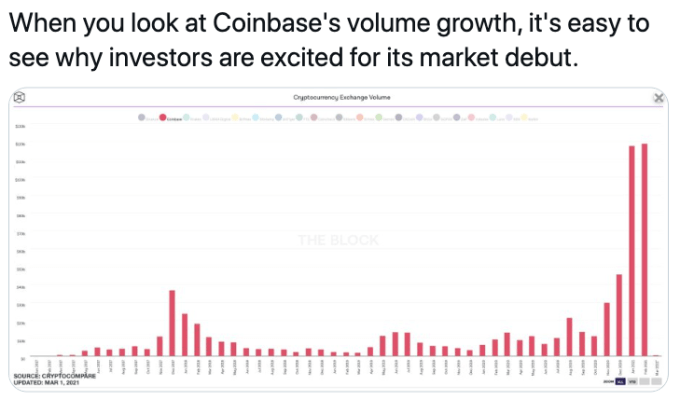
Kicking off with Coinbase, The Block’s Frank Chaparro got us thinking this morning by tweeting the following chart:

You can see why the chart caught our eye. Now, we can’t reproduce the same chart on CryptoCompare, as the tool required sits behind a locked door. But we can, however, leverage other services to confirm the gist of the image.

Other data agrees: historical trading information via Nomics shows a steep rise in 2021 bitcoin trading on Coinbase Pro, a piece of the larger Coinbase empire. And Bitcoinity shows similar gains for Coinbase trading volumes over the same time period.

Chaparro is correct that the data paints a compelling Q1 2021 revenue story for Coinbase. But it’s not the only company that is seeing crypto demand spike.


Tonal triples its physical stores with Nordstrom partnership

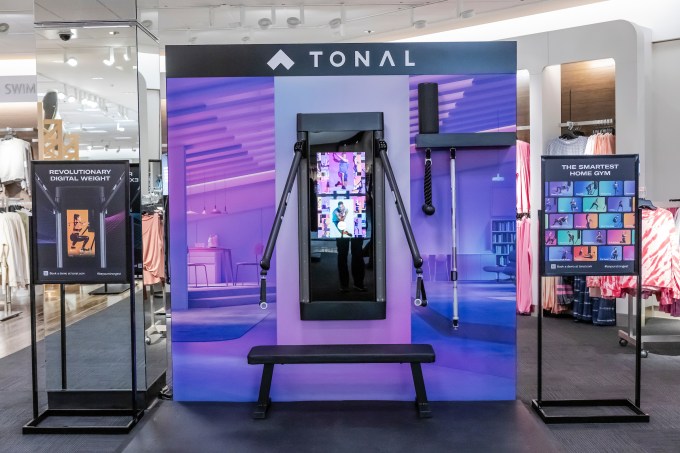
Tonal, maker of the smart home fitness trainer, announced it is more than tripling the number of physical locations it sells devices in through a new partnership with Nordstrom.

Starting this month, Tonal will have 50-square-foot stations in the women’s activewear departments of at least 40 Nordstrom locations across the U.S., bringing the total number of Tonal physical locations to 60 by the end of 2021. Shoppers will be able to walk in or book appointments to try Tonal devices and purchase them through employees on-hand.

“As we looked to expand our retail footprint and strategy, we looked to the retail landscape, and we really feel like Nordstrom says ‘best-in-class’ — the department store is well-suited to succeed in a COVID and post-COVID world,” explained Christopher Stadler, Tonal’s CMO.

Tonal, which manufactures a wall-mounted device with a digital weight system that emulates various traditional gym stations, already operates 16 locations across the country with devices shoppers can try and work out to, with plans to open four additional showrooms later this year. But the partnership with Nordstrom, which expects overall sales growth of 25% in 2021, marks a first-of-its-kind for at-home fitness makers. Peloton, for instance, operates a larger network of dedicated showrooms in the U.S., Canada, Germany and the UK, but it has yet to partner with an outside retailer to display and demo its bikes and treadmills.

An example of Tonal’s placement at a Nordstrom in Walnut Creek. Photo via Tonal.

Tonal’s physical expansion arrives amid a boom in demand for at-home equipment during the pandemic. According to Stadler, sales of Tonal equipment surged 800% from December 2019 to December 2020, causing 10-12 week wait times for deliveries. Those delays are somewhat comparable to Peloton, which has also faced significant delivery wait times in recent months and currently reports 6-10 week delays — an issue Peloton CEO John Foley acknowledged and apologized for in a note to users.

Tonal, for its part, is working to address shipment delays. According to Stadler, the startup has significantly ramped up production of devices, increased employee headcount, and in some cases, now air-ships equipment from Taiwan to the U.S. to meet demand.

“We have seen extraordinary demand for Tonal, and we’re working aggressively around the clock to produce, deliver and install Tonals faster and faster,” says Stadler. “We’ve absolutely ramped up production, and all facets of the organization are rallying to deliver our customer orders as quickly as we can.”


Early Stage is the premiere ‘how-to’ event for startup entrepreneurs and investors. You’ll hear first-hand how some of the most successful founders and VCs build their businesses, raise money and manage their portfolios. We’ll cover every aspect of company-building: Fundraising, recruiting, sales, legal, PR, marketing and brand building. Each session also has audience participation built-in – there’s ample time included in each for audience questions and discussion.


Axonius nabs $100M at a $1.2B valuation for its asset management cybersecurity platform

Remote work has become the norm for many businesses in the last year, and today a startup that has built a cybersecurity platform to help manage all the devices connecting to organizations’ wide-ranging networks — while also providing a way for those organizations to take advantage of all the best that the quite fragmented security market has to offer — is announcing a major round of funding and a big boost to its valuation after seeing its annual recurring revenues grow ten-fold over 15 months.

Axonius, which lets organizations manage and track computing-based assets that are connecting to their networks — and then plug that data into some 300 different cybersecurity tools to analyse it — has closed a round of $100 million, a Series D that values the company at over $1 billion ($1.2 billion, to be exact).

“We like to call ourselves the Toyota Camry of cybersecurity,” Axonius co-founder and CEO Dean Sysman told me in an interview last year. “It’s nothing exotic in a world of cutting-edge AI and advanced tech. However it’s a fundamental thing that people are struggling with, and it is what everyone needs. Just like the Camry.” It will be using the funding to continue scaling the company, it said, amid surging demand, with ARR growing to $10 million last year.

This latest round — led by Stripes, with past investors Bessemer Venture Partners (BVP), OpenView, Lightspeed and Vertex also participating — represents a huge jump for the startup.

Not only is this the company’s biggest round to date, but last year’s $58 million Series C — which closed just as the COVID-19 pandemic was kicking off and remote working, to better enforce social distancing, was starting to take off with it — valued the company at just over $302 million, according to PitchBook data. Axonius has now raised around $195 million in funding.

Last week BVP announced a new pair of funds totaling $3.3 billion, with one dedicated to later-stage growth rounds: This indicates that this money is already getting put to work. Amit Karp, the BVP partner who sits on Axonius’ board, describes the startup as one of the “fastest-growing companies in BVP history.”

When I last covered Axonius, one of the details that really struck me is that its platform is especially useful in today’s market, not just because of its focus on identifying devices on networks may well — and today genuinely do — extend outside of a traditional “office”, but also because of how it views the cybersecurity industry.

It’s a very fragmented market today, with hundreds of companies all providing useful tools and techniques to safeguard against one threat or another. Axonius essentially accepts that fragmentation and works within it, and it has its job cut out for it. Last year when I covered the company’s funding, it integrated with and ran network assets through 100 different cybersecurity tools; now that number is 300.

The crux of what Axonius provides starts with a very basic but critical issue, which is being able to identify how many devices are actually on a network, where they are and what they do there. The idea for the company came when Dean Sysman, the CEO who co-founded Axonius with Ofri Shur and Avidor Bartov, was previously working at another firm, the Integrity Project (now a part of Mellanox, which means now it’s a part of Nvidia).

“Every CIO I met I would ask, ‘do you know how many devices you have on your network?’ And the answer was either ‘I don’t know,’ or a big range, which is just another way of saying, ‘I don’t know,’ ” Sysman told me last year. “It’s not because they’re not doing their jobs but because it’s just a tough problem.”

He said part of the reason is because IP addresses are not precise enough, and de-duplicating and correlating numbers is a gargantuan task, especially in the current climate of people using not just a multitude of work-provided devices, but a number of their own.

Axonius’s algorithms — “a deterministic algorithm that knows and builds a unique set of identifiers that can be based on anything, including timestamp, or cloud information. We try to use every piece of data we can,” said Sysman — are built to bypass some of this.

The resulting information then can be used across a number of other pieces of security software to search for inconsistencies in use (bringing in the behavioural aspect of cybersecurity) or other indicators of malicious activity.

The fact of that platform play — and how it can grow with both the range of devices that are added, as well as technology built to counteract increasingly sophisticated threats — is what attracted investors. 

“It’s always exciting to invest in fast-growing, innovative, category-creating companies, but what Axonius has accomplished in such a short time is remarkable,” said Stripes founding partner Ken Fox in a statement. “With its commitment to solving a fundamental challenge with a simple, powerful platform that collects and correlates data from hundreds of products its customers already use, Axonius has built one of the most beloved products in security. We look forward to partnering with the Axonius team as they continue to invest in technical innovation and grow to meet global demand in 2021 and beyond.” Fox will join the Axonius board of directors with this round.

It seems that some of this news leaked out over the weekend. A spokesperson has confirmed it all to us but the “official” announcement will be coming out later today.


Get live feedback on your pitch deck from tech leaders on Extra Crunch Live

Extra Crunch Live, the members only event series that features tech leaders waxing poetic on how to perfect the pitch deck (and more!) has gotten off to a strong start in 2021. Thus far, we’ve seen the most beautifully simple deck in existence with the help of Justworks’ Isaac Oates and Bain’s Matt Harris, learned how to nail the narrative with Lightspeed’s Gaurav Gupta and Grafana’s Raj Dutt, heard about the perils of pricing with Accel’s Steve Loughlin and Ironclad’s Jason Boehmig, and learned the value of simple pitch decks with Felicis’ Aydin Senkut and Guideline’s Kevin Busque.

And that’s only the beginning. We’ve got a packed slate coming your way in March, featuring Cleo Capital’s Sarah Kunst, PlanetFWD’s Julia Collins, Flourish Ventures’ Emmalyn Shaw, Steady’s Adam Roseman, Mayfield’s Navin Chaddha, and Poshmark’s Manish Chandra.

One of the beautiful things about Extra Crunch Live is the Pitch Deck Teardown. Our esteemed speakers take a look at pitch decks submitted by the audience and give their live feedback. It’s an invaluable way to understand how VCs and founders alike think about what makes a great deck.

The importance of the pitch deck can’t be underestimated. It is often the first point of contact between a company and venture investors, but how investors consume a pitch deck (and what they really think) is also a bit of a black box.

Are they speed-flipping through the slides or taking their time? Do they prefer more information on the team or context on the industry? More numbers or more words? How many slides is the right number of slides?

There are too many questions to count, and often very few answers. But we’re popping the lid off of that black box with the Pitch Deck Teardown.

If this seems like a good fit for you, you can submit your pitch deck to be featured on Extra Crunch Live right here. (We prioritize decks submitted by Extra Crunch members, but anyone can send us a deck and we’ll take a look at as many as possible!)

See you on the next episode of Extra Crunch Live!

Early Stage is the premiere ‘how-to’ event for startup entrepreneurs and investors. You’ll hear first-hand how some of the most successful founders and VCs build their businesses, raise money and manage their portfolios. We’ll cover every aspect of company-building: Fundraising, recruiting, sales, legal, PR, marketing and brand building. Each session also has audience participation built-in – there’s ample time included in each for audience questions and discussion.


Equity Monday: More venture money for Europe, and public companies blast off

Hello and welcome back to Equity, TechCrunch’s venture capital-focused podcast where we unpack the numbers behind the headlines.

This is Equity Monday, our weekly kickoff that tracks the latest private market news, talks about the coming week, digs into some recent funding rounds and mulls over a larger theme or narrative from the private markets. You can follow the show on Twitter here and myself here — and be sure to check out our most recent Friday episode, which featured news on Finix and Coinbase and Reddit, among others.

(Also don’t forget that Equity is growing! And TechCrunch events are about to kick off and kick some butt.)

Here’s what we got into this fine Monday morning:

Equity drops every Monday at 7:00 a.m. PST, Wednesday, and Friday at 6:00 AM PST, so subscribe to us on Apple PodcastsOvercastSpotify and all the casts!


Early Stage is the premiere ‘how-to’ event for startup entrepreneurs and investors. You’ll hear first-hand how some of the most successful founders and VCs build their businesses, raise money and manage their portfolios. We’ll cover every aspect of company-building: Fundraising, recruiting, sales, legal, PR, marketing and brand building. Each session also has audience participation built-in – there’s ample time included in each for audience questions and discussion.


How VR is Changing Workforce Collaboration for Enterprise and SMB

Sponsored Post

Workforce Collaboration

COVID-19 forced businesses to learn to collaborate remotely – and quickly. Essentially overnight, offices were shuttered, travel halted, and teams were working from home – in some cases, for the first time. And while many enterprises were more adept, having already adopted tools for remote collaboration, many small-to-medium businesses (SMBs) had to scramble.

One tool that enterprises across a variety of industries have been already leveraging for workforce training and education as well as product design, is virtual reality (VR). Industries including construction and real estate, medical, automotive and aviation, and first and emergency responders have all been incorporating virtual reality into their work. Over the last several years, hotels, office buildings and cars have been designed faster and more cost effectively in VR, workplace and emergency trainings have been administered more efficiently in VR, and medical professionals have been able to sit in, and even participate, in remote surgeries in VR.

When I joined HTC VIVE in 2019, many enterprises were already adopting VR, while SMBs were just starting to look into it, though it wasn’t quite a priority. Conversations were being had, and RFPs were being formulated, but similar to how smaller companies were preparing for other emerging technology, like 5G, they weren’t ready to pull the trigger. The pandemic changed this.

In the last year, we’ve seen SMB embrace and adopt VR at a rapid pace, because in reality, the same business challenges that impact large enterprises are also impacting SMBs. These small companies are competing with enterprise, and need to stay on par with, or ahead of, innovation of larger companies – in training, in design, in overall workforce efficiency. The advantage to SMBs for a tool like VR, unlike enterprises, is that they can move quickly from RFP to investment, and roll out in record time. Adaptability, removing layers of approvals and implementation, is the SMB advantage.

In 2020, SMBs have adopted VR across a variety of interesting verticals:

  • In education, universities, districts and individual schools are adopting VR to create more immersive and engaging learning experiences – imagine swimming with sharks or exploring the moon firsthand to learn.
  • Museums are integrating VR to enhance their exhibits’ storytelling, offering virtual experiences outside of the museum to extend their message and reach an even broader global audience. The Illinois Holocaust Memorial Museum is using VR to give visitors a firsthand view of what camps looked like to envelop the emotional experience that comes with personally visiting a camp.
  • Many companies are turning to VR for workforce training in soft skills – how to handle specific workplace scenarios, how to more effectively sell, preparing for public speaking – you name it.
  • Emergency services companies, including police forces, are leveraging VR for non-lethal training and de-escalation techniques.

If 2020 taught us anything, it’s that business is adaptable – and the new way of working will be here to stay along with the business, and even life, efficiencies that remote work and collaboration has brought. A recent study from Flexjobs shows that more than half of people feel more productive from home, and 6 in 10 see remote work as more positive. Add in the business efficiencies and cost savings that remote work brings, and the future will likely look much different than the past.  Fast Company reported on a Global Workplace Analytics study that calculated if the estimated 48 million employees who have a remote-work-compatible job were to work remotely at least weekly, U.S. employers could save more than $500 billion per year.

As we continue to adjust business to this new normal, and with 5G becoming a reality, we can expect to see technologies such as VR taking a much larger role in training, learning and design – across almost every industry you can think of. Has your business invested in it yet?

By Amir Khorram, VP, HTC VIVE

Image: Depositphotos

This article, "How VR is Changing Workforce Collaboration for Enterprise and SMB" was first published on Small Business Trends


Australia-based Employment Hero raises $45M AUD for its global expansion

A photo of Ben Thompson, co-founder and chief executive officer of human resources platform Employment Hero

Ben Thompson, co-founder and chief executive officer of human resources platform Employment Hero

Businesses, and the tech platforms that support their operations, had to adapt quickly to the pandemic. Ben Thompson, co-founder and chief executive officer of human resources platform Employment Hero told TechCrunch that “COVID-19 accelerated the adoption of employment management software by roughly five years,” as teams adjusted to remote work.

The Sydney, Australia-based company announced today it has raised a $45 million AUD (about $34.8 million) Series D, bringing its valuation to more than $250 million AUD ($193.4 million USD). The capital will be used for expansion and growth in markets including New Zealand, Southeast Asia and the United Kingdom.

The round was led by SEEK, which runs job platforms around the world, with participation from OneVentures and AirTreeVentures, all returning investors. Employment Hero also added Salesforce Ventures as a new investor.

Employment Hero is designed for small-to-medium sized businesses, and combines human resources, payroll and benefits features. It currently serves about 6,000 SMEs with a combined total of more than 250,000 employees. Employment Hero doubled the number of its full-time employees to 200 last year, and launched versions in New Zealand, the UK, Malaysia and Singapore. Its Series D will be used to support growth in those markets, and enter new Southeast Asian countries, including Thailand, Vietnam, Indonesia and the Philippines.

Localized versions of Employment Hero include pre-built employment contracts and policies that comply with local laws. In Malaysia and Singapore, the platform provided research on recruitment and employment trends, Thompson said, and in Singapore, it gathered COVID-related government support materials into one factsheet.

Employment Hero also renewed its partnership with SEEK, which means the platform includes SEEK job ads in Southeast Asia.

During the pandemic, the company launched a new service called Global Teams for remote work. It serves as a professional employer organization (PEO), enabling companies to recruit new remote employees around the world and automating regional compliance paperwork. Global Teams is integrated into the main Employment Hero platform, so remote employees have access to the same resources as their colleagues.


About 75% of Employment Hero’s customer base upgraded their subscriptions to include tools for remote work management, compliance and employee wellness services.

For example, during the first week of Australia’s nationwide lockdown, Employment Hero launched a COVID-19 resource hub, including tools for the government’s JobKeeper payment scheme and employee wellness surveys. It also ran biweekly webinars with industry experts about employees’ rights to leave and pay, mental health and employee assistance programs, cashflow management, employer duty of care for remote work arrangements and live employment law.

As remote work continued, Employment Hero also introduced engagement and productivity features, like one-on-one coaching and other tools to improve communication and feedback.

“As a company, we knew we had to do whatever it took to help our clients and the wider small and medium-sized business community through COVID-19,” said Thompson.

Early Stage is the premiere ‘how-to’ event for startup entrepreneurs and investors. You’ll hear first-hand how some of the most successful founders and VCs build their businesses, raise money and manage their portfolios. We’ll cover every aspect of company-building: Fundraising, recruiting, sales, legal, PR, marketing and brand building. Each session also has audience participation built-in – there’s ample time included in each for audience questions and discussion.


Rocket Lab debuts plans for a new, larger, reusable rocket for launching satellite constellations

Because news of its SPAC-fueled public market debut wasn’t enough, Rocket Lab also unveiled a new class of rocket it has in development on Monday. The launch vehicle, called Neutron, will be able to carry 8 metric tons (around 18,000 lbs) to orbit, far exceeding the cargo capacity of Rocket Lab’s current Electron vehicle, which can host only around 660 lbs. Neutron will also have a fully reusable first-stage, designed to launch on an ocean landing platform, not unlike SpaceX’s Falcon 9 booster.

Rocket Lab says that Neutron will be designed to service increased demand from customers launching large multi-satellite constellations. The heavier lift will mean that it can take more small satellites up at one time to get those constellations in orbit more quickly. Its cargo rating also means it should be able to deliver up to 98% of all currently-forecasted spacecraft launching through 2029, according to Rocket Lab, and provide resupply services to the International Space Station. Rocket Lab also says it’ll be capable of human spaceflight missions, indicating an ambition to make it the company’s first human-rated spacecraft.

Neutron could significantly expand Rocket Lab’s customer base, and it’ll also improve costs and economics vs. what Electron can do now, thanks to a design focus don efficiency and reusability. The rocket will launch from Rocket Lab’s Wallops, Virginia facility, and since there’s already a launch pad in place for it, the company expects it’ll be able to fly Neutron for the first time by 2024. In addition to its LA-based HQ and the Wallops launch site, Rocket Lab anticipates it’ll be building a new Neutron production facility somewhere in the U.S. to build the new rocket at scale.

While it won’t have the launch capacity of SpaceX’s Falcon 9, it’s still intended to be a rocket that can also carry smaller payloads to the Moon and even deep space beyond. The medium-lift category in general is generating a lot of interest right now, given the projections in the amount and variety of constellations that both private and public organization are expected to put into orbit over the next decade. Constellations are offering advantages in terms of cost and coverage for everything from communications to Earth observation. Another rocket startup, Relativity Space, just unveiled similar plans for a larger launch vehicle to complement its first small rocket.


Klarna confirms new $31B valuation

Klarna, the Swedish buy now, pay later behemoth and upstart bank, has raised $1 billion in new funding at a post-money valuation of $31 billion. That sees the company retain the crown as the highest valued private fintech in Europe.

Backers of this round are said to be combination of new and existing investors, while Klarna claims it was 4 times oversubscribed. That’s likely prompted by reports the company is eyeing up a direct public listing and the current appetite for public tech stock in general.

As a reference point, Affirm, which is viewed in the U.S. as one of Klarna’s most direct competitors, recently IPO’d. If you want further data points, read Alex’s Extra Crunch analysis of Klarna, Affirm and AfterPay’s most recent earnings.

In addition to confirming the new fund raise — which had been widely leaked given that there dozens of frenzied investors involved — Klarna is also announcing that the company will pledge 1% of the capital raised to a newly created initiative that focuses on “key sustainability challenges around the world”. The initiative will be formally launched April 22 on World Earth Day.

A very early mover in what is now widely called buy-now-pay-later (BNPL), Klarna has been built on the concept of giving consumers a way to buy things online without having to pay for them upfront, and without resorting to a credit card. It does this both by offering online retailer integrations where Klarna appears as an option at check out, and through its own “shopping mall” app, where users can browse all the stores that let you pay with Klarna.

On the back of this, the company hopes to foster a bigger financial relationship with its users as a fully-fledged challenger bank. It has a range of licensed banking services, such as savings and current accounts, in Sweden and Germany, with more countries to follow.

On the BNPL front, Klarna is active in over 17 countries, and has over 250,000 retail partners including Macys, H&M, IKEA, Expedia Group, Samsung, ASOS, Peloton, Abercrombie & Fitch, Nike and AliExpress.

The fintech has been backed by Sequoia Capital since 2010. More recent investors include Dragoneer, Bestseller Group, Permira, Visa, Atomico, Ant Group, Commonwealth Bank of Australia, Silver Lake, HMI Capital, TCV, Northzone, GIC (Singapore’s sovereign wealth fund) and funds and accounts managed by BlackRock.

Meanwhile, Klarna was founded all the way back in 2005 and has a fascinating story from startup to scale-up — a story that almost certainly has a few more twists and turns yet. If you need to catch up, check out this 8,000 word opus on the company for Extra Crunch.


Where Is Amazon Going Now in 2021?

Jason Boyce

Amazon has a huge effect on both small businesses and consumers all over the country. With Jeff Bezos stepping down, where is the company headed in 2021?

On the Small Business Radio Show this week, I discuss that future with Jason Boyce, the founder and CEO of Avenue 7 Media, LLC, a seller management group that harnesses the power of Amazon for direct-to-consumer product brands. Jason is also the co-author of “The Amazon Jungle: The Truth About Amazon, The Seller’s Guide to Thriving on the World’s Most Perilous E-Commerce Marketplace”.

Interview with Jason Boyce on Amazon’s Future

Jason believes that a platform like Amazon was built for a worldwide pandemic since they currently have more delivery drivers than USPS and UPS. They added more distributions centers in 2020 than their next closest competitor has. Even though the two day delivery promise broke down, they still delivered a record profit for their shareholders. He predicts with the new CEO, Andy Jassey, the company will “not miss a beat” and will execute on Bezos’ vision. Jason thinks this change will free Bezos up to work on the future innovation at Amazon.

According to Jason, Amazon is establishing the “first postindustrial behemoth”; He states that Amazon has 62% of online market share. 50% of cloud computing and runs one half trillion dollars through their channel! Jason is also worried about the high level of automation that will be involved in delivering their orders like robots and drones and this will put a lot of people out of work.

Jason says that all this convenience from Amazon comes at the price of privacy. The company continues to collect more data on Americans for free than Facebook and according to Jason, they use its influence consumer behavior; “we have trusted a half a dozen… brilliant founders to do the right thing… how has that worked out? They are shirking off responsibility…” He believes that the federal government needs to take a bigger role in monitoring how much consumer data large companies like Amazon record.

Listen to this fascinating interview on the Small Business Radio Show this week

Image: jasonrboyce

This article, "Where Is Amazon Going Now in 2021?" was first published on Small Business Trends


Autonomous drone maker Skydio raises $170M led by Andreessen Horowitz

Skydio has raised $170 million in a Series D funding round led by Andreessen Horowitz’s Growth Fund. That pushes it into unicorn territory, with $340 million in total funding and a post-money valuation north of $1 billion. Skydio’s fresh capital comes on the heels of its expansion last year into the enterprise market, and it intends to use the considerable pile of cash to help it expand globally and accelerate product development.

In July of last year, Skydio announced its $100 million Series C financing, and also debuted the X2, its first dedicated enterprise drone. The company also launched a suite of software for commercial and enterprise customers, its first departure from the consumer drone market where it had been focused prior to that raise since its founding in 2014.

Skydio’s debut drone, the R1, received a lot of accolades and praise for its autonomous capabilities. Unlike other consumer drones at the time, including from recreational drone maker DJI, the R1 could track a target and film them while avoiding obstacles without any human intervention required. Skydio then released the Skydio 2 in 2019, its second drone, cutting off more than half the price while improving on it its autonomous tracking and video capabilities.

Late last year, Skydio brought on additional senior talent to help it address enterprise and government customers, including a software development lead who had experience at Tesla and 3D printing company Carbon. Skydio also hired two Samsara executives at the same time to work on product and engineering. Samsara provides a platform for managing cloud-based fleet operations for large enterprises.

The applications of Skydio’s technology for commercial, public sector and enterprise organizations are many and varied. Already, the company works with public utilities, fire departments, construction firms and more to do work including remote inspection, emergency response, urban planning and more. Skydio’s U.S. pedigree also puts it in prime position to capitalize on the growing interest in applications from the defense sector.

a16z previously led Skydio’s Series A round. Other investors who participated in this Series D include Lines Capital, Next47, IVP and UP.Partners.


Space startup Gitai raises $17.1M to help build the robotic workforce of commercial space

Japanese space startup Gitai has raised a $17.1 million funding round, a Series B financing for the robotics startup. This new funding will be used for hiring, as well as funding the development and execution of an on-orbit demonstration mission for the company’s robotic technology, which will show its efficacy in performing in-space satellite servicing work. That mission is currently set to take place in 2023.

Gitai will also be staffing up in the U.S., specifically, as it seeks to expand its stateside presence in a bid to attract more business from that market.

“We are proceeding well in the Japanese market, and we’ve already contracted missions from Japanese companies, but we haven’t expanded to the U.S. market yet,” explained Gitai founder and CEO Sho Nakanose in an interview. So we would like to get missions from U.S. commercial space companies, as a subcontractor first. We’re especially interested in on-orbit servicing, and we would like to provide general-purpose robotic solutions for an orbital service provider in the U.S.”

Nakanose told me that Gitai has plenty of experience under its belt developing robots which are specifically able to install hardware on satellites on-orbit, which could potentially be useful for upgrading existing satellites and constellations with new capabilities, for changing out batteries to keep satellites operational beyond their service life, or for repairing satellites if they should malfunction.

Gitai’s focus isn’t exclusively on extra-vehicular activity in the vacuum of space, however. It’s also performing a demonstration mission of its technical capabilities in partnership with Nanoracks using the Bishop Airlock, which is the first permanent commercial addition to the International Space Station. Gitai’s robot, codenamed S1, is an arm–style robot not unlike industrial robots here on Earth, and it’ll be showing off a number of its capabilities, including operating a control panel and changing out cables.

Long-term, Gitai’s goal is to create a robotic workforce that can assist with establishing bases and colonies on the Moon and Mars, as well as in orbit. With NASA’s plans to build a more permanent research presence on orbit at the Moon, as well as on the surface, with the eventual goal of reaching Mars, and private companies like SpaceX and Blue Origin looking ahead to more permanent colonies on Mars, as well as large in-space habitats hosting humans as well as commercial activity, Nakanose suggests that there’s going to be ample need for low-cost, efficient robotic labor – particularly in environments that are inhospitable to human life.

Nakanose told me that he actually got started with Gitai after the loss of his mother – an unfortunate passing he said he firmly believes could have been avoided with the aid of robotic intervention. He began developing robots that could expand and augment human capability, and then researched what was likely the most useful and needed application of this technology from a commercial perspective. That research led Nakanose to conclude that space was the best long-term opportunity for a new robotics startup, and Gitai was born.

This funding was led by SPARX Innovation for the Future Co. Ltd, and includes funding form DcI Venture Growth Fund, the Dai-ichi Life Insurance Company, and EP-GB (Epson’s venture investment arm).


10 Things Every New E-Commerce Business Must Plan for

E-Commerce business is very competitive. Every new business must plan for these 10 things to succeed.

[[ This is a content summary only. Visit my website for full links, other content, and more! ]]


Sunday, 28 February 2021

ADP Introduces Roll, a “Reimagined Way to Do Payroll” for Small Business

Reimagined Way to Do Payroll

As small businesses navigate their way out of the pandemic, there is a growing demand for technologies that make processes and procedures more efficient.

In walks a new payroll app named Roll.

Roll is delivered by ADP, specialists in helping organizations of all sizes unlock their potential through advanced technology and cloud-based solutions.

The payroll app enables small business owners to run payroll from anywhere and at any time. They can do so quickly and compliantly without any previous experience. Roll features an artificial intelligence-backed conversational interface. This intuitive interface allows entrepreneurs who are stuck for time to complete payroll in seconds. They simply need to make a voice a prompt like “run my payroll” and the do-it-yourself app guides users through the process.

ADP Launches Roll for Small Business Payroll from Anywhere

The pandemic has created rafts of challenges for small businesses. To navigate the challenges and recover from the impact of the pandemic, small businesses need make adaptations to operations to help create greater efficiency and productivity.

While vital, payroll tasks are notoriously time-consuming. Spending hours on inefficient payroll processes means precious time is lost. Such time could be spent more valuably on tasks related to growing a business, increasing productivity, and ultimately making it more profitable.

Utilizing tech like the Roll app helps businesses streamline mundane and time-consuming tasks. With more time on their hands, small business owners can be better prepared to navigate their way out of these challenging times with greater success.

Joe DeSilva, president of small business solutions at ADP, spoke of the need for small businesses to eliminate time-consuming tasks.

“Small business owners have been impacted by the pandemic in a way we are never seen in our history. As they continue to rebuild, the last thing an employer needs is to focus time and resources on another process that can be arduous or perceived as cost-prohibitive. Roll by ADP completely upends the way small businesses will think about payroll by turning it into an experience as familiar as having a conversation with a friend. There’s nothing else out there remotely like it,” said DeSilva.

Roll replaces complex forms and static spreadsheets with an app that mimics a conversational chat exchange. The chat-based interface runs anytime and anywhere, and on any device in less than a minute.

No Training Required

Small businesses don’t have to devote time to training, as Roll requires no preliminary training prior to use. The app requires a one-time set-up, which takes just 15 minutes.

Users can add employees, alter salaries, offer promotions, and much more with the app. Employees can use Roll to update their personal information and access pay statements. Live, in-app chat support offers real-time help.

Maintaining Compliance with Pay Regulations

With pay regulations constantly updating, it’s important small business stay up-to-date with changing legislation. Roll helps businesses maintain compliance through regular updates about any changes to pay regulations.

Another welcome feature of the Roll app is notification of when it’s payday!

Roll is available to small businesses in the US. The introductory pricing is $17 per month plus $5 per employee.

Image: rollbyadp

This article, "ADP Introduces Roll, a “Reimagined Way to Do Payroll” for Small Business" was first published on Small Business Trends