Tuesday, 2 March 2021

Humaans raises $5M seed to make it easier for companies to on-board and manage staff

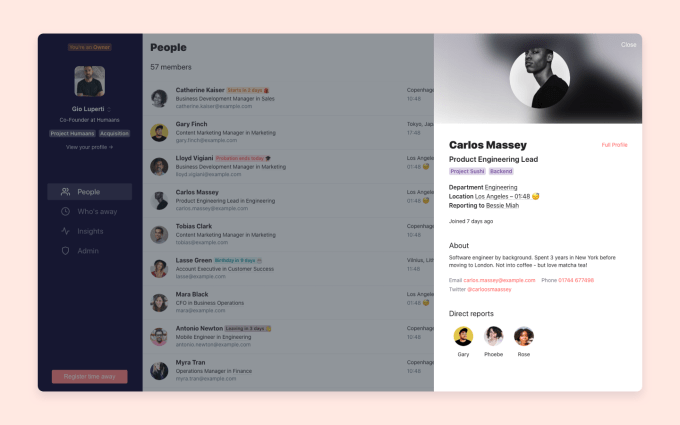
Humaans, a London-based HR startup, has raised $5 million in seed funding to accelerate the development of its employee on-boarding and management platform. Backing the round is Y Combinator, Mattias Ljungman’s Moonfire, Frontline Ventures and former head of Stripe Issuing, Lachy Groom.

A number of other investors, made up of seasoned entrepreneurs and startup operators, also participated. They include LinkedIn CEO Jeff Weiner (via Next Play Ventures), Stripe COO Claire Johnson, Figma CEO Dylan Field, Intercom co-founder Des Traynor, former Workday CTO David Clarke, former Benchmark GP Scott Belsky, Notion COO Akshay Kothari, Qubit co-founder Emre Baran, Evervault CEO Shane Curren and Stripe head of security Gerardo Di Giacomo.

Founded by former Qubit employees Giovanni Luperti and Karolis Narkevicius, Humaans came into existence formerly in April 2020 after the pair quit the product agency they had founded together. With a soft launch the previous year while bootstrapping, and with validation from early users, Luperti and Narkevicius decided they had found enough product-market fit to focus on the startup full-time.

“We bootstrapped Humaans by reinvesting capital from the previous businesses we co-founded,” explains CEO Luperti. “After gaining initial commercial traction, we decided to raise capital and brought a number of investors and operators onboard, and joined Y Combinator”.

Pitching itself as a central hub for employee on-boarding and management — or a single source of truth for staffing — Humaans aims to play nicely by integrating with other existing SaaS used across the “HR stack”. This is because scaling companies are increasingly rejecting all-encompassing HR software and using the best modern SaaS offerings for various different functions.

“Companies are frustrated with poorly integrated HR stacks, making processes slow while exposing them to compliance risks,” says Luperti. “This is why the adoption of point solutions is increasing dramatically. Companies are adopting what’s best based on their needs and stage of growth to address their people needs”.

For example, a company may choose an applicant tracking system, a performance management system, contract management software and an employee engagement platform, and so on. “This makes the ‘all-in-one’ model antiquated, creating the opportunity for a solution like Humaans to emerge. We’re building a layer of infrastructure for all employee data”.

This is seeing Humaans attempt to bring together the full HR stack and automate processes like on-boarding, off-boarding and compensation management with fast workflows that can be set up not dissimilar to an IFTTT or Zapier-style type of interaction model.

Image Credits: Humaans

“If you ask around, most employees dislike their HR software,” says Luperti. “HR tools have historically been clunky, slow and not good at providing a good user experience. Existing players focused more on sales and acquisition than retention through product. But HR buyers today are more sophisticated than ever and have an appetite for best in class. We’re building the Slack of HR… an employee management platform that’s both delightful and very powerful”.

To that end, Humaans says it grew 3x in the past few months and is popular amongst distributed companies, such as Pleo, ChartMogul, Bombinate, HeySummit and Pento.

Adds the Humaans CEO: “There are two segments of existing players: those targeting SMEs, and those working with corporations. Serving the companies in the middle is the opportunity we’re going after”.


Coupang may raise up to $3.6 billion in its IPO, at a potential valuation of $51 billion

According to an amended S-1 filing, South Korean e-commerce leader Coupang expects to price its initial public offering between $27 to $30 per share, potentially raising up to $3.6 billion. After the IPO, Coupang will have a total of 1.7 billion shares outstanding, including Class A and Class B. This means the means the pricing would give Coupang a potential market capitalization between $46 billion to $51 billion, a huge increase over the $9 billion valuation it reached after its last funding round in 2018, led by SoftBank Vision Fund.

Coupang and some of its existing shareholders will offer a total of 120 million shares during the IPO.

If Coupang’s IPO is successful, it would be a huge win for SoftBank Vision Fund, which will own 36.8% of its Class A shares after the listing.

Founded in 2010 by Bom Kim, Coupang is known for its ultra-speedy deliveries and is now the largest e-commerce company in South Korea, according to Euromonitor. According to the filing, Kim will hold 76.7% of voting power after the listing, while SoftBank Vision Fund will hold about 8.6%. Other investors that currently own 5% or more of Coupang’s shares include Greenoaks Capital Partners, Maverick Holdings, Rose Park Advisors, BlackRock and Ridd Investments.

Coupang filed to go public on the New York Stock Exchange last month, under the symbol CPNG. Based on Bloomberg data, Coupang’s listing will be the fourth-biggest by an Asian company on a U.S. exchange, and the largest since Alibaba’s $25 billion IPO in 2014.


Compass files S-1, reveals $3.7B in revenue on net loss of $270M

Compass, the real-estate brokerage startup backed by roughly $1.6 billion in venture funding, filed its S-1 Monday.

The move comes just under one year after the New York-based company laid off 15% of its staff as a result of the shifting economic fortunes created by the global response to the novel coronavirus pandemic.

Prior to the IPO, SoftBank’s Vision Fund holds slightly more than a one-third stake in the company. Other investors include the Canadian Pension Plan Investment Board, Fidelity, Wellington Management, and the Qatar Investment Authority, according to Crunchbase.

The company’s last fundraise was in July 2019, when Compass — a company that has built a three-sided marketplace for the real estate industry, along with a wide set of algorithms to help make it work — raised a $370 million round of funding. That financing valued Compass at $6.4 billion.

One of the greatest things about companies going public is that we get insight into their financials. Compass is not profitable but it did see a massive surge in revenue over the past few years.

The company’s revenues have increased from $186.8 million in 2016 to a whopping $3.7 billion last year, with much of the top-line revenue growth coming in the last two years, according to its S-1. Given the startup’s agency model, most of that revenue is paid out directly to the firm’s agents, who netted about $3 billion in commissions in 2020. Compass posted a net loss of $270 million in 2020, a net loss roughly in line with what it has experienced in the past two years.

Total transactions on the platform grew from about 27,000 in 2018 to 145,000 in 2020, while total transaction volume (the value of the properties the company brokers) went up by about five-fold, from $34 billion to $152 billion last year. Since commissions on real estate are determined as fixed percentage of the value of the property, more transaction volume directly translates into more revenue for Compass. The company has been able to sustain that growth while limiting the number of agents it has added. From 2019 to 2020, the company only had 28% growth in its total number of agents, reaching just shy of 9,000 last year.

Compass had its share of trouble before the pandemic. In September 2019, the Wall Street Journal reported that the company had lost a number of senior level individuals over the previous eighteen months including its chief financial officer, chief marketing officer and chief technology officer.


Square’s bank arm launches as fintech aims ‘to operate more nimbly’

Known for its innovations in the payments sector, Square is now officially a bank.

Nearly one year after receiving conditional approval, Square said Monday afternoon that its industrial bank, Square Financial Services, has begun operationsSquare Financial Services completed the charter approval process with the FDIC and Utah Department of Financial Institutions, meaning its ready for business.

The bank, which is headquartered in Salt Lake City, Utah, will offer business loan and deposit products, starting with underwriting, and originating business loans for Square Capital’s existing lending product.

Historically, Square has been known for its card reader and point-of-sale payment system, used largely by small businesses – but it has also begun facilitating credit for the entrepreneurs and smalls businesses who use its products in recent years.

Moving forward, Square said its bank will be the “primary provider of financing for Square sellers across the U.S.”

In a statement, Square CFO and executive chairman for Square Financial Services, Amrita Ahuja said that bringing banking capability in house will allow the fintech to “operate more nimbly.”

Square Financial Services will continue to sell loans to third-party investors and limit balance sheet exposure. The company said it does not expect the bank to have a material impact on its consolidated balance sheet, total net revenue, gross profit, or adjusted EBITDA in 2021.

Opening the bank “deepens Square’s unique ability to expand access to loans and banking tools to underserved populations,” the company said.

Lewis Goodwin had been tapped to serve as the bank’s CEO, and Brandon Soto its CFO. With today’s announcement, Square also announced the following new appointments:

  • Sharad Bhasker, Chief Risk Officer
  • Samantha Ku, Chief Operating Officer
  • Homam Maalouf, Chief Credit Officer
  • David Grodsky, Chief Compliance Officer
  • Jessica Jiang, Capital Markets and Investor Relations Lead

The trend of fintechs becoming bank continues. In February, TechCrunch reported on the fact that Brex had applied for a bank charter.

The fast-growing company, which sells a credit card tailored for startups with Emigrant Bank currently acting as the issuer, said that it had submitted an application with the Federal Deposit Insurance Corporation (FDIC) and the Utah Department of Financial Institutions (UDFI) to establish Brex Bank.

A number of fintech companies, or those with fintech services, have spun up products typically offered by banks, including deposit and chequings accounts as well as credit offerings. Often, these are designed to provide capital to customers who might not be able to get funding on favorable terms from traditional banking institutions, but who might qualify for business-building loans from a provider who knows their company, like Square, inside and out.


Kaltura files to go public on the back of accelerating revenue growth, rising losses

Kaltura, a software company focused on providing video technology to other concerns, has filed to go public.

The Kaltura S-1 filing only partially surprised. TechCrunch previously covered the company as part of our ongoing $100 million ARR series focusing on private companies that have reached material scale. (TechCrunch has also covered its product life to a moderate degree.)

The company’s IPO documentation details a business that did more than merely accelerate its growth in 2020, and more specifically, during the COVID-19 era. Seeing a company that powers video tooling do well when much of the world has transitioned to remote work and education is not a bolt from the blue. What is notable, however, is that the company’s revenue growth has accelerated yearly since at least 2018 and its final quarter of 2020 placed the company at a new growth rate maximum.

Public investors, hungry for growth, may find such a progression compelling.

Kaltura also has an interesting profitability profile: As its GAAP net losses scaled in the last year, its adjusted profitability improved. Depending on your stance regarding adjusted metrics, Kaltura’s bottom line will either irk or delight you.

This afternoon, let’s rip into the company’s S-1 and yank out what we need to know. It is IPO season, with SPACs galore and other private companies taking more traditional routes to the public markets, including Coupang announcing a price range for its traditional debut today and Coinbase’s impending direct listing.

For now we’ll focus on Kaltura. Let’s get into it.

Inside Kaltura’s IPO filing

When TechCrunch last covered Kaltura’s financial results, we noted that the company founded in 2006 had raised just north of $166 million, crossed the $100 million ARR mark, and was, per its own reporting, “profitable on an EBITDA.” Kaltura also told TechCrunch that it had margins in the 60% range and was growing at around 25% year over year. That was just over a year ago.

Do those figures hold up? In the Q1 2020 period Kaltura recorded $25.9 million in revenue, software margins of around 78% and blended gross margins of 59.8%. And the company had grown 16.6% from the year-ago quarter. In Kaltura’s defense, the company’s growth accelerated to 24% in the year, so its self-reported numbers were mostly fair. Better than, I think, most numbers we get from private companies.


Apple alum’s jobs app for India’s workers raises $12.5 million

A startup by an Apple alum that has become home to millions of low-skilled workers in India said on Tuesday it has raised an additional $12.5 million, just five months after securing $8 million from high-profile investors.

One-year-old Apna said Sequoia Capital India and Greenoaks Capital led the $12.5 million Series B investment in the startup. Existing investors Lightspeed India and Rocketship VC also participated in the round. The startup, whose name is Hindi for “ours,” has now raised more than $20 million.

More than 6 million low-skilled workers such as drivers, delivery personnel, electricians and beauticians have joined Apna to find jobs and upskill themselves. But there’s more to this.

An analysis of the platform showed how workers are helping one another solve problems — such as a beautician advising another beautician to perform hair dressing in a particular way that tends to make customers happier and tip more, and someone sharing how they negotiated a hike in their salary from their employer.

“The sole idea of this is to create a network for these workers,” Nirmit Parikh, Apna founder and chief executive told TechCrunch in an interview. “Network gap has been a very crucial challenge. Solving it enables people to unlock more and more opportunities,” he said. Harshjit Sethi, principal at Sequoia India, said Apna was making inroads with “building a professional social network for India.”

The startup has become an attraction for several big firms, including Amazon, Flipkart, Unacademy, Byju’s, Swiggy, BigBasket, Dunzo, BlueStar and Grofers, which have joined as recruiters to hire workers. Apna offers a straightforward onboarding process — thanks to support for multiple local languages — and allows users to create a virtual business card, which is then shown to the potential recruiters.

The past six months have been all about growth at Apna, said Parikh. The app, available on Android, had 1.2 million users in August last year, for instance. During this period, there have been 60 million interactions between recruiters and potential applicants, he said. The platform, which has amassed more than 80,000 employers, has a retention rate of over 95%, said Parikh.

“Apna has taken a jobs-centric approach to upskilling that we are very excited about. Lack of accountability has been the core issue with current skill / vocational learning alternatives for grey and blue-collar workers. Apna has turned the problem on its head by creating net-positive job outcomes for anyone who chooses to upskill on the platform,” said Vaibhav Agrawal, partner at Lightspeed India, in a statement.

Image Credits: Nirmit Parikh

Parikh got the idea of building Apna after he kept hearing about the difficulty his family and friends faced in India in hiring people. This was puzzling to Parikh, as he wondered how could there be a shortage of workers in India when there are hundreds of millions of people actively looking for such jobs. The problem, Parikh realized, was that there wasn’t a scalable networking infrastructure in place to connect workers with employers.

Before creating the startup, Parikh met workers and worked with them to understand where are the core challenges they faced. That journey has not ended. The startup talks to over 15,000 users each day to understand what else Apna could do for them.

“One of the things we heard was that users were facing difficulties with interviews. So we started groups to practice them with interviews. We also started upskilling users, which has made us an edtech player. We plan to ramp up this effort in the coming months,” he said.

Parikh said the startup is overwhelmed each day with the response it is getting from its customers and the industry. Each day, he said, people share how they were able to land jobs, or increase their earnings. In recent months, several high-profile executives from companies such as Uber and BCG have joined Apna to scale the startup’s vision, he said, adding that the problem Apna is solving in India exists everywhere and the startup’s hope is to eventually serve people across the globe.

The app currently has no ads, and Parikh said he intends to not change that. “Once you get in the ad business, you start doing things you probably shouldn’t be doing,” he said. The startup instead plans to monetize its platform by charging recruiters, and offering upskill courses. But Parikh maintained that Apna will always offer its courses to users for free. The premium version will target those who need extensive assistance, he said.

As is the case elsewhere, millions of people lost their livelihood in India in the past year as coronavirus shut many businesses and workers migrated to their homes. There are over 250 million blue and grey-collar workers in India, and providing them meaningful employment opportunities is one of the biggest challenges in our country, said Sethi.

This is a developing story. More to follow…


Corporate sustainability initiatives may open doors for carbon offset startups

Commitments to carbon neutrality keep coming from all corners of the business world — over the past few weeks, companies ranging from the fast-casual restaurant chain Sweetgreen to the security-focused networking IT company Palo Alto Networks to the online craft retailer Etsy committed to net-zero carbon emission plans.

As the companies look for ways to reduce their energy consumption, they’re turning to carbon offset programs as a stopgap measure until the energy grid decarbonizes, they implement technologies to reduce their energy consumption, or both.

This push toward corporate sustainability is creating all kinds of strange bedfellows and startup opportunities, with major corporate offset programs and the establishment of new startups focused on offsets creating channels for sustainable technologies to get to market.

The latest example of a company leveraging a sustainability angle to tie a corporate partner even closer to their business is the agreement between Delta and Deloitte, which involves the accounting and consulting firm paying Delta for renewable jet fuel to offset the emissions of its corporate travel.

To be clear, a better policy for Deloitte would be to cut back on non-essential travel significantly and focus on doing as much remote work as possible to reduce the need for flights. But in some cases business travel is unavoidable, and most folks want to get back to a pre-pandemic normal, which — at least in the U.S. and other countries — will include significantly ramping up air travel for a percentage of the population.

As the BBC noted, air travel accounts for roughly 5 percent of the emissions that contribute to global climate change, but only a small percentage of the world actually uses air transport. According to one analysis from the International Council on Clean Transport, just 3 percent of the world’s population flies regularly. And if everyone in the world did fly, aircraft emissions would top the CO2 emissions of the entire U.S.

Which brings us back to Deloitte and Delta and startups.

Delta’s deal to buy sustainable aviation fuel that would offset a portion of the carbon emissions associated with Deloitte’s business travel is one small step toward greening the airline industry, but the question is whether it’s a significant first step or just an attempt to greenwash the unsustainable travel habits of a consulting industry that prides itself on such perks.


Monday, 1 March 2021

How to Minimize 3rd Party Risk at Your Business

Identifying and minimizing 3rd party risk is key to success for small business owners. Here are ways by which you can do that.

[[ This is a content summary only. Visit my website for full links, other content, and more! ]]


BrioHR raises $1.3M ahead of Y Combinator’s demo day

As the next Y Combinator demo day approaches, more startups from the current Winter 2021 batch are showing up in our inboxes. One of the most interesting from the mix is BrioHR, which is building human resources (HR) software for Southeast Asia.

The company fits into a theme I’ve noticed amongst startups, namely a focus on taking proven software genre approaches to specific parts of the world, localizing them and building in-region winners. This theme is not new, of course, but it does feel slightly more pronounced amongst recent accelerator batches than before (TechCrunch covers Techstars, Y Combinator, 500 Startups and other accelerators as part of our startup focus). Perhaps this is the impact of so many accelerators going virtual, widening the founder pool from whom they might matriculate to include a more global group of founders.

Back to BrioHR itself, the company is announcing $1.3 million in fundraising, inclusive of its YC check. The investment was led by Global Founders Capital, and saw participation from East Ventures and angel investors.

TechCrunch caught up with Benjamin Croc, the company’s co-founder and CEO, who is located in Kuala Lumpur, Malaysia (the city pictured in the image at the top of this post). The time zones were tricky to navigate, but the company’s vision was simple enough: A software-as-a-service (SaaS) HR software suite, tailored to fit the laws of the Southeast Asian region.

Croc and his co-founder, Nabil Oudghiri, founded the company in 2018, incorporating in the second half of the year after talking over their idea for a few months. BrioHR did not launch its product until the fourth quarter of 2019, opening for what Croc described as early adopters. The startup launched more broadly in the first quarter of 2020, right in time for COVID-19 to shake up the world.

Its fundraising came in two chunks, one in the middle of 2020 and one that came in the third quarter of the year; the first chunk of the raise was larger than the second. BrioHR raised the capital using a convertible note, with terms that Croc described as near to standard.

In our conversation, TechCrunch was curious about how prevalent SaaS as a model is in Malaysia and the other countries the startups wants to sell into. The co-founder said that while SaaS is not as well known in his part of the world as it is in the United States — not a huge surprise given that the U.S. is the largest SaaS market in the world — he praised the speed at which Southeast Asian countries adopt business trends; if Croc is right, his view could point to a very active subscription software market in the region in coming years.

BrioHR competes with local companies that are more focused on providing single solutions, like payroll management. From our discussion, it appears that Croc hopes that by going broad, in a feature sense, BrioHR will surpass legacy competitors. The startup is itself still building out its regional tooling, providing payroll support in only a handful of countries. It intends to expand that service to new countries this year, and be everywhere with its payroll product in two to three years, its co-founder said.

Notably, even though it has already raised capital, BrioHR intends to take part in Y Combinator’s demo day. Croc said it is taking part for optionality. TechCrunch read that as the company isn’t actively looking to raise more capital at the moment, but wouldn’t turn down another convertible note at a comfortable cap. Then again, what company at any demo day would?

Since launching out of its early-adopter program, Croc said that the company has grown 10x. That’s not hard from a small base, so the company’s 2021 growth will be more illustrative of its true near-term potential. Let’s see what new metrics it breaks out in a few weeks’ time.


Early Stage is the premiere ‘how-to’ event for startup entrepreneurs and investors. You’ll hear firsthand how some of the most successful founders and VCs build their businesses, raise money and manage their portfolios. We’ll cover every aspect of company-building: Fundraising, recruiting, sales, legal, PR, marketing and brand building. Each session also has audience participation built-in — there’s ample time included in each for audience questions and discussion.


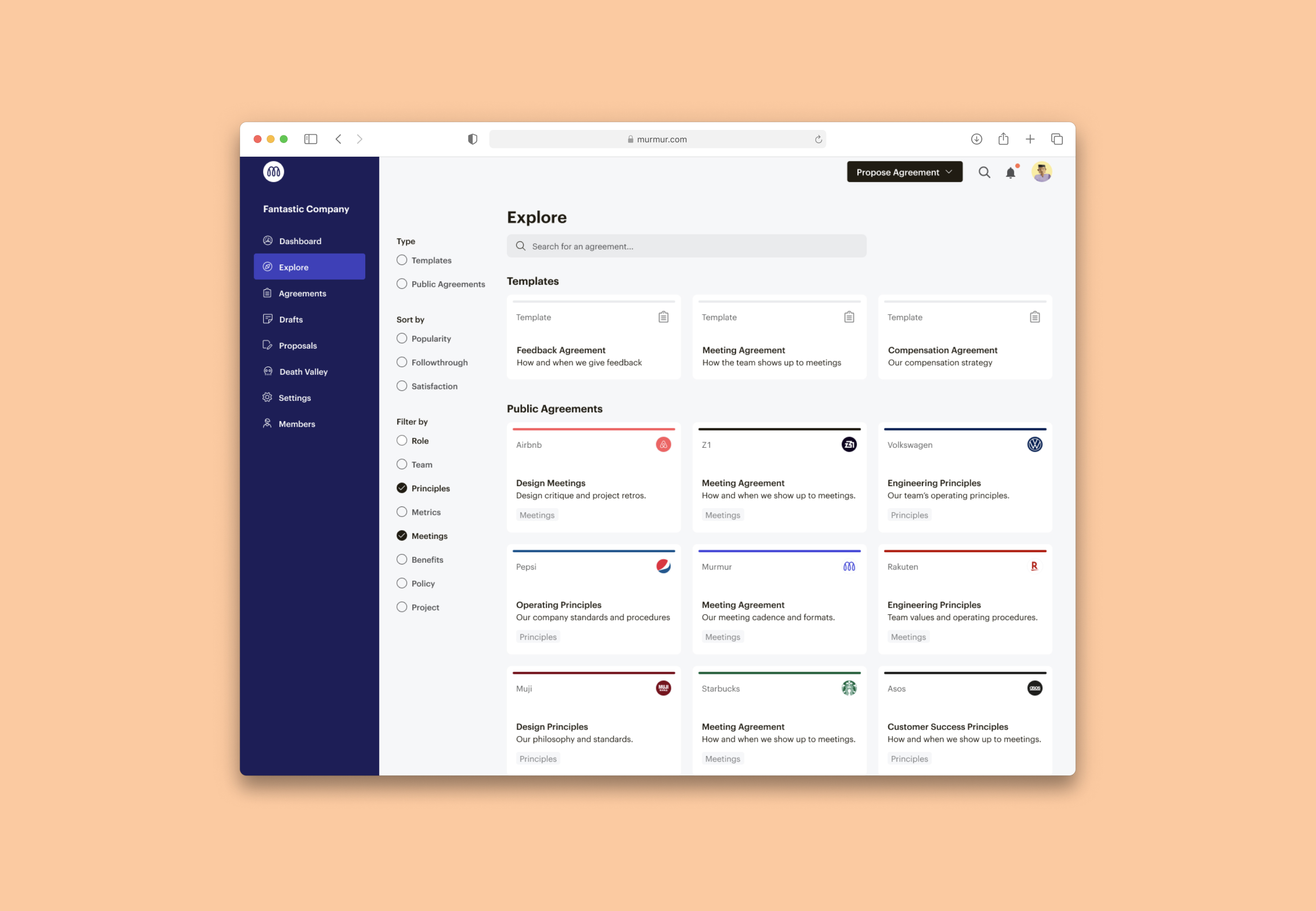
Murmur, still in private beta, wants to help startups make private work agreements public

As building in public continues to gain popularity with early-stage startup founders, Murmur, coming out of stealth today, wants to leverage that natural transparency to a louder frequency.

Founded by Aaron Dignan, Murmur helps startups create work agreements based on the policies of other startups. “Work agreements” is an intentionally broad phrase, but encapsulates everything that a team decides about how work works, from paternal leave strategies to strategic priorities to how hiring works.

“It’s everything you’ve ever argued about [within your startup],” Dignan said.

It requires a healthy level of transparency within the ecosystem, meaning that a startup would have to be open with sharing its policies to the public in the first place. But, if Murmur works, it could help early-stage founders save time on the pain-staking process of figuring out how to build policies from scratch around hiring, OKR goals and vacation policies.

Instead, a new founder could just rely on other, seasoned founders, who have shared their policies for anyone to enjoy, and customize their own plan based around those practices.

Today, Murmur announced that it has raised $1.8 million to scale its working agreements platform in a round led by Lerer Hippeau, with participation from SemperVirens, Human Ventures and Remote First Capital. Other investors include Steve Schlafman, Mariano Suarez-Battan (the CEO of Mural), Brian Sugar (the CEO of PopSugar) and Adam Pisoni (the co-founder of Yammer).

The company, still in private beta, will be launching to the public in early summer 2021.

Murmur is a web-based platform that allows startups to author, customize and plan policies that will shape a team’s culture. The platform helps teams go from proposal to decision with features like voting, edits and feedback throughout the process of creating an agreement. Instead of pushing a copy and paste of another startup’s policy, Murmur prompts founders to use the outsourced policies as seeds, and add customization as they go.

“Anybody can Google and find some company’s years-old processes; the trick is in making an inclusive ‘agreement’ with a real team all participating [and] the magic of keeping it and iterating it, and improving it,” Dignan said.

Image Credits: Murmur

Right now, it is free for anyone to see listed company public agreements. But it costs money to use the Murmur platform to create and customize your own agreements off of this information. With this format, you can see that Dignan thinks that the conversion power of the company lies more in its platform than the content.

Dignan tells me that the team is still testing pricing strategies, but the current plan is a free trial followed by a monthly per-seat fee of $12 to $15 per month, per user. One day, companies could charge a premium for a “kit” of tools on their platform.

Murmur’s initial target for customers are startups that are growing fast and already work in public, such as Buffer, Basecamp, Lattice and Blinkist, but in the future, big enterprises could also see it useful.

Murmur is launching amid a general trend of companies that are pitching themselves as best-practices-as-a-service. Companies in this space aren’t simply enabling other startups to use a fancy SaaS tool, they are not-so-gently pushing them to use those tools in the best possible way for the best possible outcome. Murmur, if it hits scale, could help the next generation of startups figure out the best way to start companies.

Dignan says that the startup “aims to do for working practices what GitHub did for code.”

Remote work is obviously a key catalyst for the company, since the transition has reminded teams that transparency, standards and communication is vital to a functioning organization.

While the startup currently only has Murmur working agreements on the platform, it plans to onboard the agreements of dozens of companies in the coming months. Even though the platform is what makes Murmur special, it’s clear that curating agreements from top companies plays a vital role in Murmur’s success.

It is not paying companies to publicly list their agreements, and the branding benefit of transparency is well worth the confidentiality cost of sharing due to recruitment benefits.

Dignan says connections from his book about the future of work will help land those agreements. Writing a book about a changing world of work before a global pandemic turned everything upside down is ironic, but Dignan, it appears, doesn’t view Murmur as a pandemic pivot.

“I’ve been thinking about this tool for seven years,” he said. But he didn’t think an opinionated tool would have a large enough total addressable market, and that anything that would scale would just reinforce the status quo. He didn’t build Murmur for a while because he thought that the ecosystem didn’t need “yet another customer engagement tool.”

So, he waited. And the pandemic, another peak of the Black Lives Matter movement and the election happened within one year.

“It was all signaling that the complexity is too much,” he said. “We need new ways of working, making decisions and organizing as people. And that felt like this huge moment where we plant the seed and in a few years’ time, the market will be huge.”


20 Email Marketing Services and Tools

email marketing services

For a small business, choosing the right email marketing services and tools can help you reach and connect with your target audience in a personalized way and increase sales at an affordable cost. Often overlooked, email marketing does have a significant impact on the bottom line of your business. Email continues to be the best-performing marketing channel. In fact, email marketing delivers an average Return on Investment (ROI) of 4400% or a $44.25 return for every single $1 spent.

By 2023 the number of daily global email users will jump to 3.473 billion and there will be 4.371 billion email users. Current trends suggest email accounts will grow faster than the number of worldwide email users, underscoring why your business should focus on email marketing campaigns. And the right email marketing services are essential to ensure the success of your business in this area.

Why is choosing the right email marketing software so important?

Email marketing isn’t just about sending promo emails and feelers to people with the hope that you can make conversions. It is also about communicating with customers and using targeted content to deliver your message across different targeted segments.

The benefits of email marketing for small businesses are numerous. Email marketing services can be used to promote businesses and grow revenue. Unlike some other marketing channels, email marketing allows you to frequently keep in touch with your customers. In addition to having the ability to send bulk emails, you can also customize them for different audiences so your emails are always engaging.

With email marketing, you can boost your conversions and build your brand without breaking your budget. No matter your level of experience, you can create professional email marketing campaigns quickly. But in order for your email marketing efforts to succeed, you need to use the right email marketing software. Updating lists and sending emails manually is time consuming. So you will need to choose an email marketing platform that integrates seamlessly with your Customer Relationship Management (CRM) platform. You will be able to manage content and customer data, as well as getting an overview of key analytics that include open rates, click-through rates and overall engagement trends to see which campaigns are performing the best.

What should you look for in a great email marketing software?

In a nutshell, the best email marketing services should deliver the following:

Customizable Templates

Your service should include personalized email marketing. Most providers offer a library of templates for users to choose from, customize, and fill with information about their businesses. You can select one template to use every time, or pick a different one whenever you write a new email if you like to keep things fresh. It is also important for your marketing services provider to allow you to create highly engaging email newsletters with an easy user interface, preferably a drag and drop editor.

List Segmentation

Your email service should provide the ability to segment your subscribers based on your marketing strategy. The email marketing service should give you the ability to segment your list based on the different stages of their buying cycle. Successful marketing is all about connecting customers with the right service and product. You will need to break up your subscriber list into common groupings and suggest products and services that suit their particular needs.

Personalization is key here by crafting the perfect subject lines, copy, and images that resonate with your customer so you can deliver effective personal feeling messages. This will also help lower the chances of your emails violating email SPAM laws.

Customer Service and Support

Should issues arise, a good email service provider should help you implement your marketing strategy at all times. Your email service provider must offer round the clock support whenever glitches take place.

Automation

With email automation, you get the opportunity to respond rapidly to your customers for inquiries, purchases, or even canceling purchases. Autoresponders can help you stay in touch with your customers using automatically generated emails based on key milestones, welcome emails for new subscribers, or thank you emails for recent purchases.

If your customers are making a purchase, they are prime candidates for additional sales. You want to send follow up messages that could include thank you emails with messages such as ‘Customers like you also found these similar items very interesting’. They could also be valuable sources of information to gauge the reasons for abandoned carts and determine why your customers have opted out of a purchase.

Analytics

Analytics are important for any marketing effort. A good email marketing service provider should be able to provide you with analytics to help improve your campaigns. These include measuring open rates, click rates, bounce rates, unsubscribe rates, and spam complaints. All these data points will help you track engagements and see how your campaigns are preforming.

Top Email Marketing Services

So here are some of the most popular email marketing tools on the market. We’ve also included descriptions and some of the main features that set each email marketing service apart.

1. Hubspot

HubSpot is considered among the best email marketing services on the market. It offers end-to-end marketing technology solutions combining marketing automation with email marketing, sales, and CRM under one umbrella. With this email marketing service, you can quickly and easily create, personalize, and optimize your emails without the need for designers or tech support.

HubSpot’s easy-to-use email marketing tool gives you the option of a standalone or a combination of other offerings such as Marketing Hub and its Customer Relations Management (CRM) platform. Also on offer are features like pre-made email templates along with calls-to-action and images, and the ability to modify content in line with your brand using its drag-and-drop editor. Your email campaigns also come with A/B tests and robust analytics. HubSpot offers its email tool free for up to 2,000 email sends per month, with upgrade solutions starting at $45 per month. The robust all-in-one marketing package comes in at $800 per month.

2. Zoho Campaigns

Zoho Campaigns offers email marketing services to help users create responsive designs, customize messages, deliver emails to inboxes, trigger automated workflows, and connect with new customers. The toolkit has all the bells and whistles you need to meet your email marketing tasks.

With Zoho Campaigns you can create responsive emails by using the tool’s drag-and-drop functionality for marketing designs and dynamics fields. The revamped user interface offers a large selection of email templates, including 274 pre-designed templates, and a host of new autoresponders. A seamless integration with the Zoho suite allows for 360 degree email marketing services for small businesses.

Zoho Campaigns comes with dynamic content, email polls, and automated list segmentation to help you send personalized messages to your audiences. With A/B testing campaigns, you can test which design or subject line resonates well with your audience while the list management keeps your list clean and spam-free.

The most popular subscription is $5 per month for up to 500 subscribers. It includes unlimited emails, autoresponders, workflows, dynamic content, batch sending, email polls and more.

3. Mailchimp

Mailchimp is a popular email marketing service that brings all your audience data, marketing channels, and insights together so you can reach your marketing strategy goals faster — all from a single platform.

This easy?to?use email builder provides individual profiles on each subscriber, which shows their activity on your website. Using its pre?designed templates and drag?and?drop builder, you can easily create engaging emails. Real-time analytics helps you keep tabs on your campaigns to quickly identify what’s working and to make smart decisions moving forward.

Mailchimp touts its inbox acceptance rates are 96-99% – well above the industry standard. Mailchimp’s subscription starts at $9.99 per month though a free plan is also available that comes with a marketing CRM, a creative assistant, website builder, forms and landing pages, and up to 2,000 contacts.

4. Constant Contact

With Constant Contact email marketing software, you get tools to build a professional brand online, attract customers, and sell more products. The platform helps you create professional emails, find new customers, and drive sales for your business. The easy to use email automation is a key benefit of Constant Contact as you are able to trigger welcome messages for new subscribers and set up drip campaigns based on their actions.

The website builder gives you a custom-designed website in just minutes along with a free logo maker with hundreds of customizable options in seconds. Constant Contact also offers social media campaign integration that lets you add contacts into a form using various formats (CSV, TXT, XLS, or XLSX), import from Gmail, or pull from Microsoft Outlook and other Customer Relationship Management (CRM) tools.

For your campaigns, you can use a template to get started using the drag-and-drop feature and choosing from a variety of layout options. The editing tool lets you tweak text with access to Google fonts as well as images and colors. With Constant Contact, you can also add a blog post teaser and import PDFs which transform into interactive emails.

Constant Contact offers two kinds of plans according to the size of the customer’s email list. Pricing starts at $20 per month where you get unlimited email sends, customizable templates, branded templates, tracking and reporting, automated email resend to non-openers, subject line A/B testing and more. Like most email marketing platforms, subscription rates will be based on the number of subscribers on your list.

5. SendinBlue

SendinBlue offers both SMS and email marketing solutions for businesses. The intuitive platform gives users the tools to create beautiful and highly engaging marketing emails through its drag and drop email editor making it easy for beginners with no experience in email marketing. The platform helps to boost your marketing efforts by providing an all-in-one solution with marketing automation features, email marketing, SMS marketing, live chat, Facebook Ads, CRM, and transactional messages via email and SMS.

SendinBlue includes beginner-friendly marketing automation tools that allow you to send transactional emails, create workflows for automatic follow-up emails, and segment users. It can also select the best time to send bulk emails using its AI algorithms to ensure the best email deliverability.

It offers a free email marketing plan that lets you send up to 300 emails a day, but all your emails will have SendinBlue’s branding. Meanwhile, paid plans start from $25 per month.

6. Campaign Monitor

Campaign Monitor offers an email marketing solution that enables businesses to send personalized emails, creating a reliable channel to grow engagement with subscribers and promote loyal readership and conversions. It comes with customizable templates which can be tweaked using its drag-and-drop builder. When it comes to your mailing lists, Campaign Monitor seamlessly integrates with Salesforce or WordPress for better impact.

Campaign Monitor includes features like email marketing, automation, and reporting features starting at $9 per month. This includes the ability to send up to 2,500 emails a month, comprehensive email marketing features, an insights analytics suite and more.

7. GetResponse

GetResponse offers businesses email marketing, landing pages, e-commerce, sales funnels and webinars all under one roof. This email marketing platform helps you create mailing lists, send emails, automate emails and view and analyze statistics related to your email campaigns including open rate, click through, forwards, and others.

When it comes to creating emails, the drag-and-drop email creator lets you design and send pixel-perfect emails in a few clicks. The layouts and sections help you build your message, and also preview designs on desktops and mobile devices.

GetResponse’s email marketing software plans start at $15 per month. Since the pricing model is based on the subscriber count, you can send out an unlimited number of emails to your list. This email marketing software also offers unlimited landing pages, unlimited automation templates, one sales funnels, Facebook and Google ads and more.

8. Omnisend

Omnisend’s email marketing platform is tailored for ecommerce sites. It offers small businesses with features such as automated email and SMS messaging in order to convert leads into customers. To dive up sales, it offers pre-built automation for cart abandonment, a welcome series and transactional emails.

With this platform, you can provide your recipients with an omnichannel customer experience combining text messages, web browser push notifications, email marketing, Google Customer Match, Facebook ads, and more. You also have the capability to allow for segmented campaigns to target the right customer for your products or services. The free plan comes with the option for omnisend-branded email campaigns of up to 15,000 emails a month, signup forms, boxes, pop ups and reports.

The starter package begins at $16 per month which offers SMS campaigns and automation, email automation, audience segmentation, reports, and more.

9. MailerLite

MailerLite can help you create newsletters using its customizable templates through its drag and drop tool within minutes. This email marketing service offers tools for automation, landing pages, pop-ups, and surveys. With it, you can also segment your subscribers to enhance personalization, and optimize your campaigns with features like A/B testing.

The free plan comes with a drag and drop feature, rich text editor, built-in photo editing, file manager, mobile-friendly email newsletters, video tutorials, and A/B Testing. However, the free plan limits you to only 1,000 subscribers and 12,000 emails per month. The paid tier starts at $10 per month with unlimited emails and can accommodate up to 1,000 subscribers along with reports and analytics.

10. Sender

Sender is an email marketing tool that lets users create newsletters without any HTML knowledge. By simply choosing from its template library, users can customize their newsletters with elements like images, videos and text within minutes. By connecting Sender with your website, web shop or any other system, all subscriber data will be synchronized automatically. In terms of analytics, it offers reports on open and click tracking, date and time analysis, click map, subscriber profiles, Google Analytics integration and more. In addition, it offers desktop push notifications, transactional and automated email sequences, API integrations, and an easy to use drag and drop subscription form builder.

Sender’s pricing starts at $11.00 per month. The free forever offering allows you to accommodate up to 2,500 subscribers, send up to 15,000 emails per month and access all features, including automation.

11. Campaigner

Campaigner is an email marketing automation platform that comes with an intuitive interface to create emails, tweak email campaigns, view feedback from contacts, and perform across the board email marketing tasks. It also provides users with the ability to integrate their email marketing campaign with social media accounts that include Twitter, Facebook, and LinkedIn. The platform generates real-time reports of your email marketing activities, thus allowing you to improve upon every email campaign you carry out. For customization of emails, you have the option to choose from over 900 templates.

Campaigner offers three plans: Starter, Essential and Advanced. The first tier which is the Starter plan starts at $49.95 per month and includes full code editor, geolocation, A/B testing, analytics, landing pages, suppression lists, segmentation, recurring campaigns and conversion tracking.

12. SendPulse

SendPulse offers a multi-channel marketing platform including email marketing, SMS, Web Push Notification, and Viber and Facebook Chatbot messenger through a single platform email marketing solution. The suite of marketing tools helps you collect customers’ contact information, create responsive templates, and set up automated flows.

In terms of trigger emails with automation 360, you can set up trigger flows using emails, web push notifications, and SMS and send messages based on your customers’ behavior. You also have the option to remind customers about their abandoned cart, invite them to upcoming webinars, or ask them about their experience with your product or service.

The drag and drop editor helps users create responsive emails without any HTML knowledge. You also have more than 130 free templates to customize your emails for any event or promotion. Additional features offered by this email marketing solution provider include segmentation, A/B testing, analytics, SPAM checker and more.

SendPulse pricing starts at $6.40 per month and comes with the option to accommodate up to 500 subscribers, send unlimited emails and take advantage of other professional features. There is also a free plan available.

13. AWeber 

AWeber offers a simple and easy to use email marketing service with a robust set of email marketing features. This includes a landing page builder, newsletters, emails to RSS, and, autoresponders to help grow your number of subscribers.  With AWeber, you get all of the basic features that you expect with an email marketing service that includes over 700 pre-built templates, drag-and-drop email builder, email analytics, A/B testing, sign up forms, automation, third-party integrations and subscriber segmentation.

AWeber also offers phone, email and live chat support and comes with a monthly subscription plan of $16.15 billed annually. With this email marketing tool, you get an unlimited number of subscribers, behavioral automation, cart abandonment and purchase tagging, click-tracking links, unlimited landing pages, AWeber e-commerce services, audience analytics, custom domains and more. You also have the option to try the free version which allows you to engage with 500 subscribers with limited capabilities. AWeber’s email marketing services come with 24/7 support via phone, email and live chat.

14. ConvertKit

ConvertKit is an email marketing service provider and landing page builder that lets you create easy forms and drip campaigns to automatically send mails to new subscribers.

With its email designer, you can easily create many branded email templates. You can also add buttons, images or videos to your email with a simplified interface for a great writing experience. ConvertKit boasts a high delivery rate of 98% and a 30% average open rate. In addition, you get unlimited landing pages and forms, A/B testing, analytics, automated funnels and sequences, and more.

The ConvertKit plan starts from $29 per month to $79 per month for 1,000 subscribers to 5,000 subscribers respectively.

16. ActiveCampaign

ActiveCampaign is an email marketing software that offers reporting and automation tools to help you achieve your email marketing goals. This solution not only allows autoresponders based on numerous conditions, but it also allows automation of your contacts and email list management, as well as automation within its CRM system. It also has features that enable you to text message your subscribers. 

Furthermore, with the conversations feature you can send targeted messages straight to your website visitors, therefore optimizing the overall customer experience. When it comes to offering lead/contact scoring, you can set it up using rules or automation, and it also allows you to assign scores to contacts based on their demographic, or actions they take. This covers page views, open emails, email clicks and more.

ActiveCampaign subscription starts at $9 per month and includes marketing automation, unlimited email sending, subscription forms, segmentation, site and event tracking, 500+ automation recipes and more.

17. Drip

Drip’s email marketing software offers a broader CRM platform that is built with eCommerce in mind. You also get insights into customer’s browsing history, social media interactions, cart abandonment and purchases, and email engagement. You can add your contacts in three standard ways: individually, importing emails in bulk from a file, and copy and pasting.

The visual email editor affords you a generous amount of freedom in template options and design, and it’s easy to add or remove segments, buttons, and images where you want them. Drip’s platform integrates with WordPress, WooCommerce, Facebook Ads, and other tools to help you boost your e-commerce sales. This includes additional tools you’re using to sell online, analyze, collect data, and personalize marketing for customers.

Drip’s paid plans start at $19 per month and offer behavior and event tracking, segmentation, revenue attribution, multichannel automation, detailed email analytics, customizable forms, and more. A 14-day trial is also available which allows you to add 500 people to your account and get access to all of Drip’s core features including sending unlimited emails after the trial period.

18. Mailjet

Mailjet’s email marketing solution allows users to create, send, and track their marketing and transactional emails. Mailjet’s intuitive user interface is available in 5 languages (English, French, German, Spanish, and Italian) and enables marketing teams to create, test, and send compelling emails. Through its drag and drop email builder, you can easily create responsive emails and thanks to its intuitive user interface, you have the option of the five languages.

In terms of ease of use, Mailjet provides a full setup and use guide in one place. This starts with creating a test email campaign and moves on to importing your contacts, designing an email template, managing your contacts, and using more advanced features such as A/B testing and segmentation.

Mailjet also helps you optimize transactional emails including delivery notifications and change in payment details by providing real-time notifications if there are problems with email delivery. Its collaborative email editor gives you the ability for multiple users to make changes in real-time thus making collaboration easy.

Mailjet pricing starts at $9.65 per month. There is a free plan with limited capabilities that includes an email editor, email templates, unlimited contacts, and integration.

19. iContact

iContact offers an email marketing platform that helps small businesses achieve their email marketing goals.

This email marketing platform can help save considerable time as it is easy to use, offers customizable templates, and enables anyone to send out email messages — which is great for first-time email marketers. Users are not required to have any HTML knowledge while automated email campaigns can deploy once a subscriber interacts with a landing page, makes a purchase, clicks a link, or meets any specific criteria that you have established.

The platform offers the full gamut of email marketing services that include drag and drop editing, email list management, autoresponders, SPAMCHECK, reports, social amplify email campaigns, scheduled messages on Facebook, Twitter, and LinkedIn and more. iContact’s paid plans start at $15 per month for 1,500 subscribers. A free trial is also available.

20.Emma

Emma’s email marketing service offers automation features to help you send campaigns and connect with your subscribers for maximum impact. This platform makes it easy to manage your email marketing service across multiple departments or locations, share templates and creative assets, and quickly approve every email before it goes out. It also offers templates that are mobile-responsive, integrate with social networks and connect to Google Analytics to see stats.

Through its list segmentation tool, you can target subscribers bases on zip code, birthday, purchased items, and even if they have opened your last email. Segmented groups are easily searchable, and you have the ability to create an unlimited number of segments when it comes time to send targeted campaigns which comes in handy when you want to test your markets and fine-tune your results.

Emma’s branching logic can help you deliver the most relevant message based on whether or not someone opens a specific email or makes a certain click. The next email in your drip sequence can be matched to the activity of your audience. When integrated with your site, Emma can track recent purchases and send an automated email that ensures your customer gets a timely touchpoint to support the purchase, encourage an upgrade, or schedule a follow-up.

The service starts at $89 per month for up to 10,000 contacts and includes drag and drop email editor, an email template gallery, real-time reporting and analytics, guestbook app, list importing, segmentation tools, lightbox signup forms, A/B content testing and built-in integrations.

What is the best email marketing service?

When trying to determine the best email marketing service around, Hubspot quickly jumps to the top of the list. Here’s why.

Hubspot offers a wide variety of tools giving you great flexibility when creating your email marketing campaign. Hubspot also offers lead management and SEO features as well as tools to boost your email marketing campaigns and community support that extends even to its free services. See details below.

Q: What tools are available with Hubspot email marketing services?

  • Email·
  • Websites
  • Search Engine Optimization
  • Marketing automation
  • Landing pages
  • Analytics
  • Social media
  • Blogging

Q: What can you do with Hubspot’s Email Marketing Solution?

  • Create new emails
  • Edit columns to show metrics like bounce rate, delivery rate, and other important metrics
  • Export your email information
  • Filter by email type or campaign
  • Navigate through sent, scheduled, drafted, or archived messages
  • Search for specific emails
  • View most recently edited, created, and sent emails with a performance summary
  • Create your own HTML emails, or choose from Hubspot’s templates
  • Schedule emails up to one year in advance
  • Create emails that are automatically mobile friendly
  • Take advantage of an unsubscribe feature mandated by CAN-SPAM laws
  • Benefit from a feature allowing those who unsubscribe to be given the option to opt-out of certain email topics or take a temporary break as opposed to a permanent unsubscribe
  • Personalize emails to improve your open rates.

Q: Does it help in lead management and SEO?

Hubspot helps you to access each contact’s information and see every interaction you’ve had with them. The data gleaned from subscribers will be used to create targeted campaigns that close more deals. In regards to SEO, you can plan a content strategy around topics that will elevate your authority in search engines, get as-you-type optimization advice as you’re creating content, and measure real SEO ROI with integrated analytics.

Q: What tools does HubSpot offer to boost my email marketing services?

With HubSpot you get free CRM, marketing, sales, and customer service tools. You get free marketing tools that help you achieve a myriad of objectives. These include: tools to convert website visitors into leads for free, contact management, integration with Facebook, Instagram, Google, and LinkedIn ads, live chat, traffic and conversion analytics.

HubSpot’s free CRM gives you everything you need to organize, track, and nurture your relationships with leads and customers. You can connect HubSpot’s free CRM tools to Gmail, G Suite, and many versions of Outlook. While HubSpot’s free Sales Hub provides your business with time saving tools that help you get deeper insights into your prospects, automate the tasks you hate and close more deals faster.

And what’s more, HubSpot allows you to invite your entire team to collaborate in one place. You can also store as many as one million contacts and companies.

Q: Can I get support from HubSpot for its free services?

HubSpot’s free users have access to the HubSpot Community at community.hubspot.com for support. According to HubSpot, the mission of this inbound community is to provide users with a vibrant channel to ask questions, find answers, and engage with professionals from around the world about HubSpot software best practices.

What are the best free email marketing tools?

Here are some of the best email marketing software tools that come with free plans.

Mailchimp

Mailchimp receives good ratings for its reliability, scalability and secure delivery service for transactional emails from websites and applications. And for those who use WordPress to power their business website, MailChimp is one of the best available. Particularly for a cost conscious small business, since it’s free.

MailChimp provides a wide range of professional quality email templates with customizable fields and features, so you can create campaigns that match your company’s branding. There are easy sharing tools for social channels, and the platform integrates seamlessly with WordPress, as well as other popular services. In addition, MailChimp offers full-featured tracking and analytics for smart campaign management making it a solid email marketing service provider.

AWeber

AWeber has gained popularity among users because it focuses on auto response emails. The platform makes it easy to create forms prospects can fill out. The service then auto responds with whatever message you set up. It offers a robust set of tools including email service, newsletters, emails to RSS, and, of course, autoresponders.

SendinBlue

Sendinblue is another WordPress compatible email marketing platform ideal for small businesses that run both email and mobile campaigns. This all-in-one email marketing service helps you manage email marketing, transactional emails, text messaging and more. It includes detailed, real-time analytics and tools for campaign creation, contact management, and trigger marketing. Integrating SendinBlue with WordPress is as simple as installing the WordPress plugin.

Constant Contact

With Constant Contact, automated triggers come easy. Inside its interface, users can easily trigger a single email or an entire series of messages based on user actions. The platform also has a strong toolbox of email marketing tools from HTML newsletter templates to personal coaching on how to get your email campaigns done right. Event management has also been added so you can handle online registration and online survey tools to gather info from customers and prospects.

ManyContacts

Simple, unique and free to use, ManyContacts is a free drop down email collection bar that runs across the top of your website. The drop down animation grabs attention, and the bar can be fully customized by color, form field and text, giving you the ability to add subscribe offers.

ManyContacts also includes enriched data collection that can be accessed through a Contacts Manager dashboard, showing your subscribers’ location, IP, social profiles and more

Sender

Sender offers free email marketing tools with features to ensure deliverability. It lets you create stunning newsletters without any HTML knowledge. Just choose from a template and customize it with elements like images, videos and text. You can even personalize your newsletters for each recipient to create an even bigger impact.

Emma

Emma is a Web-based service that combines do-it-yourself with free personal assistance when you need it. Custom email design comes at an additional charge. Emma has strong tracking and analytics components that allow you to learn what works — or doesn’t — with your audience.

Image: Depositphotos

This article, "20 Email Marketing Services and Tools" was first published on Small Business Trends


Why your organization needs product principles

At Slack, every one of our processes and features has been designed with the primary goal of making Slack a workplace tool that feels human. We see ourselves as our users’ hosts, and we want them to feel comfortable and happy every time they’re in Slack. Our product isn’t just built for work — it’s built for people doing work, and everything we create is meant to forward our mission of making work life simpler, more pleasant and more productive.

Our job is to understand what people want, and then translate that value through thoughtfully designed, well-functioning products and features.

Against the backdrop of an unprecedented shift to remote work, we’ve seen an influx of people turning to Slack to make the transition to a digital-first workplace. Building thoughtful, intuitive products that add value, delight and human-centric experiences into peoples’ working lives has never been more important.

Product principles are essential guidelines that help teams evaluate work across functions.

To ensure we’re meeting our customers where they’re at, we created a set of guiding “product principles” that inform everything we build, and which serve as the foundation for our entire product decision-making process.

There’s business value in improving an organization’s processes, and we’ve been able to provide better experiences for our customers by enacting ever-evolving product principles and using them to evaluate our products and features. Any company can benefit from having product principles — it’s all about how you develop and deploy them across your organization.

First, what are product principles?

Product principles are essential guidelines that help teams evaluate work across functions, as well as up and down the decision-making chain, by ensuring all work ladders up to the organization’s ultimate goals. Better alignment, in turn, leads to better and faster product decisions.

Product principles should always evolve to keep up with the changing ways you work and what your customers need. At Slack, we currently have five principles that guide us:

  1. Don’t make me think.
  2. Be a great host.
  3. Prototype the path.
  4. Don’t reinvent the wheel.
  5. Make bigger, bolder bets.

By implementing these principles into all we build across teams — design, legal, marketing and more — they provide a shared framework for decision-making that keeps us aligned and therefore able to make better decisions, faster.

The idea of having principles themselves isn’t a new concept, but the creation process behind building and promoting these principles is often overlooked or underdeveloped.

Start with your product philosophy

Before building the principles themselves, it’s important to first establish your product philosophy, which will inform how your organization will ultimately view and abide by its principles.

At Slack, we embrace an approach we call “getting to the next hill.” While there is a long-term product strategy, we don’t spend a lot of time debating exactly where we’ll be in one or two years from now. Instead, we focus on more immediate, incremental moves to improve our customers’ working lives.

We’ve found that because Slack is used in so many different ways by so many different companies, it’s better to learn from how our customers use our features than from endlessly debating aspirational future ideas.


Hear how to nail your virtual pitch meeting at Early Stage 2021

On a recent episode of Extra Crunch Live, Bain Capital Ventures’ Matt Harris said that if you had asked him a year ago what would happen to venture capital during a pandemic lockdown, he would have replied “it would have fallen off a cliff.” Before the world changed so fundamentally, VCs and founders alike believed they needed to meet in person to build trust before signing paperwork that would financially and emotionally bond them together for years and years.

Today, the landscape is very different. More institutional capital is flowing into startups at much faster rates and a good deal of credit must go to the virtual pitch meeting. Founders can now take 30+ meetings in a single day, but are they making the most of those meetings?

At TechCrunch Early Stage in April, Melissa Bradley will talk us through how to nail your virtual pitch meeting and take questions from the audience.

Bradley is the co-founder of Ureeka, a venture-backed mentorship platform for SMBs that pairs founders with experts and mentors. Bradley is also founder and managing partner of 1863 Ventures, a business development program that accelerates underrepresented entrepreneurs (a group Bradley calls the New Majority) into their hyper-growth phase.

She’s also a professor at Georgetown University’s business school, teaching impact investing, social entrepreneurship, P2P economies and innovation.

In short, Bradley deeply understands what it’s like to sit on both sides of the table, as a VC and a founder, and even more deeply understands what it takes to have a successful virtual meeting from her experience building Ureeka (which is entirely virtual).

Bradley joins an all-star cast of speakers at TC Early Stage, an event that is packed with breakout sessions focused on all the core competencies that a startup needs to be successful. Here’s a preview of some of the sessions going down at TC Early Stage:

  • How to Get An Investor’s Attention (Marlon Nichols, MaC Venture Partners)
  • Four Things to Think About Before Raising a Series A (Bucky Moore, Kleiner Perkins) 
  • How Founders Can Think Like a VC (Lisa Wu, Norwest Venture Partners) 
  • Finance for Founders (Alexa von Tobel, Inspired Capital) 
  • Building and Leading a Sales Team (Ryan Azus, Zoom CRO)
  • Keys to Nailing Product Market Fit (Rahul Vohra, Superhuman)

That’s not all. The TC Early Stage curriculum is being spread across two events, with fundraising and operations represented on April 1 & 2 and fundraising and marketing deep dives on July 8 & 9. Folks who buy a ticket to just one event will get three months of Extra Crunch for free, and folks who buy a dual-event ticket will get six months of Extra Crunch membership for free.

An Extra Crunch membership comes with access to:

And much more! Really, what are you waiting for? Pick up a ticket to TC Early Stage here or use the widget below: