Tuesday, 1 June 2021

Venrock’s Camille Samuels is joining us to judge Startup Battlefield at Disrupt 2021

The team at TechCrunch is preparing for another epic Startup Battlefield competition this year at Disrupt 2021 on September 21-23 and we’re assembling a superstar team of judges that will choose the winner who gets to take home $100K and the Disrupt Cup. We’re thrilled to have Venrock’s Camille Samuels join us as one of our esteemed Battlefield judges at our second virtual Startup Battlefield.

Samuels is a partner at Venrock, building out the team’s investments in the healthcare world, focusing specifically on plays in biotech, medical devices and consumer health. Some recent bets include Unity Biotechnology, Iris Medicine and Biolux. Samuels joined Venrock in 2014 after 12 years at healthcare-centric firm Versant Ventures. Before the start of her 20+ year career in venture, Samuels worked in business development at drug discovery company Tularik and had stints in corporate development at Genzyme and Millennium Predictive Medicine.

When we spoke with Samuels early last year she talked about her interests in technology that could keep people healthier for longer. “In general, the big idea of improving health span is what really interests me. I want us to extend out the years that we can be healthy and happy versus on medication and decrepit,” she told us.

It’s been a big year for Venrock, which recently closed its ninth fund with $450 million; the firm’s latest exits include last year’s IPOs of Cloudflare and 10x Genomics.

Disrupt 2021 runs September 21-23 and will be 100% virtual this year. Get your pass to attend with the rest of the TechCrunch community for less than $100 if you secure your seat before next month.


Molecule.one grows its drug synthesis AI platform with a $4.6M seed round

Polish computational chemistry outfit Molecule.one has raised $4.6M to expand its quest to bring theoretical drug molecules to reality. Its machine learning systems predict the best ways to synthesize potentially valuable molecules, a crucial part of creating new drugs and treatments.

Molecule.one went on stage at Disrupt SF 2019’s Startup Battlefield, where they explained the difficulty faced by the drug discovery industry, basically that they come up with lots of theoretical treatments but can’t actually make the molecules.

The company’s system enters play when you have some exotic new compound you want to make in order to test it in real life, but don’t know how to make it. After all, these molecules are brand new to science — no one has created them before, so why should anyone know? Molecule.one creates a workflow starting with ordinary off-the-shelf chemicals and provides step by step instructions using known methods of how to go from A to B… and to C, D, and so on (it’s rarely simple).

The company leverages machine learning and a large body of knowledge about chemical reactions to create these processes, though as CSO Stanisław Jastrzębski explained, they do it backwards.

“Synthesis planning can be characterized as a game,” he said. “In each move of this game, instead of moving a piece on a board, we break a chemical bond between a pair of atoms. The goal of the game is to break down a target molecule to molecules that can then be bought on the market and used to synthesize the target. We use algorithms similar to the ones used by DeepMind to master Go or chess to find the synthesis pathway.”

Co-founders Piotr Byrski and Paweł Włodarczyk-Pruszyński note that predicting organic reactions is no cakewalk, and that they have dedicated a great deal of resources towards making their system efficient and verifiable. The theoretical pathways they produce seem plausible but still need to be tested, something they do regularly internally so companies see that Molecule.one just selling good ideas but workable ones.

Since their debut at Disrupt, the company has acquired a number of customers with annual contracts, Byrski said, and rolled out lots of features on the platform. Włodarczyk-Pruszyński said that their efficiency has increased as well.

Molecule.one founders Piotr Byrski and Paweł Włodarczyk-Pruszyński in a lab.

Image Credits: Molecule.one

“Our system has matured and we have extended our platform to support planning synthesis for thousands of molecules per hour,” he said. “This feature is incredibly useful when combined with AI systems for drug discovery that generate huge numbers of candidate drug molecules. All these improvements helped us gain trust in the industry and initiate collaborations with relevant parties.”

Certainly the problem becomes one of scaling as your customers start asking about pathways for hundreds of thousands of possible therapeutic molecules rather than a handful. For them, if they are to bear the manufacturing cost, it’s worth the outlay at the start to see if one of the compounds they’re looking at is considerably easier to make than another with a similar effect. Without simulating the entire process that’s difficult to say for sure, so they can just send the list to Molecule.one and get the report back a few days later.

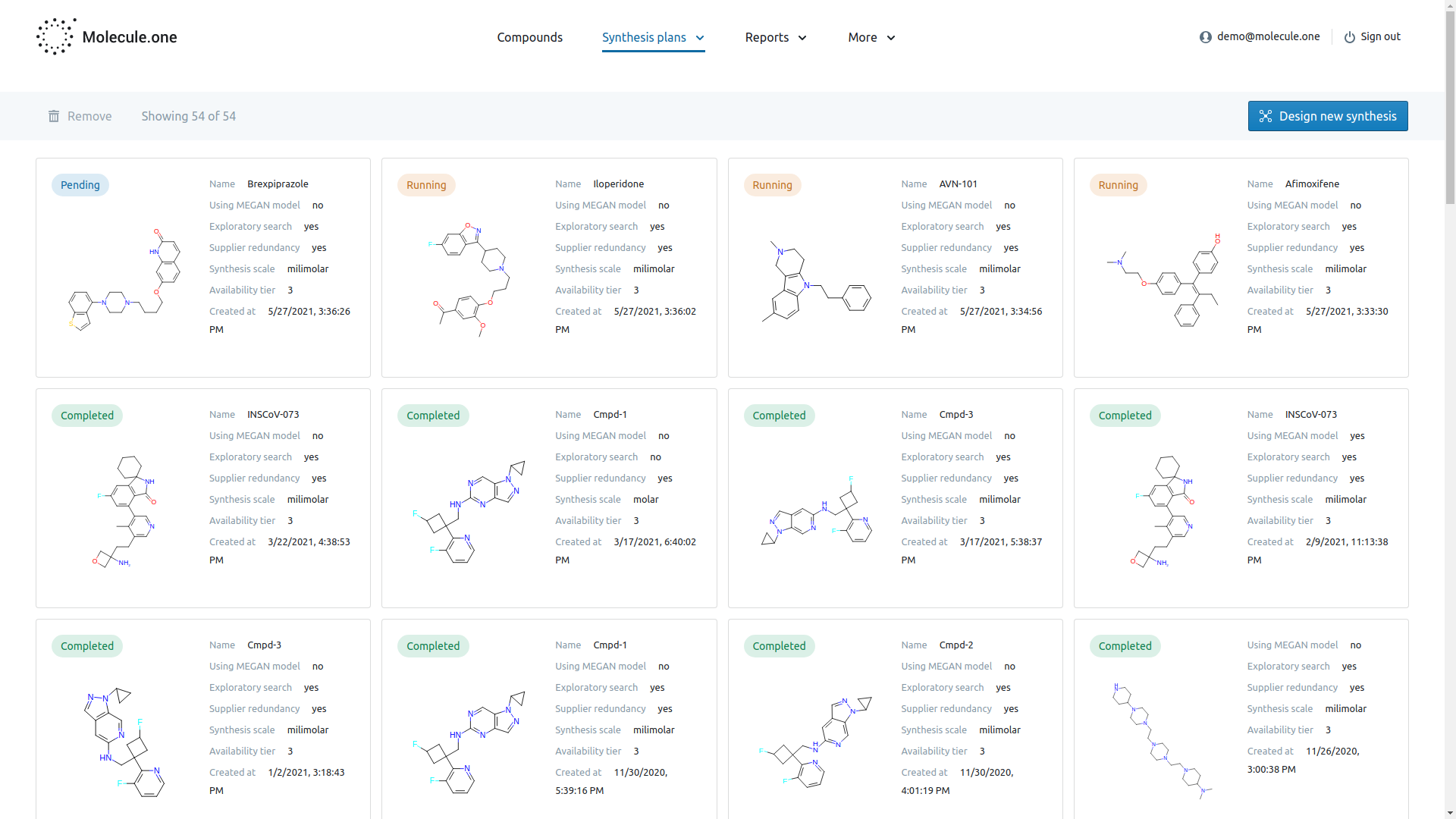
Screenshot of the Molecule.one interface, showing chemical structures.

Image Credits: Molecule.one

The team can’t share any of their customers’ successes (though presumably there have been some) because of course all this work is highly confidential. But they did say that like many companies in biotech they are doing what they can to support COVID-related therapies.

“We made part of our platform free to eligible researchers working on COVID drug discovery. This has resulted in a lasting collaboration with the LambdaZero project at MILA, which is advised by Prof. Yoshua Bengio,” said Byrski.

This also offered the opportunity to test their new scaling methods, since for such a project many candidate molecules must be evaluated, not just for efficacy but the capability of being manufactured easily.

“We are incredibly excited about this area in general because it enables traversing novel regions of the chemical space, which offers enormous promise in terms of looking for drugs that have not yet been synthesized,” Byrski said.

The funding round was led by Atmos Ventures, with a long list of participating investors: AME Cloud Ventures, Cherubic Ventures, Firlej Kastory, Inventures, Luminous Ventures, Sunfish Partners, and individuals including Bayer executive Sebastian Guth.

The company plans to use the money to expand the team and continue expanding generally; it also has a plan to open new offices in the U.S. and Western Europe (they’re based in Poland).


Opting for a debt round can take you from Series A startup to Series B unicorn

Debt is a tool, and like any other — be it a hammer or handsaw — it’s extremely valuable when used skillfully but can cause a lot of pain when mismanaged. Fortunately, this is a story about how it can go right.

At the beginning of 2020, my company, Quantum Metric, was on a tremendous growth curve. We couldn’t have been more excited — and then COVID hit. Suddenly, everything was up in the air. Customer behavior quickly began to reflect the uncertainty we all felt, and my team wasn’t immune to it, either. Like most, we sweated through the first few months of the pandemic.

If companies want to preserve equity, debt can be an advantageous choice.

On the one hand, we felt it might be our time to shine, as digital solutions rose to the surface even in industries that were previously slow to adopt them (think banking and airlines). On the other, companies were trying to lock up as much cash as they could, as fast as they could. What if our customers weren’t able to pay us?

One thing became crystal clear: We needed cash, too. First and foremost, we needed it to protect the company against the income loss we anticipated from customers who were having an especially tough time — namely, those who relied on in-person business as a major revenue source.

Second, we needed cash in order to scale. As the weeks following the initial shelter-in-place orders ticked by, the rush toward digital grew exponentially, and opportunities to secure new customers started piling up. A solution to our money problems, perhaps? Not so fast — it was a classic case of needing to spend in order to make.

Most startups face this dilemma at some point. Some face it continuously. We needed a way to funnel capital into growth and manage to stay cash strong, which was important for another reason: As we headed downstream toward a Series B funding round, we were hesitant to devalue the company (and employee shares) any more than was absolutely necessary.

“There are no solutions, there are only trade-offs,” Thomas Sowell wrote about politics. It’s no different in business. We knew that for Quantum Metric to succeed, we had to give up something in the future in order to get what we needed in the short term. Choosing a debt round as a younger company ran the risk of cash-flow misalignment down the road, but in the same vein, an equity round might have made subsequent funding rounds more challenging.

Whatever we did, we had to do fast, and we had to do it in a chaotic venture capital environment (that may be an understatement). In some meetings, it felt as if VC money had dried up completely. In others, record deals were being made. Startups were bypassing IPOs and going public via SPACs and direct listings. Factoring in the amount of hype that was permeating the market (something I’ve never been a fan of), the “wise” decision felt elusive. As you know from the headline of this piece, though, we chose debt, and it paid off.

The benefits of choosing debt over equity

There ended up being two “layers” of benefits to our debt round. The benefits of the first layer correspond directly with the goals I mentioned above; we got the cash we needed in order to expand — which meant investing in our team, product, marketing and infrastructure — and avoided diluting the company’s value for existing shareholders in the process.


Redacted comes out of stealth with $60M in funding and a new take on fighting cybercrime

The cybersecurity industry has no shortage of technology to fight against network intruders, app corrupters, email hackers and other cyber criminals. Today a startup called Redacted is coming out of stealth with a different approach to tackling that malicious activity: It applies threat intelligence, and then proactively goes after the hackers to recover data loss and disrupt their activities. And along with its public launch, Redacted is announcing $35 million in funding to expand its business.

The Series B is being led by Ten Eleven Ventures, with participation from Valor Equity Partners and SVB Capital. (Ten Eleven is a VC specializing in cybersecurity that has backed a number of other startups.) It brings the total raised by Redacted — which it specifically styles “[redacted]”…with brackets — to $60 million, including a previous funding of $25 million.

It’s always interesting when a startup comes out of nowhere with a substantial round of VC backing, but it’s almost always because that startup has some interesting pedigree — and that is the case here. The company is led by Max Kelly, who was previously the chief security officer at Facebook and before that held roles at the National Security Agency and U.S. Cyber Command. His co-founder, John Hering, was the founder and CEO of cybersecurity firm Lookout. The startup is populated with a bigger team that the startup likes to say has “more than 300 years of combined experience” in cyber defense, with experience at Facebook, Amazon, NASA JPL, Symantec, Cisco, FBI, CIA, NSA, DIA, Army, Air Force, Navy, U.S. Marine Corps, U.S. Cyber Command and the U.K.’s GCHQ.

I’d actually heard about the company before — it works with another cyber startup I’ve covered called Cado, which provides cyber forensics tools to Redacted (among others) — but when I mentioned I’d heard of the company previously, they suggested it was because I’d covered Ocado and its move into the U.S. market, so while Redacted is not particularly forthcoming about its customers, I guess that this grocery giant might be one of them.

The core of what Redacted does comes out of direct experience that Kelly said he had while working at Facebook, where he both built in-house threat response tools but also worked with third-party vendors to secure the social networking giant’s systems, employees and users.

“A big focus of the industry in the last 10 years was preventing the breach,” Kelly said. “But that was always a lie. There is nothing you can do to prevent a breach. The point is not to prevent the breach but the damage from it. Make sure people can’t get data out, and if they do, make sure you can get it back.”

There was also the issue of the size of Facebook itself.

“We couldn’t buy any security tools that worked because of the scale of the company,” he said. “So we thought about it and decided that the best approach would be to ask who is doing this, get them to stop.”

In an environment where cybercrime has taken on the profile of some of the most advanced innovations in technology, with both bad actors and security apps and services leaning on artificial intelligence and automation to do their work, it sounds almost too human an approach. But from how Kelly describes it, it sounds like there is a very human face to cybercrime, and the mere fact of identifying bad actors can get them to retreat.

It’s also a highly technical operation: The startup has also built tools, with some of its own tech and leaning on tech built by others, to find patterns in the work that cybercriminals do and eventually track them to where they are.

“If they’re in a place where they can be touched by law enforcement, that can be used to get them to stop,” he said. “But if not, then it’s just the awareness that they’d been seen and that generally causes them to retreat.”

The mix of what Redacted has built to date, he says, is being aimed at smaller, mid-sized and slightly larger corporates, particularly those that are not capable of building tools like this themselves.

The name, meanwhile, in my opinion says something about the nimble, but also very focused, approach the startup is taking. It comes from a period when the company hadn’t yet come up with a name for itself but was already operating commercially while in stealth mode (which actually is very standard among cybersecurity startups, I’ve found, which don’t really want a lot of attention, for obvious reasons).

“We used it as a placeholder, but I realized, as I talked to people, that they were using the name “Redacted” when referring to us,” Kelly said. He looked up redacted.com and saw it was available. “It was the universe telling me to use the name,” he said with a little smile.

“With the industry’s most advanced pursuit capabilities, Redacted has the power to teach attackers that companies will hold them accountable for attacks,” said Alex Doll, founder and managing general partner at Ten Eleven Ventures, in a statement. “Redacted’s cloud-native security platform also enables them to protect and defend companies that run their operations within a modern cloud architecture. Together, these features enable [redacted] to offer the most holistic and proactive security solution for companies in today’s elevated threat environment.” Doll is joining the board with this round.


“Claiming Space” is an Eye Opener for Women in Business

A-Womans-Guide-to-Claiming-Space.png

If you’re a businesswoman or you know a younger woman heading into the workforce, I highly recommend  Eliza Van Cort’s book, A Woman’s Guide to Claiming Space: Stand Tall. Raise Your Voice. Be Heard.

Claiming Space is a blunt, and honest guidebook for how women can take their place in our society and be proud of themselves.

I received a review copy of this book. And on a recent rainy Saturday, I snuggled into the couch with a blankie, a warm cup of tea, and a dose of “where have you been all of my life” wisdom from Eliza Van Cort.

How a Literal “Whack on the Side of the Head” Transformed Eliza Van Cort

Eliza Van Cort’s life might have come out of a Hollywood studio, except that it hadn’t.  Her schizophrenic mother kidnapped her three times, taking her on a hitchhiking adventure across the country where she ended up in foster care. Her father eventually found her and brought her back to Ithaca, NY where he enlisted women in their community to help — forging Elizia’s belief that women must support each other.

She went on to have a normal, successful life; going to college, being a mom, working as an actor, and starting an actor’s studio.

Then in 2014, she was hit by a car while riding her bike. Both her memory and communication were affected.  Eliza’s best friend Kate encouraged her to write. This helped her recovery both mentally and physically.

I wonder what Eliza Van Cort’s life would have been like had she not been hit by a texting driver, suffered a traumatic brain injury, and ultimately clawed her way to success.

Would she have been an object in motion that stayed in motion and ended up like so many women; competent, credible, and carrying just enough insecurity to achieve moderate success, but not her true potential? Or, was this accident more like the pull of a slingshot that set her back only to be projected so much further than she thought she could go.

You’ll have to read her story to see how your recovery and therapy inspired the content of this book.

Today, she is a speaker, consultant, and writer.  She’s a Fellow at Cornell University, an advisory board member of the Performing Arts for Social Change, and a member of Govern for America’s League of Innovators.

Straight Talk and Practical Advice Because Your Life Depends on It

Let’s get something straight. I’m not an especially emotional person.  I don’t cry at commercials or even at movies (too often.) But there were chapters in this book that took my breath away.

The book is structured like the ripple formed by a stone’s throw:

Part 1: Claiming physical space: This one is all about moving and controlling your body and your voice.

Part 2: Claiming space collaboratively: This section is about cleaning and clearing your head; understanding your worth, getting away from people who make you small, and creating connections.

Part 3 and Part 4: These are power chapters and give examples and advice that will make most women over 40 cringe at the many opportunities for strength and power that you’ve ceded to others.

Part 5: Include parting words of advice on how to use your newfound strength.

Oh Yes You Can — And You Should!

There were too many times I found myself reading and rereading entire sections because I thought I read it wrong.

Here’s an example —

Van Cort talks about high and low behaviors.  High behaviors are those that are designed to “scare the crap out of someone even if your words sound really nice” (yeah, that’s a direct quote)

So wait, it gets better — here’s what she says to DO.  Remember this is advice for women.

  • Take up space with your body. Manspread!
  • When someone is talking, don’t look at them
  • Interrupt without apology
  • Speak in complete sentences
  • Stare at people and don’t blink or look away

I read and re-read this section because I couldn’t believe what she was saying.  My “girl brain” was screaming “that’s rude!” Whether you’re a woman or a man, I know you’re thinking “that’s rude!” And, at the same time, we all know that these are physical power moves whether conscious or unconscious.

Every other page in this book is filled with this kind of eye-opening advice.

Claiming Space is Emotionally Draining and Empowering

Reading this book was a profoundly emotional experience for me. At times, I felt like a lot of lessons came too late for me to apply.  But, in truth, it’s never too late to take on the challenges Van Cort throws down.

While men are NOT the target audience here, I think men who are interested in understanding and helping the women in their lives might find it interesting. Reflecting on my own emotions around some of the content in Claiming Space, I’m insanely curious to hear honest feedback from male readers.

Reading Claiming Space feels like a bucket of cold water. I’d make it required reading for any young woman over 18 and women in any leadership position.

Image: amazon

This article, "“Claiming Space” is an Eye Opener for Women in Business" was first published on Small Business Trends


Sprinklr’s IPO filing shows uneven cash flow but modest growth

Another week, another unicorn IPO. This time, Sprinklr is taking on the public markets.

The New York-based software company works in what it describes as the customer experience market. After attracting over $400 million in capital while private, its impending debut will not only provide key returns to a host of venture capitalists but also more evidence that New York’s startup scene has reached maturity. (More evidence here.)


The Exchange explores startups, markets and money. 

Read it every morning on Extra Crunch or get The Exchange newsletter every Saturday.


Sprinklr last raised a $200 million round at a $2.7 billion valuation in September 2020. That round, as TechCrunch reported, also included a host of secondary shares and $150 million in convertible notes. Inclusive of the latter instrument, Sprinklr’s total capital raised to date soars above the $500 million mark.

Temasek Holdings, Battery Ventures, ICONIQ Capital, Intel Capital and others have plugged funds into Sprinklr during its startup days.

Sure, Robinhood didn’t file last week as many folks hoped, but the Sprinklr IPO ensures that we’ll have more than just SPACs to chat about in the coming days. But one thing at a time. Let’s discuss what Sprinklr does for a living.

Sprinklr’s business

Sprinklr’s IPO filing and corporate website suffer from a slight case of corporate speak, so we have some work to do this morning to determine what the company does. Here’s what the company says about itself in its filing:

Sprinklr empowers the world’s largest and most loved brands to make their customers happier.

We do this with a new category of enterprise software — Unified Customer Experience Management, or Unified-CXM — that enables every customer-facing function across the front office, from Customer Care to Marketing, to collaborate across internal silos, communicate across digital channels, and leverage a complete suite of modern capabilities to deliver better, more human customer experiences at scale — all on one unified, AI-powered platform.

Not very clear, yeah? Don’t worry, I’ve got you. Here’s what the company actually does:


Kudos, with its cotton-based, eco-friendly diaper, soaks up $2.4 million in seed funding

If you’ve experienced parenthood, you’re well versed in the surprisingly small world of disposable diapers. Help may be on the way.

Kudos, a startup that is looking to reinvent the disposable diaper with sustainability in mind, announced the close of a $2.4 million seed round of financing today. Investors include Foundation Capital, XFund, PJC, Precursor Ventures, Liquid 2 Ventures,  SV Angel, Underscore VC, Alpha Bridge Ventures, April Underwood and more.

Cofounder and CEO Amrita Saigal says that Kudos is the first and only disposable baby diaper to earn the cotton natural seal from Cotton Inc. for having 100 percent cotton touching the baby’s skin instead of plastic. They’re also made with four times more plant-based materials than the top disposable diaper out there.

Disposable diapers are made up of many layers. Your average disposable diaper from brands like Huggies, Pampers, etc. employ petrochemicals, fabrics like polyester, and a whole lot of plastic. In fact, despite how soft it feels, most disposable diapers’ top sheet (the part that touches your baby’s skin) are made of plastic.

Kudos uses organic cotton in place of that, and focuses on using green materials, with the absorbent core of the diaper made of wood fluff pulp that is totally chlorine free and harvested through the Forest Stewardship Council.

All that said, Saigal explained that performance is just as important as the composition of the diaper, saying that most parents feel that going to a more eco-friendly product sometimes means trading on performance. She explained how parents often have a much higher standard for products for their babies than they do for their own products.

“When I’m thinking about feminine care products, I might go to an eco-friendly product and it’ll be a pain if it has a little bit less performance but I can handle that for myself,” said Saigal. “But with parents, if their kid gets a rash it affects their life and their sleep. When it comes to diapers, parents aren’t willing to give that same leeway for a sustainable product.”

You might be wondering, as I did, about the defensibility of a product like this. What’s to stop the big players from developing a more sustainable, cotton-based diaper.

According to Saigal, the big brands would need to overhaul their entire manufacturing process to switch from plastic to cotton. Saigal actually left a career at P&G, which is where she met Kudos’ diaper engineering advisor Jim Keighley (her former boss at P&G).

Here’s what he had to say about it, in a prepared statement:

Big brands would need to do a complete overhaul of their bonding equipment, since the pressure technology they and everyone else uses for bonding only works with plastic-based materials. It just won’t work with natural materials. That would take a big investment of time and money, while detracting from their flexibility to run current products, which are market leaders.

Kudos operates on a D2C subscription model, offering a monthly box based on your baby’s changing size and weight, for $78/month. Folks can also purchase a box (with a three to five day supply) a la carte for $14.


Goldman Sachs leads $202M investment in project44, doubling its valuation to $1.2B in a matter of months

The COVID-19 pandemic disrupted a lot in the world, and supply chains are no exception. 

A number of applications that aim to solve workflow challenges across the supply chain exist. But getting real-time access to information from transportation providers has remained somewhat elusive for shippers and logistics companies alike. 

Enter Project44. The 7-year-old Chicago-based company has built an API-based platform that it  says acts as “the connective tissue” between transportation providers, third-party logistics companies, shippers and the systems. Using predictive analytics, the platform provides crucial real-time information such as estimated time of arrivals (ETAs).

“Supply chains have undergone an incredible amount of change – there has never been a greater need for agility, resiliency, and the ability to rapidly respond to changes across the supply chain,” said Jason Duboe, the company’s Chief Growth Officer.

And now, project44 announced it has raised $202 million in a Series E funding round led by Goldman Sachs Asset Management and Emergence Capital. Girteka and Lineage Logistics also participated in the financing, which gives project44 a post-money valuation of $1.2 billion. That doubles the company’s valuation at the time of its Insight Partners-led $100 million Series D in December.

The raise is quite possibly the largest investment in the supply chain visibility space to date.

Project44 is one of those refreshingly transparent private companies that gives insight into its financials. This month, the company says it crossed $50 million in annual recurring revenue (ARR), which is up 100% year over year. It has more than 600 customers including some of the world’s largest brands such as Amazon, Walmart, Nestle, Starbucks, Unilever, Lenovo and P&G. Customers hail from a variety of industries including CPG, retail, e-commerce, manufacturing, pharma, and chemical.

Over the last year, the pandemic created a number of supply chain disruptions, underscoring the importance of technologies that help provide visibility into supply chain operations. Project44 said it worked hard to help customers to mitigate “relentless volatility, bottlenecks, and logistics breakdowns,” including during the Suez Canal incident where a cargo ship got stuck for days.

Looking ahead, Project44 plans to use its new capital in part to continue its global expansion. Project44 recently announced its expansion into China and has plans to grow in the Asia-Pacific, Australia/New Zealand and Latin American markets, according to Duboe.

We are also going to continue to invest heavily in our carrier products to enable more participation and engagement from the transportation community that desires a stronger digital experience to improve efficiency and experience for their customers,” he told TechCrunch. The company also aims to expand its artificial intelligence (AI) and data science capabilities and broaden sales and marketing reach globally.

Last week, project44 announced its acquisition of ClearMetal, a San Francisco-based supply chain planning software company that focuses on international freight visibility, predictive planning and overall customer experience. WIth the buy, Duboe said  project44 will now have two contracts with Amazon: road and ocean. 

“Project44 will power what they are chasing,” he added.

And in March, the company also acquired Ocean Insights to expand its ocean offerings.

Will Chen, a managing director of Goldman Sachs Asset Management, believes that project44 is unique in its scope of network coverage across geographies and modes of transport.  

“Most competitors predominantly focus on over-the-road visibility and primarily serve one region, whereas project44 is a truly global business that provides end-to-end visibility across their customers’ entire supply chain,” he said.

Goldman Sachs Asset Management, noted project44 CEO and founder Jett McCandless, will help the company grow not only by providing capital but through its network and resources.


Equity Tuesday: Everyone is raising money at the same time

Hello and welcome back to Equity, TechCrunch’s venture capital-focused podcast where we unpack the numbers behind the headlines.

This is Equity Monday Tuesday, our weekly kickoff that tracks the latest private market news, talks about the coming week, digs into some recent funding rounds and mulls over a larger theme or narrative from the private markets. You can follow the show on Twitter here and myself here.

We are back from a long weekend here in America. But not break here in the States can stop the flow of global tech news. So, here’s the rundown:

Welcome back, America, to the week. It’s nice to see you, everyone else. Maybe Robinhood will file this week.

Equity drops every Monday at 7:00 a.m. PST, Wednesday, and Friday at 6:00 AM PST, so subscribe to us on Apple PodcastsOvercastSpotify and all the casts!


Americans Plan to Spend $747 on Average to Return to Work

spending-on-work-related-items.png

The US workforce is planning on spending an average $747 on work-related items as they return to the office.

This statistic involving the spending habits of workers as physical workspaces reopen across the US, was unveiled by online lending marketplace, LendingTree.

LendingTree’s Post-Pandemic Spending Survey commissioned Qualtrics to conduct a survey of the spending habit of 2,192 Americans.

Back-to-Work Spending

Remote working employees returning to the office are especially keen to spend money as offices open up. The research found that 83% of employees who have been working from home say they have purchased or plan to purchase something new on their return to onsite work.

New Clothes Tops the Spending Agenda

An average of $747 is planned to be spent on work-related purchases. 59% say they have bought or plan to buy to new clothes. 41% are purchasing shoes, 27% accessories, and 16% plan to buy new office décor or supply.

The survey also found that Americans are planning on eating out, with clothing and dining out topping the top three things they plan to budget for, alongside travel.

The findings of the survey verify how markets and the economy are rebounding following months of stagnation due to the Covid-19 pandemic.

For small retail businesses, knowing what employees are wanting to purchase as they return to the office could help them target the right products to the right markets.

As Rebecca Safier, a personal finance writer who authored the LendingTree report notes: “Shopping plans may vary widely as the pandemic lifts, but there are definitely some popular themes. In particular, Americans expect travel to eat up a large part of their budget.

“Clothing and restaurant means round out the top three, as we’ll see later, the rush to eat out may be a little more restrained then some expect.”

Out of the participants of the survey, 36% say they plan to spend money on travel. 24% plan to spend part of their budget on clothes, 18% on dining out, 8% of events such as concerts, and 3% on bars and breweries.

Gen Zers and Millennials Expect to Borrow Money

The study also looked at the spending plans of different age demographics. It found that for many Americans admit that their spending plans this summer are likely to translate into going into debt.

Generation Zers and Millennials were most likely to expect to be going into debt. In both groups, 61% said they expect to borrow, compared to just 17% of Baby Boomers.

The research provides important insight into the planned spending habits of workers as markets open up. Such insight can be invaluable to small businesses, as they will have greater understanding as to what products to sell and who to market them to.

Image: Depositphotos

This article, "Americans Plan to Spend $747 on Average to Return to Work" was first published on Small Business Trends


Kushki, an Ecuador-based fintech, raises $86M to build financial infrastructure in Latam

Just about every week there’s a blockbuster round coming out of South America, but in certain countries such as Ecuador, things have been more hush hush. However, Kushki, a Quito-based fintech, is bringing attention to the region with today’s announcement of a $86 million Series B and a $600 million valuation.

“We never thought that we would return home [from the U.S.] and build a company that was more valuable in Ecuador than we had built in the U.S.,” said Aron Schwarzkopf, CEO and co-founder of Kushki.

Schwarzkopf and his business partner, Sebastián Castro, had previously built and sold a fintech called Leaf in the U.S. in 2014. The two are originally from Ecuador but moved to Boston for college, where they met watching soccer.

Unlike many other fintechs in Latam that are out to help the unbanked, Kushki works behind the scenes building the tech infrastructure that companies like Nubank use to transfer money. Some of the functionalities they build enable both local and cross-border payment players in credit and debit cards, bank transfers, digital cash, mobile wallets, and other alternative payment methods.

“We realized there was a gigantic opportunity to democratize and create infrastructure to move money,” Schwarzkopf told TechCrunch.

The company, which was founded in 2017, already has operations in Mexico, Colombia, Ecuador, Peru, and Chile. The Series B will be used to accelerate growth and expand to Brazil and nine other markets in Central America.

Generally, expanding to Brazil is an expensive proposition, and therefore not a path that all companies can take, even though it can be an extremely profitable move if done right. Some of the challenges include the need to translate everything into Portuguese followed by the varying financial regulations.

That’s why Kushki’s approach has to be somewhat custom in each country.

“We focus on going into the markets and we basically rebuild an entire infrastructure, so we put everything into one API,” said Schwarzkopf.

Products similar to Kushki have been successful in other regions around the world, such as in India with Pine Labs, Africa with Flutterwave, and Checkout.com that now has 15 international offices.

To build all this infrastructure, Kushki, which means “cash” in a native Andes dialect, has raised a total of $100 million from SoftBank, an undisclosed global growth equity firm, as well as previous investors including DILA Capital, Kaszek Ventures, Clocktower Ventures, and Magma Partners.

“From now until 2060, people will need servers and ways to move money, and we knew that the existing payment infrastructure couldn’t support that,” said Schwarzkopf.


Truebill raises $45 million for its personal finance app

Personal finance startup Truebill has raised a $45 million Series D funding round led by Accel. This comes just a few months after the company raised a $17 million Series C. Overall, the startup has raised $85 million since its creation.

Existing investors Bessemer Venture Partners, Cota Capital and Eldridge Industries are also participating in today’s funding round.

Truebill offers several tools to help people living in the U.S. take control of their finances. One of the app’s key features is that you can track all your subscriptions in one place. Users can also cancel unwanted subscriptions. For cell phone and cable bills, Truebill can negotiate a discount for you.

More recently, the startup has been adding features to turn the app into a financial companion. You can see spending insights, create a healthy monthly budget and track it from the app, view your credit reports and more.

Truebill also lets you put some money aside automatically. The company analyzes your accounts to save some money when you have some money left.

Now, the company is working on a wealth management dashboard that centralizes all your assets and debt. Wealth management is a bit tedious as you need to connect to every single pocket of money otherwise you don’t see the full picture.

“More than 10,000 members sign up for Truebill every day seeking to better understand and improve their finances,” co-founder and CEO Haroon Mokhtarzada said in a statement. "With this new capital, we’re transforming Truebill into an all-in-one, holistic platform that makes it easy for members to not only manage subscriptions and spending but also optimize their savings and make informed decisions to improve their financial health. Truebill is rapidly becoming the most valuable financial membership for everyday consumers.”

As you can see, the startup is growing at a rapid pace. The user base has doubled from 1 million to 2 million users since November 2020. The company analyzes $40 billion in monthly transaction volume.


Belvo, LatAm’s answer to Plaid, raises $43M to scale its API for financial services

Belvo, a Latin American startup which has built an open finance API platform, announced today it has raised $43 million in a Series A round of funding.

A mix of Silicon Valley and Latin American-based VC firms and angels participated in the financing including Future Positive, Kibo Ventures, FJ Labs, Kaszek, MAYA Capital, Venture Friends, Rappi co-founder and president Sebastián Mejía (Rappi), Harsh Sinha, CTO of Wise (formerly Transferwise) and Nubank CEO and founder David Vélez.

Citing Crunchbase data, Belvo believes the round represents the largest series A ever raised by a Latin American fintech. In May 2020, Belvo raised a $10 million seed round co-led by Silicon Valley’s Founders Fund and Argentina’s Kaszek.

Belvo aims to work with leading fintechs in Latin America, spanning across verticals like the neobanks, credit providers and personal finance products Latin Americans use every day.

The startup’s goal with its developer-first API platform that can be used to access and interpret end-user financial data is to build better, more efficient and more inclusive financial products in Latin America. Developers of popular neobank apps, credit providers and personal finance tools use Belvo’s API to connect bank accounts to their apps to unlock the power of open banking.

As TechCrunch Senior Editor Alex Wilhelm explained in this piece last year, Belvo might be considered similar to U.S.-based Plaid, but more attuned to the Latin American market so it can take in a more diverse set of data to better meet the needs of the various markets it serves. 

So while Belvo’s goals are “similar to the overarching goal[s] of Plaid,” co-founder and co-CEO Pablo Viguera told TechCrunch that Belvo is not merely building a banking API business hoping to connect apps to financial accounts. Instead, Belvo wants to build a finance API, which takes in more information than is normally collected by such systems. Latin America is massively underbanked and unbanked so the more data from more sources, the better.

“In essence, we’re pushing for similar outcomes [as Plaid] in terms of when you think about open banking or open finance,” Viguera said. “We’re working to democratize access to financial data and empower end users to port that data, and share that data with whoever they want.”

The company operates under the premise that just because a significant number of the region’s population is underbanked doesn’t mean that they aren’t still financially active. Belvo’s goal is to link all sorts of accounts together. For example, Viguera told TechCrunch that some gig-economy companies in Latin America are issuing their own cards that allow workers to cash out at small local shops. In time, all those transactions are data that could be linked up using Belvo, casting a far wider net than what we’re used to domestically.

The company’s work to connect banks and non-banks together is key to the company’s goal of allowing “any fintech or any developer to access and interpret user financial data,” according to Viguera.

Viguera and co-CEO Oriol Tintoré founded in May of 2019, and was part of Y Combinator’s Winter 2020 batch. Since launching its platform last year, the company says it has built a customer base of over 60 companies across Mexico, Brazil and Colombia, handling millions of monthly API calls. 

This is important because as Alex noted last year, similar to other players in the API-space, Belvo charges for each API call that its customers use (in this sense, it has a model similar to Twilio’s). 

Image Credits: Co-founders and co-CEOs Oriol Tintore and Pablo Viguera / Belvo

Also, over the past year, Belvo says it expanded its API coverage to over 40 financial institutions, which gives companies the ability to connect to over 90% of personal and business bank accounts in LatAm, as well as to tax authorities (such as the SAT in Mexico) and gig economy platforms.

“Essentially we take unstructured financial data , which an individual might have outside of a bank such as integrations we have with gig economy platforms such as Uber and Rappi. We can take a driver’s information from their Uber app, which is kind of built like a bank app and turn it into meaningful bank-like info which third parties can leverage to make assessments as if it’s data coming from a bank,” Viguera explained.

The startup plans to use its new capital to scale its product offering, continue expanding its geographic footprint and double its current headcount of 70. Specifically, Belvo plans to hire more than 50 engineers in Mexico and Brazil by year’s end. It currently has offices in Mexico City, São Paulo, and Barcelona. The company also aims to  launch its bank-to-bank payment initiation offering in Mexico and Brazil.

Belvo currently operates in Mexico, Colombia and Brazil. 

But it’s seeing “a lot of opportunity” in other markets in Latin America, especially in Chile, Peru and Argentina, Viguera told TechCrunch. “In due course, we will look to pursue expansion there.” 

Fred Blackford, founding partner of Future Positive, believes Belvo represents a “truly transformational opportunity for the region’s financial sector.”

Nicolás Szekasy, co-founder and managing partner of Kaszek, noted that demand for financial services in Latin America is growing at an exponential rate .

“Belvo is developing the infrastructure that will enable both the larger institutions and the emerging generation of younger players to successfully deploy their solutions,” he said. “ Oriol, Pablo, and the Belvo team have been leading the development of a sophisticated platform that resolves very complex technical challenges, and the company’s exponential growth reflects how it is delivering a product that fits perfectly with the requirements of the market.” 


Brazil’s idwall raises $38M for identity validation platform

Online fraud and identity theft is a global problem that has only been exacerbated with increased online transactions amid the COVID-19 pandemic. In particular, it is estimated that Brazilian companies lose over $41 billion due to fraud every year.

In an attempt to tackle this problem head on, Lincoln Ando and Raphael Melo started idwall in mid-2016. São Paulo-based idwall started as an automated background check solution and has since grown into a suite of data and identity validation and risk analysis products. For the consumer market, its “MeuID” app is aimed at users who want to change the way they identify themselves and share their data.

And now the Brazilian regtech has raised $38 million in a Series C round led by Endurance.

GGV Capital, monashees, Canary, Qualcomm Ventures, ONEVC, Peninsula and Norte also participated in the funding, bringing its total raised to nearly $50 million.

The company says it has grown 1,458% between 2017 and 2020, with average growth of 144% per year. Its more than 300 clients include 10 unicorns, two out of the three biggest banks in Brazil and companies such as iFood, Claro, Cielo, Loggi, Ebanx, QuintoAndar and OLX, among others.

Fintechs make up a significant portion of its client base, and in 2020, the company saw its revenue from clients in the financial industry alone climb by 588% compared to 2019.

Idwall uses machine learning and AI to automate the onboarding process via its face match, background check, risk analysis, ID validation and automated optical character recognition (OCR) offerings to help companies avoid fraud.

The company said its APIs verify personal documents and information by searching in public and private databases “quickly and pursuant to the compliance rules.” Idwall does all this by first validating that an ID is authentic. Then it works to ensure the person using it is actually the owner of the ID. And lastly, it runs a full background check. It claims it does all this in less than three minutes.

“We help them do all these onboarding processes in a safer, better and faster way,” said idwall co-founder and CEO Ando.

Over the years, idwall has generated more than 65 million data reports for its clients, a number that it says surged by 5,000 times between 2017 and 2020.Those reports, it claims, have helped its clients scale their operations, register more of their own clients and optimize compliance and KYC processes, as well as reduce fraud.

Image Credits: idwall

In general, the pandemic’s drive to digital led to a massive increase in the number of digital bank accounts, mobile payment services and also of companies adjusting to digital platforms and/or expanding their digital operations — leading to a boom in business for idwall.

“The more digitized companies become, the more client expectations grow — and market competition grows stronger,” Ando said. “Our mission is to always stay ahead of innovation in our market, and that’s why we invest so much in growth and in building the best possible team to develop our products.”

Part of that includes using its new capital to recruit more developers, strengthen its existing products and release new ones. Idwall plans to increase its headcount from its current 200 to about 300 over the next few months. The company is also examining the possibility of expanding outside of Brazil to all of Latin America. 

“Many of the identity validation and fraud problems faced in Brazil are seen in other Latin American countries as well,” Ando said. “Besides, places like Mexico and Colombia also have highly innovative companies pushing the envelope when it comes to identity and technology. We still have a lot to achieve in Brazil, but we see a big opportunity for us to take our mission even further.”

Still, in its home country, recent regulatory changes in Brazil in recent years have also led to an increase in demand for idwall’s offerings.

In addition, Brazil’s documentation databases are highly siloed, the company says, with each state having its own model for the most common identity document, the RG (“Registro Geral” or “General Registry”). Plus, each citizen can be issued a different RG document in each state.

“It’s undeniable how much digital onboarding and automated identity validation processes are fundamental for the Latin American market to reach as far as it has the potential to,” Ando said. “It’s extremely difficult to understand and validate identification and personal data in Brazil.”

Also, in general, the company has observed how weary Brazilians are of having to show their IDs for routine events. Idwall helps with that via its aforementioned “MeuID” solution, which stores in a single wallet all the documents necessary for the onboarding processes of fintechs, startups, office buildings and other businesses.

Its investors are, naturally, bullish.

Hans Tung, GGV Capital’s managing partner, describes idwall as a “one-of-a-kind” startup. 

“idwall is leading the discussions and innovations in Brazil regarding digital onboarding and identity validation,” he said. “And their B2C digital identity app MeuID could be the first true super-app in Latin America.”

GGV aims to invest in category leaders that are using technology to create positive impact for its users and for society, Tung added.

“The idwall founders are tackling a huge yet underserved problem in Brazil, and have led the company through terrific growth,” he said. “They have the ingredients to become the leading personal data platform in LatAm for the enterprise.”

Marcos Toledo, managing partner at Canary, notes that idwall was one of his firm’s first investments.

“Lincoln and Raphael’s abilities to build and scale a business solving a very relevant problem in Brazil have caught our attention,” he told TechCrunch. “Their culture, tech level and agility as a company also are very remarkable in the Brazilian market.”



The Average Small Business Loan in 2020 was $71,072

average-small-business-loan-in-2020.png

The average small business loan amount for small businesses in the United States in 2020 was $71,072. This compared to fixed-rate loans, which had an average balance of $66,917 in the same year.

These figures were uncovered by research by small business resource and research provider, AdvisorSmith.

Average Small Business Loan Amount in 2020

The study was designed to discover the average loan amount for small businesses in the US. It involved AdvisorSmith examining recent data by the Federal Reserve’s Small Business Loan Survey. 105 lenders were surveyed.

The average loan amount for loans guaranteed by the Small Business Administration’s (SBA) 7 (a) loan program in 2020 was $567,599. While fixed-rate loans were an average $66,917, variable-rate loans had an average balance of $150,647.

Traditional Banks Failing to Help Small Businesses

The study is interesting as it underscores the reliance among small businesses on alternative loan sources. With the Paycheck Protection Program (PPP) running out, small businesses are having to turn to alternative solutions to secure funding.

As Hitendra Chaturvedi, Professor of Practice, Supply Chain Management at Arizona State University, said in relation to the major trends occurring in the small business lending market: “The biggest trend happening in small business lending is the arrival of technology and data-driven business models, or fintech companies and COVID-19 is accelerating this. The sector that was hit the hardest was the small business, and the traditional banks failed to help them (one just needs to look at the troubled PPP rollout), as they are too big to be nimble and fintech stepped in to capitalize on this opportunity.

New Options for Small Business Loans

AdvisorSmith’s research confirms the growing popularity to source small business loans from alternative lenders. Such lenders typically operate online and offer loans with more flexible terms and, in some cases, quicker underwriting compared to traditional lenders.

The research lists the leading alternative lenders, and the range of loan amounts they typically lend.

Topping the list is Bluevine, which provides loans between $5,000 and $250,000. Credibly is another leading alternative lender, which lends small business loans of between $5,000 and $400,000. For small businesses looking for lower loan amount, Lendio is a leading provider, offering small business loans starting at $1,000 and going up to $500,000.

Traditionally, alternative lenders have been associated with charging higher interest rates. Though as AdvisorSmith notes, the space has become more competitive and, as a result, interest rates and fees have come down.

Alternative Underwriting Sources

These lenders often use alternative underwriting sources in loan applications, such as a business’s credit card sales and its accounts receivable. As such, small business loans from alternative lenders are popular among small businesses that may not quality for traditional bank lending.

The research validates how the small business lending and borrowing landscape is changing in the United States. As traditional means such as PPP and bank loans become increasingly difficult to secure, small businesses are turning to alternative methods that are driven by technology and are inherently more flexible.

With an abundance of alternative, flexible and data-driven loans available, it is important small businesses looking to secure funding carry out sufficient research to help identify the most suitable loan for their unique requirements.

Image: Depositphotos

This article, "The Average Small Business Loan in 2020 was $71,072" was first published on Small Business Trends


Singapore-based D2C dental brand Zenyum raises $40M Series B from L Catterton, Sequoia India and other investors

Zenyum, a startup that wants to make cosmetic dentistry more affordable, announced today it has raised a $40 million Series B. This includes $25 million from L Catterton, a private equity firm focused on consumer brands. The round’s other participants were Sequoia Capital India (Zenyum is an alum of its Surge accelerator program), RTP Global, Partech, TNB Aura, Seeds Capital and FEBE Ventures. L Catteron Asia’s head of growth investments, Anjana Sasidharan, will join Zenyum’s board.

This brings Zenyum’s total raised so far to $56 million, including a $13.6 million Series A announced in November 2019. In a press statement, Sasidharan said, “Zenyum’s differentiated business model gives it a strong competitive advantage, and we are excited to partner with the founder management team to help them realize their growth ambitions.” Other dental-related investments in L Catteron’s portfolio include Ideal Image, ClearChoice, dentalcorp, OdontoCompany, Espaçolaser and 98point6.

Founded in 2018, the company’s products now include ZenyumSonic electric toothbrushes; Zenyum Clear, or transparent 3D-printed aligners; and ZenyumClear Plus for more complex teeth realignment cases.

Founder and chief executive officer Julian Artopé told TechCrunch that ZenyumClear aligners can be up to 70% cheaper than other braces, including traditional metal braces, lingual braces and other clear aligners like Invisalign, depending on the condition of a patients’ teeth and what they want to achieve. Zenyum Clear costs $2,400 SGD (about $1,816 USD), while ZenyumClear Plus ranges from $3,300 to $3,900 SGD (about $2,497 to $2,951 USD).

The company is able to reduce the cost of its invisible braces by combining a network of dental partners with a technology stack that allows providers to monitor patients’ progress while reducing the number of clinic visits they need to make.

First, potential customers send a photo of their teeth to Zenyum to determine if ZenyumClear or ZenyumClear Plus will work for them. If so, they have an in-person consultation with a dentists, including an X-ray and 3D scan. This costs between $120 to $170 SGD, which is paid to the clinic. After their invisible braces are ready, the patient returns to the dentist for a fitting. Then dentists can monitor the progress of their patient’s teeth through Zenyum’s app, only asking them to make another in-person visit if necessary.

ZenyumClear is currently available in Singapore, Malaysia, Indonesia, Hong Kong, Macau, Vietnam, Thailand and Taiwan, with more markets planned.

Sequoia India principal Pieter Kemps told TechCrunch, “There are 300M customers in Zenyum’s core markets—Southeast Asia, Hong Kong, Taiwan—who have increased disposable income for beauty. We believe spend on invisible braces will grow significantly from the current penetration, but what it requires is strong execution on a complex product to become the preferred choice for consumers. That is where Zenyum shines: excellent execution, leading to new products, best-in-class NPS, fast growth, and strong economics. This Series B is a testament to that, and of the belief in the large opportunity down the road.”