Tuesday, 5 March 2019

73% of All Small Business Teams Will Have Remote Workers by 2028

The Latest Remote Workforce Trends Show that 73% of All Small Business Teams Will Have Remote Workers by 2028

Traditional fixed places of work, such as the office are detached from the way today’s workforce actually works. This is in part being driven by remote/freelance workers. And according to the third annual “Future Workforce Report” from Upwork, 73% of all teams will have remote workers by 2028.

With close to three in four teams expected to use remote workers, the future of work is being reshaped in front of our very own eyes. The office and the team can literally be almost anywhere in the world.

The change is being driven by millennials and Gen Z in decision making positions. And these young managers are 3X more likely to prioritize future workforce planning compared to older generations.

For small businesses, it means being able to adapt to this new environment when it comes to hiring talent because they will expect a flexible schedule. Whether it is a full-time in-office or remote position, flexibility is key for the workforce of the future.

Stephane Kasriel, CEO of Upwork, addressed this very issue in the emailed press release. Kasriel said this all starts as younger generations get into managerial positions and they reshape the workplace.

He goes on to say, “We know already that the most in-demand professionals place high value on flexibility. For example, the youngest generations are most likely to freelance. And professionals craving flexibility will increasingly have managers who not only understand this priority but will themselves expect it. We see this clear trend towards more flexible, remote work on the hiring side already based on this year’s Future Workforce Report.”

The report looked into the hiring behaviors of more than 1,000 hiring managers in the US. For this year’s report, researchers examined the impact different generations had in shaping the future of work. This included just how much younger generations are shaping the future of work.

Remote Workforce Trends

Today 48% of younger generation managers are at a director-level or higher, and they are already showing their influence on workforce planning. But overall, they only make up 20% of the workforce in these positions. According to Upwork, by 2028 this number will jump to 58%, an increase of 38%.

So, there is no question they will be shaping the future, but how exactly are they going to do it?

In the report, Upwork says it all starts by supporting remote teams, which will become the new norm. For 69% of these young managers allowing their team to work remotely is just par for the course.

When you compare the numbers to baby boomers, young managers are letting their workers spend a significant portion of their time carrying out their jobs remotely at a 74 to 58 percent ratio.

The younger generation is also more likely to use remote workers. They said within the next three years two out of five full-time employees will work remotely.

The Workforce

The change is inevitable, and young managers see a need for this change to take place with the workforce. They want them to be more independent and skillful. Compared to baby boomers, they want them to be responsible for their own reskilling in order to adapt to the rapidly changing work environment. Nine in 10 baby boomers in the report believe the burden of reskilling falls on the employer.

If the right skillsets are not present in the organization, younger managers are 30% more likely to acquire the talent from a freelancer compared to baby boomers. Again, this shows the young generation is more flexible when it comes to getting the job done by acquiring the talent and filling any skill gaps.

Young managers are also using freelancers at a higher rate. The report says their usage of freelancers has increased by two-fold compared to baby boomers in the past several years.  Some of the reasons they gave for hiring freelancers include to increase productivity, access specialized skills, and improve cost.

Once young managers hire freelancers, they are more likely than older generations to keep using them for strategic partnerships across multiple projects instead of one-time, one-off projects.

What does this all mean for small businesses hiring young managers? Matthew Mottola, Future of Work and On-Demand Talent Program Manager at Microsoft, put it best in the press release when he said, “The good news for companies is that if they embrace this agility and flexibility they can drive innovation and change with their organization.”


Image: Depositphotos.com

This article, "73% of All Small Business Teams Will Have Remote Workers by 2028" was first published on Small Business Trends


Quip launches toothbrush for kids

Quip, the dental care startup, is releasing a new product aimed toward kids. Similar to the electric toothbrush it makes for adults, the kids’ brush features a timer that pulsates every 30 seconds and automatically turns off after two minutes.

The main differences between the brush for kids and one for adults is the non-slip grip plastic handle, smaller brush head and new colors. Quip for kids costs $25 for a brush head starter set with a flavored toothpaste subscription ($10 every three months) or $30 with a starter set and brush head subscription ($5 every three months).

“If we’re going to fulfill our mission of improving oral health for every age, it’s better to cast those habits and form those habits at an early age,” Quip CEO Simon Enever told TechCrunch. “And build right habits before you’re nine years old.”

Quip began as a subscription-based electric toothbrush service that replaces toothpaste and brush heads, partly because you’re apparently supposed to change your toothbrush every three months. Since its launch, Quip has steadily evolved its offerings by inviting dentists to join the platform to connect with Quip’s consumer subscribers.

“The features dentists were asking for was the same Quip for kids,” Enever said. “Knowing that the timer and pulses would guide basic habits, the biggest thing dentists wanted was getting kids to want to brush their teeth. That would be the win.”

Last May, Quip raised $10 million and acquired dental insurance startup Afora to live inside Quip Labs, the startup’s venture studio. The idea with Labs is to fuel innovation in oral health products, platforms and services. This brush for kids, however, is Quip’s first new product since launch.

That’s thanks to Quip’s $40 million funding round back in November. At the time, Enever told me Quip had a lot of new products and services launches ahead of it. To date, Quip has raised over $60 million in funding.


What is a Greypreneur and Why is this a Growing Trend?

What is a Greypreneur?

A greypreneur is an older person embarking on an entrepreneur journey late in life.

A new infographic commissioned by Best Masters Program and created by Nowsourcing has revealed 25% of the US workforce will be 55 years of age and older by 2024. It also says 4 in 5 baby boomers expect to keep working rather than retire due to financial need.

Titled, “Re-imagining Your Career Past 50,” the infographic offers a glimpse of things to come in the workforce. It also provides valuable insight into the challenges this demographic will face as more young individuals enter the workplace.

While there are challenges facing this demographic, there are also opportunities for those willing to seize it.

In a blog written on Hackernoon, the CEO of Nowsourcing, Brian Wallace said older people have a distinct advantage when it comes to pursuing their own business. This includes everything from communication skills to sales, industry know how, and even reliable credit to get loans.

Wallace goes on to say they should go out on their own if companies can’t see the benefit they offer an organization. Adding, “Staying ahead of the curve doesn’t necessarily mean learning a whole new skillset — quite the contrary, in fact. For older workers with industry seniority, these years of experience go a long way and though short-sighted employers would rather ignore the benefits of this experience, it’s possible to make it work on your own terms instead.”

What is Driving the Growth of Greypreneurs?

The answer is longer life expectancy. Life expectancy is almost twice what it was just 100 years ago, and living longer means people will have to work more and they will have multiple careers.

The days of retiring at 65 is falling by the wayside because seniors want to continue working, contributing, and being productive.

For those who plan well for later in life, it means they can choose what to do and really go after their passion without the trappings of early career development.

Takeaways from the Infographic

One of the biggest challenges older workers are facing and will continue to face is ageism. According to the report, 60% of workers over 45 have experienced or seen age discrimination in the workplace.

A disturbing example of this trend is forcing older employees to take early retirement. The report says IBM has forced more than 20,000 older employees 40 years or older out of the workforce in order to correct the seniority mix in the organization since 2013.

Workers in the US have also experienced age discrimination as 19% said they were not hired for a position they were qualified for, 12% were passed over for a promotion, and 8% were laid off or fired for unclear reasons.
So what is a person to do? The answer according to Jane Jackson, career management coach and author, “I believe that rather than waiting for an employer to ‘pick you’, you should ‘pick yourself’.”

Picking Yourself Up

The fact of the matter is older Americans are already picking themselves up. Baby boomers make up 49% of self-employed workers, and this number is growing.

This group is starting their own small business, doing freelance work and using technology to optimize their experience.  Older workers are also using their extensive network to connect with other businesses. And as the number of older Americans continues to grow, these networks will deliver more tangible results.

The infographic says 57% of all small business owners are over 50 and they are ready to be their own boss (43%) and pursue their passion (42%).

Benefits of Age

Growing older means more experience, but it also holds other advantages. For many older Americans it means better credit and a nest egg which makes it much easier to get a loan for starting a business.

If you plan carefully and use your experience to start a business later in life, you can take control of your own destiny. You won’t have to worry about age discrimination, get fired for the right “seniority mix”, or any other reason you are not in control of.

Take a look at the rest of the data in the infographic.

What is a Greypreneur?

Image: Best Master Programs

This article, "What is a Greypreneur and Why is this a Growing Trend?" was first published on Small Business Trends


7 Easy Steps to Generate More Social Media Traffic

7 Ways to Increase Social Traffic in 2019

Want more social media buzz for your brand or business?

How to Increase Social Traffic

Here are my seven best tips for getting more social engagement and social traffic in 2019.

1. Install a Facebook Customer Chatbot

You know those customer chat widgets that pop up on the bottom of a website?

You can take them to the next level with a Facebook Messenger website widget.

It functions the same way as a normal website chat, but with an added bonus: Every time a customer chats with you, they have to opt in to Facebook Messenger communications.

That means you can get contact information from them and follow up with them down the road.

Every time someone talks with you via site chat, you’ll automatically gain a new Facebook Messenger contact, and that’s a huge win.

Upgrading your old customer chat to a Facebook Messenger customer chatbot is a unicorn move you should pounce on.

2. Point to Your Social Media Accounts From Your Website

Having social icons that link out to your social media channels is an easy way to broadcast your social media channels to your website visitors.

Ideally, you’ll be able to add them prominently above the fold, so it’s impossible for visitors to miss them!

3. Make Your Content Easy to Share on Social Media

Make it simple for users to share your content on social media.

Add “Share This!” buttons to any blog post, infographic, video, podcast, or any other engaging content you produce.

When you make it easy to share your content on social media, people will be far more likely to share it.

You can install a plug-in that adds share buttons on every page of your website, especially if you’re using a CMS that supports it.

4. Enable Comments

Enabling comments on your content allows users to interact with you directly from your site.

The comments section of popular posts can hold great discussions — just make sure your comment plug-in or widget has a way to automatically filter spam so the comments section doesn’t get overwhelmed with junk.

5. Make Sure Your Content Looks Good When Shared on Social

There’s a next step beyond just buttons that let users share your content.

You have to also make sure the content will look good once a user tries to share it.

Have you ever gone to share something on Facebook, only to find that the thumbnail or title was missing?

Chances are you probably stopped in your tracks and didn’t share it.

That’s why, as a digital marketer, it’s so key that you take the time to make sure when someone attempts to share your content, it looks like it’s supposed to.

Mark up the Open Graph tags with a super-clickable headline and attention-grabbing image that fits the proper dimensions of each network.

6. Add Click-to-Tweets Throughout Your Content

If you’ve never heard of a click-to-tweet, it’s a neat little tool that allows you to handcraft tweets featuring little snippets from a piece of content, like one line or a great quote.

When you insert click-to-tweets in your content, it makes it easy for readers to post a great tweet without even thinking about it — you’ve done the work for them.

The quote, image, headline, and link are already to go for them.

They just have to click and post!

There’s even a click-to-tweet WordPress plug-in that makes it super simple to craft click-to-tweets (though you can do without the plug-in, of course).

7. Have a Social Login

If you really want your website to go full-on social, then incorporate a social login to increase membership and participation in your website.

Give people benefits to joining your website through their social media accounts by letting them be able to comment and join discussions, customize their avatars, tweak their settings, buy from your shop, and so on.

Taking the extra steps to make sure your content is social media friendly, easily shareable, and, of course, worth sharing are unicorn moves for any brand or business. Always keep social traffic in mind!

Image: Depositphotos.com

This article, "7 Easy Steps to Generate More Social Media Traffic" was first published on Small Business Trends


More Atomico promotions sees three new Partners at the European VC firm

Atomico, the European venture capital firm founded by Skype’s Niklas Zennström, sometimes feels like it’s on a perpetual hiring and promotions spree, even if a number of partners have also departed over the years.

Most recently, in November Sophia Bendz, the former Spotify Global Director of Marketing, promoted to Partner. Bendz had already spent two and a half years as an Executive-in-Residence at the London-based VC firm. The same month, Partner Carolina Brochado left to join Softbank’s Vision Fund to help it source more deals in Europe.

Today we can add three more Partner promotions to the list, including Bryce Keane, who for the past two and a half years has been Atomico’s Head of Communications.

Prior to joining Atomico, Australia born Keane (who I promised not to refer to as the Aussie spin doctor — sorry!) founded the PR arm of creative agency Albion and worked with a number of now household names in European tech, such as TransferWise, years before the company was a celebrated fintech unicorn.

He also co-founded 3beards, which among other projects (involving beards, beer and the Unicorn Hunt jobs board), was the custodian of one of London’s most popular tech networking events, leading one BBC journalist to dub Keane “the social secretary for London’s tech community”. With my aversion to both crowds and heaping any resemblance of praise on PRs, I couldn’t possibly comment.

But what I will say, having covered TransferWise from Day One and reporting on Atomico pretty relentlessly over the years, is that Keane is possibly one of the hardest working flacks I know and certainly one of the best briefed, typically making it his business to know the founders and startups he supports at least as well as anyone. Well, almost anyone.

Also being promoted to Partner is Alison Smith, Atomico’s Chief of Staff. She has been with the VC firm for four years and as Partner will continue to lead key projects for Atomico, both internally and externally.

And last but definitely not least is Camilla Richards, who for the past four years has been Head of Investor Relations, overseeing Atomico’s own fundraising and its important relationship with LPs.

In her new role, she’ll continue to manage those relationships, as well as facilitating introductions between founders and LPs where new business opportunities arise or if direct investment makes sense.

“Bryce, Alison and Camilla have the ambition, shared mission and energy we need as we continue to build Atomico. I’m proud to have them as Partners at Atomico and excited to see what they will achieve in the years ahead in their new roles,” writes Atomico’s CEO and Founding Partner Niklas Zennström in a blog post.

Meanwhile, in addition to Atomico’s three new Partners, the European VC firm is making a number of promotions within its investment team. Senior Associate Stephen Thorne becomes a Principal, and Associates Hillary Ball, Will Dufton and Adam Lasri are moved up to Senior Associate. Notably, I’m told Lasri will also be relocating permanently to Paris, becoming Atomico’s first full-time investment member on the ground in the French capital city.


Neutrino employees who once worked for a controversial surveillance tech company will leave Coinbase

Last month, Coinbase’s acquisition of blockchain analytics startup Neutrino was criticized because of the founders’ ties to a controversial surveillance technology company called Hacking Team. Today Coinbase CEO Brian Armstrong said in a blog post that employees of Neutrino who had previously worked at Hacking Team will transition out of Coinbase, instead of joining its team in London as originally planned.

Neutrino maps blockchain networks, focusing on crypto token transactions, and one of its main services is working with law enforcement to track stolen digital assets, investigate ransomware attacks and analyze activity on the “darknet.” Before launching Neutrino, CEO Giancarlo Russo, CTO Alberto Ornaghi and chief research officer Marco Valleri, worked at Hacking Team, a security and surveillance tech company that has been criticized for selling products to governments with a history of human rights violations, including Egypt, Kazakhstan, Russia, Saudi Arabia, Sudan and Turkey. As The Intercept reported in 2015, Hacking Team’s malware has also been found on the computers of activists and journalists.

The close link between Hacking Team and Neutrino concerned many members of the blockchain community. Amber Baldet, CEO of Clovyr and the former lead of JP Morgan’s blockchain program, told Motherboard that “given the number of accounts Coinbase has opened, how they choose to implement compliance tools and their relationship with law enforcement will impact a lot of people.”

In his post, Armstrong said there was “a gap in our diligence process” while Coinbase was shopping for a blockchain analytics startup to acquire.

“While we looked hard at the technology and security of the Neutrino product, we did not properly evaluate everything from the perspective of our mission and values as a crypto company,” he wrote. “We took some time to dig further int this over the pats week, and together with the Neutrino team have come to an agreement: those who previously worked at Hacking Team (despite the fact that they have no current affiliation with Hacking Team), will transition out of Coinbase. This was not an easy decision, but their prior work does present a conflict with our mission. We are thankful to the Neutrino team for engaging with us on this outcome.”

“Coinbase seeks to be the most secure, trusted, and legally compliant bridge to cryptocurrency,” he added. “We sometimes need to make practical tradeoffs to run a modern, regulated exchange, but we did not make the right tradeoff in this specific case. We will fix it and find another way to serve our customers while complying with the law.”

Coinbase achieved an $8 billion valuation last October after raising a $300 million Series E and is focused on broadening its user base from consumers to institutional investors. Neutrino’s eight employees had planned to move to Coinbase’s office in London has part of the acquisition.


Moka raises $27M led by Hillhouse to make hiring more data-driven in China

Moka, a startup that wants to make talent acquisition a little more data-driven for China-based companies that range from smartphone giant Xiaomi to Burger King’s local business, announced Monday that it has raised a 180 million yuan ($27 million) Series B round of funding.

The deal was led by Hillhouse Capital, an investor in top Chinese technology companies such as Tencent, Baidu, JD.com, Pinduoduo — just to name a few. Other investors that took part include Xianghe Capital, an investment firm founded by two former Baidu executives, Chinese private equity firm GSR Ventures and GGV Capital.

Moka claims more than 500 enterprise customers were paying for its services by the end of 2018. Other notable clients are McDonald’s and one of China’s top live-streaming services, YY. It plans to use its new capital to hire staff, build new products and expand the scope of its business.

Founded in 2015, Moka compares itself to Workday and Salesforce in the U.S. It has created a suite of software aiming to make recruiting easier and cheaper for companies with upwards of 500 employees. Its solutions take care of the full cycle of hiring. To start with, Moka allows recruiters to post job listings across multiple platforms with one click, saving them the hassle of hopping between portals. Its AI-enabled screening program then automatically filters candidates and makes recommendations for companies. What comes next is the interview, which Moka helps streamline with automatic email and message reminders for job applicants and optimized plans for interviewers on when and where to meet their candidates.

That’s not the end, as Moka also wants to capture what happens after the talent is on board. The startup helps companies maintain a talent database consisting of existing employees and potential hires. The services allow companies to keep close tabs on their staff, whose resume update will trigger a warning to the employer, and alerts the recruiter once the system detects suitable candidates.

Moka is among a wave of startups founded by Chinese entrepreneurs with foreign education and work experiences. Zhao Oulun, whose English nickname is Orion, graduated from the University of California, Berkeley and worked at San Francisco-based peer-to-peer car-sharing company Turo before founding Moka with Li Guoxing. Li himself is also a “sea turtle,” a colloquial term in Chinese that describes overseas-educated graduates who return home to work. Li graduated from the University of Michigan and Stanford University, and worked at Facebook as an engineer.

When the founders re-entered China, they saw something was missing in the booming domestic business environment: effective talent management.

“Businesses are flourishing, but at the same time many of them fall short in internal organization and operation. To a large extent, the issue pertains to the lack of digital and meticulous operation for human resources, which slows down decision-making and leads to mistakes around talents and company organization,” says chief executive Zhao in a statement.

Moka’s mission has caught the attention of investors. Jixun Foo, a partner at Moka backer GGV Capital, also believes China’s businesses can benefit from a data-driven approach to people management: “We are positive about Moka becoming a comprehensive HR service provider in the future through its unique data-powered and intelligent solutions.”


Monday, 4 March 2019

Failed meal-kit service Munchery owes $6M to gift card holders, vendors

Several weeks after a sudden shutdown left customers and vendors in the lurch, meal-kit service Munchery has filed for bankruptcy. In the Chapter 11 filing, Munchery chief executive officer James Beriker cites increased competition, over-funding, aggressive expansion efforts and Blue Apron’s failed IPO as reasons for its demise.

Munchery owes $3 million in unfulfilled customer gift cards and another $3 million to its vendors, suppliers and various counterparties, the filing reveals. The company’s remaining debt includes $5.3 million in senior secured debt and convertible debt of approximately $23 million. Munchery says its scrounged up $5 million from a buyer of its equipment, machinery and San Francisco headquarters.

The business had raised more than $100 million in venture capital funding, reaching a valuation of $300 million in 2015 before ceasing operations on January 22 and laying off 257 employees in the process. Munchery was backed by Menlo Ventures, Sherpa Capital, e.Ventures, Cota Capital and others.

The company, which failed to notify its vendors it was going out of business, has been scrutinized for failing to pay those vendors in the wake of its shutdown. To make matters worse, emails viewed by TechCrunch show Munchery continued aggressively marketing its gift cards in emails sent to customers in December, weeks before a final email to those very same customers announced it was ceasing operations, effectively immediately.

An email advertising Munchery gift cards sent to a customer weeks before the startup went out of business.

The latest court filings shed light on Beriker’s decision-making process in those final months, touching on Munchery’s frequent pivots, the company’s 2017 layoffs, its plans to scale sales of Munchery products in Amazon Go stores and failed attempts at a sale. Beriker is the sole remaining Munchery board member. He has not responded to several requests for comment from TechCrunch.

In the third quarter of 2018, Munchery, at the recommendation of its board, hired an investment bank to find a buyer for the startup, to no avail. Beriker suggests the lack of a buyer, coupled with industry trends like larger-than-necessary venture capital rounds and inflated valuations, were cause for the startup’s failure to deliver.

“The company expanded too aggressively in its early years,” the filing states. “The access to significant amounts of capital from leading Silicon Valley venture capital firms at high valuations and low-cost debt from banks and venture debt firms, combined with the perception that the on-demand food delivery market was expanding quickly and would be dominated by one or two brands– as Uber had dominated the ridesharing market– drove the company to aggressively invest in its business ahead of having a well-established and scalable business model.”

Increased competition from well-funded competitors drove the startup off course, too, and the epic failure that was Blue Apron’s IPO, which had a “material negative impact on access to financing for startups in the online food delivery business,” was just the cherry on top, according to Beriker’s statements.

Munchery’s vendors, who were not notified or paid following Munchery’s announcement, have provided outspoken criticism to the company and venture capital’s lack of accountability in the weeks following Munchery’s shutdown. Lenore Estrada of Three Babes Bakeshop, among several vendors owed thousands of dollars in unpaid invoices, orchestrated a protest outside of Munchery investor Sherpa Capital’s offices in January. She said she has spoken with Beriker and founding Munchery CEO Conrad Chu in an attempt to pick up the pieces of the failed startup puzzle.

“None of us who are owed money are going to get anything,” Estrada told TechCrunch earlier today. “But the CEO, after fucking it all up, is still getting paid.”

Beriker, indeed, is still earning a salary of $18,750 per month, one-half of his pre-bankruptcy salary, as well as a “success fee based on the net proceeds recovered from the sale of the company’s assets up to a maximum of $250,000,” the filing states.

View the full bankruptcy filing here:


Glossier launches its first spin-off brand, a line of Instagram-friendly ‘dialed-up’ beauty extras

Glossier, known for its line of understated makeup products and a cult-following of millennial Instagrammers, is getting colorful with the launch of its first spin-off brand, Glossier Play.

The company — led by founder and chief executive officer Emily Weiss, who built the nearly $400 million business from a makeup blog called Into The Gloss — has raised a total of $92 million in venture capital funding from top-tier consumer investors Forerunner Ventures, Index Ventures and IVP. Stitch Fix founder Katrina Lake and Forerunner founder and general partner Kirsten Green, are among the company’s board members.

Weiss introduced Glossier in 2014 as a clean-skincare and natural beauty advocate. Today, the direct-to-consumer business boasts a growing line of barely there makeup, designed to mimic Weiss’s own subtle, au naturale vibe. The launch of Glossier Play, inspired by 1970s’ nostalgia, is its first foray into bright colors, glitter and, in the brand’s own words, “dialed-up extras.”

“We wanted to explore color the Glossier way,” a spokesperson for the company said. “This meant developing high-quality products without the moody, expert-centric rhetoric of most luxury brands. Glossier Play is all about fun and creative expression. These products were two years in the making, and just like Glossier’s modern essentials, they are designed to stand the test of time (not trend-driven or fast fashion).”

Glossier Play’s initial line-up of “extras” includes colored eyeliners ($15), highlighters ($20), multi-purpose glitter gel ($14) and the “Vinylic Lip” ($16). Customers can purchase “The Playground,” a set that includes each of the new products, for $60.

The advertising campaign for the Instagram-friendly line will be led by none other than Instagram star Donté Colley, as well as pop musician Troye Sivan. The new line and future spin-offs will help Glossier compete with beauty incumbents, Estée Lauder and L’Oréal, for example, in a market estimated to be worth $750 billion by 2024.

Glossier, headquartered in New York, counts 200 employees, meager in comparison to its nearly 2 million — and growing — social media following. The company surpassed $100 million in annual revenue in 2018, it tells TechCrunch, and acquired 1 million new customers. In total, Glossier retails 29 products across skincare, makeup, body, and fragrance.

The company won’t be introducing additional brands this year and clarified it is not a brand incubator.


Jupiter raises $23 million to tell businesses and governments how climate change will destroy them

Whether it’s by flood, fire or the fury of a storm, climate-related catastrophes are now impacting most cities and towns across the country. As these natural disasters increase in frequency and severity, cities and the businesses that reside in them are mobilizing to understand how best to prepare for the climatological challenges they’re going to face — and increasingly they’re turning to companies like Jupiter Intelligence for information.

From offices in San Mateo, Calif., Boulder, Colo. and New York, Jupiter Intelligence has made a business selling data from satellite imagery and advanced computer models to cities like New York and Miami, along with the federal government and big insurance and real estate customers.

With its new financing, Jupiter plans to take its show on the global road, and is bringing its services to clients in Rotterdam, London and Singapore.

It’s a story that has its roots in more than two decades of work from founders Rich Sorkin, Eric Wun, Josh Hacker and Alan Blumberg.

Wun and Sorkin met in 1996 in the early days of the development of mapping and weather prediction technologies. They got their start in the business co-founding Zeus, a weather prediction technology developer that was pitching its services to commodities traders.

“Zeus was way too early from a technology platform perspective,” says Hacker. “We put Zeus on the shelf eight years ago. Then when we came up with the idea for Jupiter most of the early ideas were already there.”

In the interim, Hacker served as the president of Kaggle, a company Google acquired in 2017. By that point, Hacker had already left to launch Jupiter, which he started in 2016.

While Zeus predicted the 30-day weather for commodities traders, Jupiter is a more powerful toolkit that predicts the possibility of damage from severe weather and climate change for a much broader set of customers, Hacker says.

Wun and Sorkin were on board immediately, and the next person to join the fledgling team was Hacker — who had run satellite operations for Skybox — another Google acquisition. Following the merger of Skybox with Planet Labs, Hacker took a job at the National Oceanic and Atmospheric Administration within the Department of Commerce (one of the pre-eminent organizations focused on climate change).

The final recruit was Blumberg, who was approached because of his role in developing the Princeton Ocean Model, which is used by more than 5,700 research and operational groups in 70 countries, and his leadership position in developing two-hour and four-day flood predictions for Port Authority of New York and New Jersey.

Storm surge from Hurricane Sandy in New York City

After its launch, the company was able to land three big insurance companies (QBE, Mistui and Nephila), which all agreed to throw cash into the company’s new $35 million round.

Jupiter’s predictive and analytics technologies have applications far beyond insurance. Airports, ports, power plants, water facilities, hospitals, municipalities and even the federal government are turning to the company for information, according to Sorkin.

Jupiter raised $1 million in its seed round from DCVC (Data Collective), then closed on $10 million more from Ignition Partners. The latest $23 million was led by Energize Ventures, a fund focused on infrastructure and climate-related investments.

SYSTEMIQ, which was co-founded by McKinsey veteran Jeremy Oppenheim, also invested in Jupiter’s Series B. The architect of McKinsey’s Sustainability and Resource Practice said in a statement, “For a decade the planet has needed the kind of repeatable, globally consistent, insurance grade analytics Jupiter now delivers.”

Photo courtesy of Shutterstock

The toolkit the company pitches purports to offer new levels of granularity and insight into the kinds of threats climate and weather-related disasters pose to government and private assets.

“We predict probabilistically at the asset level… at the loading dock of a warehouse or a transmission box or a hotel on the beach, we determine the actual expected risk in a form that the insurance industry or the risk manager at an organization can use and integrate into their plans,” says Sorkin. 

The company’s process begins with global climate models and then drills down into a specific region, which is used as the basis of predicting peril-like events, according to Sorkin.

That goes into a statistical model that translates the predictions into a form that quantifies the uncertainty and in a way that’s tailored to decision makers, he said.

Using APIs from Mapbox, the company can also provide a mapping interface that gives customers visualizations along with a product that lets users see what damage can look like inside of a building through virtual reality and a collaboration with Oculus.

“The strategy was to start with one peril in one place in one market, so we started with flooding in Carolinas for the real estate,” says Sorkin. “We have expanded into much broader perils and geographies and market segments.”

For all of the time that Sorkin spends modeling out how cities will meet their doom in one form of cataclysm or another, Jupiter’s chief executive is fairly positive about the prospects for society to withstand the climate threat it currently faces.

“Even with all the bad things that could happen, we don’t think the apocalypse is inevitable,” Sorkin says. “The extent of damage is a function of how much people invest in avoiding it over the next decade.”


Shift Technology raises $60 million to detect insurance fraud

Paris-based Shift Technology has raised another $60 million funding round. Bessemer Venture Partners is leading the round and existing investors Accel, General Catalyst, Iris Capital and Elaia Partners are also participating.

Shift Technology is all about detecting fraudulent insurance claims. There are 70 insurance companies around the world relying on its product, such as MACIF in France, Axa in Spain, Assurant, Chubb, CNA and HyreCar in the U.S. And given the size of those companies, it means that Shift Technology is processing a ton of claims every day.

It’s easy to sell this kind of products as fraudulent claims cost a ton of money. If Shift Technology can help you catch a more fraudulent claims, you can spend a bit of money to save a lot of money.

The startup has already grown quite a lot since its previous funding round. They now have 200 employees and customers all around the globe. In addition to its headquarters in Paris, Shift Technology also has offices in Boston, London, Hong Kong, Madrid, Singapore and Zurich.

With today’s funding round, the company plans to hire more people in Boston including data scientists and developers. The company is also playing around with an automated claim processing solution.

Shift Technology is creating a strong barrier to entry. Thanks to its huge data set, it can create an AI-powered detection model that is getting more and more accurate. A new company would have a hard time catching up.


Go-Jek pulls in $100M more for its massive Series F round

U.S. ride-hailing giants Lyft and Uber are going public in the U.S. imminently, but in Southeast Asia, the two largest on-demand companies are still madly fueling up on investment capital.

The latest update to that story today saw Go-Jek, the Indonesian ride-hailing firm aiming to go regional in Southeast Asia, announce that it has pulled in $100 million from conglomerate Astra, an existing investor, as part of the Series F round it is raising right now. We know Go-Jek is aiming to bring in at least $2 billion from that round — and that it has closed around half of that capital — so the addition from Astra is likely one of many that will take it toward that target.

There’s also a strategic component to this deal.

Astra, for those who are not aware of it, is a $20 billion conglomerate that specializes in manufacturing, automotive and infrastructure industries. It plans to start a joint venture with Go-Jek to equip its cars with Astra’s fleet management system to help improve the way Go-Jek manages its fleet and on-demand services. The rollout will start with “thousands” of Go-Car drivers.

The capital is being raised to expand Go-Jek’s services in Southeast Asia.

The company recently went official with the launch of its Thailand-based Get business. It has also expanded to Vietnam and Singapore over the last year and it is primed to offer its services in the Philippines soon.

Grab, meanwhile, Go-Jek’s key adversary, recently raised $2 billion for its recent Series H round. The company is working to extend that figure to $5 billion with a planned investment of up to $1.5 billion from SoftBank’s Vision Fund in the offing.


Scytale grabs $5M Series A for application-to-application identity management

Scytale, a startup that wants to bring identity and access management to application-to-application activities, announced a $5 million Series A round today.

The round was led by Bessemer Venture Partners, a return investor which led the company’s previous $3 million round in 2018. Bain Capital Ventures, TechOperators and Work-Bench are also participating in this round.

The company wants to bring the same kind of authentication that individuals are used to having with a tool like Okta to applications and services in a cloud native environment. “What we’re focusing on is trying to bring to market, a capability for large enterprises going through this transition to cloud native computing to evolve the existing methods of application to application authentication, so that it’s much more flexible and scalable,” Sunil James, company CEO told TechCrunch.

To help with this, the company has developed the open source, cloud native project, Spiffe, that is managed by the Cloud Native Computing Foundation (CNCF). The project is designed to provide identity and access management for application-to-application communication in an open source framework.

The idea is that as companies transition to a containerized, cloud native approach to application delivery, there needs to a smooth automated way for applications and services to prove they are legitimate very quickly in much the same way individuals provide a username and password to access a website. This could be, for example, as applications pass through API gateways, or as automation drives the use of multiple applications in a workflow.

Webscale companies like Google and Netflix have developed mechanisms to make this work in-house, but it’s been out of reach of most large enterprise companies. Scytale wants to bring this capability to authenticate services and applications to any company.

In addition to the funding announcement, the company also announced Scytale Enterprise, a tool that provides a commercial layer on top of the open source tools that the company has developed. The enterprise version helps companies, who might not have the personnel to deal with the open source version on their own by providing training, consulting and support services.

Bain Capital Venture’s Enrique Salem sees a startup solving a big problem for companies who are moving to cloud native environments and need this kind of authentication.”In an increasingly complex and fragmented enterprise IT environment, Scytale has not only built Spiffe’s amazing open-source community but has also delivered a commercial offering to address hybrid cloud authentication challenges faced by Fortune 500 identity and access management engineering teams,” Salem said in a statement.

The company, which is based in the Bay area, launched in 2017 and currently has 24 employees.


15 Mesmerizing Examples of Resources Small Business Owners Should Use as A Salary Guide

A Salary Guide Can Help You Navigate Tight Labor Market

With an unemployment rate of 3.9% in 2018 and an average of 196,000 jobs being created monthly for the whole year, the labor market was tight and it seems to be getting tighter in 2019.

According to the annual Randstad US 2019 Salary Guide, these positive economic indicators have created an extremely competitive labor market place. The challenge for anyone looking to hire in 2019 is how to address the compensation conundrum.

For small businesses, this means competing with large enterprises for a dwindling talent pool of qualified candidates. And workers are fully aware of the leverage they have.

In the Randstad report, 66% of workers consider strong benefits and perks package an important factor when considering a job offer. And only 39% of workers are satisfied with the benefits their employers currently offer.

In the press release for the report, Jim Link, chief human resources officer, Randstad North America, goes on to explain the competitive salary market in the workforce.

Link said, “Simply put, the data we’re seeing around the tighter labor economy means the definition of a ‘competitive’ salary has changed.”

Adding, “It’s no longer enough for organizations to pay on par with other companies. Being competitive now means employers must offer salaries and benefits that differentiate themselves in a very tight labor market.”

The Randstad Salary Guide has accurate benchmarks for employers to ensure they are offering competitive salaries for new hires. The salaries cover engineering, finance and accounting, healthcare, non-clinical healthcare, human resources, information technology, life sciences, manufacturing and logistics, and office and administration.

You can download the guide here.

Salary Guide Sources

Employee salaries are a vital decision all business owners must make. Paying your employees a competitive rate is crucial in attracting and retaining a loyal, contented workforce, which will help drive your business forward.

Knowing what the right salaries are for different positions and for specific industries is a key challenge many small business owners face. Fortunately, help is at hand.

If you’re struggling to know what the right salary is for your employees or for a new job opening at your business, take a look at where to find the best salary guides so you have a clearer understanding of what you should be paying employees.

SalaryList

SalaryList provides information related to salaries provided by the United States Department of Labor. You can search for details on specific jobs, companies and states on this popular salary guide tool.

Bureau of Labor Statistics’ Occupational Outlook Handbook

The Bureau of Labor Statistics’ Occupational Outlook Handbook provides businesses with insight on salary data for thousands of jobs. You can search for data from occupational groups, such as media communication, healthcare and management, and then search for specific positions within teach sector.

Totaljobs

The popular job search site Totaljobs has a salary checker feature where you can compare average salaries for any job. You can also view salaries for the top sectors and the highest and lowest salaries for specific positions based on the job advertisement placed on Totaljobs.

PayScale

PayScale enables you to see the latest compensation research from the PayScale Data Analytics team. Through big data, business owners can see market pay trends and insights on issues, ranging from compensation best practices to pay equity, to ensure your business nurtures employee satisfaction through the right pay and salary practices.

Monster.com

Head to the global employment website Monster.com to use the salary calculator in order to find out what the average pay is for different jobs within specific sectors.

IEEE Salary Survey

If you operate an engineering company you can find out what the best salaries are to pay your engineering staff at the Institute of Electrical and Electronics Engineers Inc. (IEEEE). The tool is one of the most accurate available to engineering-based businesses, though it does require paid membership to access the tool.

Career Builder

Career Builder provides a free salary calculator that small business owners and HR professionals can use to check what the right pay is for different jobs.

Glassdoor

Glassdoor is essentially a company review site where employees leave feedback about employers. The site has a salary search feature, which provides details about compensation for certain jobs at specific organizations.

Salary.com

Salary.com is a useful tool for business owners wanting insight on the right rates to pay employees. The site lists every position within a specific field designed to help businesses supercharge the impact of compensation at their organization.

Job Star

Job Star’s salary surveys provide data and descriptions of the salaries of hundreds of jobs. The surveys are compiled for different sources and can be searched through occupation and industry.

Janco Associates

If you work in the IT industry and are wanting to know what to pay members of staff, you can order a salary survey or opt to download specific pages from the Janco Associates Inc. website.

Salary Expert

On Salary Expert you can find the market pay range for specific positions, industries, locations and more. Salary Expert provides businesses of all sectors and locations with quality compensation benchmarking for thousands of jobs based on global data.

Hays

The international recruiting experts Hays features a salary checker tool on its site where you can check the average salaries in different sectors, job titles, locations, experience level and areas of expertise.

Indeed

Indeed is a leading job search site which features a salary search tool. From warehouse worker positions to engineers, sales representative to project managers, you can find out what the average salaries are, by both hourly rate and per annum, for specific jobs on Indeed to ensure you pay your staff a competitive salary.

Homefair

You can compare the pay of over a thousand job descriptions in more than 300 cities across the United States using the Homefair compensation calendar. The information is presented in a concise, informative and easy way, meaning no time is lost finding out what the right pay is for your employees.

Image: Shutterstock

This article, "15 Mesmerizing Examples of Resources Small Business Owners Should Use as A Salary Guide" was first published on Small Business Trends


Tide Foundation gives consumers full control of personal data on blockchain

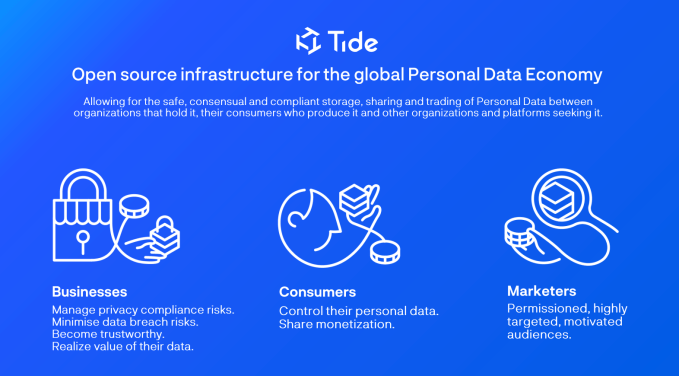
It seems that on a regular basis, we hear about massive data breaches or companies sharing highly personal information with third parties without a consumer’s permission or knowledge. The Tide Foundation wants to change that by giving consumers complete control over their personal data on the blockchain by allowing them to manage their own encryption keys.

The startup wants to take that notion a step further by giving users the ability to sell that personal information in an open marketplace that the company is announcing today.

“The overall concept is that when a consumer engages with a business and provides that business with personally identifiable information, the Tide Protocol encrypts that information and provides the consumer with the only key to decrypt it,” Issac Elnekave, Tide co-founder told TechCrunch.

With full control over their data, companies could not transfer any information to a third party without the consumer granting permission first. The marketplace provides a way for companies who need data, the vendors who manage that data and the consumers who ultimately own the data to negotiate a fair market value for access to it. What’s more, the companies buying the data know that they are getting much more valuable and accurate information, delivered with the full knowledge of the consumer.

In the event of a massive data breach like Equifax or Marriott, if customers had been using the Tide Protocol, the hackers couldn’t have actually used the PII in the breached databases because consumers would control the keys to decrypt it, rendering it useless to the data thieves.

Technically, the protocol works in a kind of standard business blockchain fashion. “Tide Protocol uses forked EOS nodes, smart contracts and additional proprietary decentralized layers to manage permissioned access to encrypted consumer data stored by businesses (vendors),” the company explained in a statement.

As for consumers controlling encryption keys, the company says it has created a patented technology to simplify the process of managing those keys in order to put that process within reach of anyone, one that passes what they call “the Grandpa Test.”

“We have developed a layer, a decentralized way to dumb down blockchain to a ubiquitous user experience on the web,” Yuval Hertzog, the other company co-founder explained. He said the idea is to simplify the highly complex and make key management a typical kind of web experience.

Elnekave says that the company has also found a way to comply with GDPR, the strict EU privacy regulations that went into effect last year that includes the right to be forgotten. Because the protocol gives consumers full control over the encryption keys, the user simply has to stop giving access to the business, essentially throwing away the encryption key and blocking access, he explained.

Tide launched three years ago in Sydney, Australia and developed the Tide Protocol, the basis of its blockchain data privacy solution, two years ago. Today it has 13 employees. The company raised a $2 million seed round in November.

The startup believes data ownership should be a basic human right in a similar fashion to Hu-manity.co, the startup that wants to provide a similar set of tools as Tide, but focussed on medical information.


What is Cross Selling and How Can It Boost your Small Business Revenue?

What is Cross Selling and How Can It Make You More Money?

Getting a customer to spend more money on your goods and services is a priority for small business owners and cross selling can help you do that. This sales technique is designed to get a client to buy something that’s directly related to the purchase they’ve just made.

What is Cross Selling

Here’s an example. If you walk into an electronics store to buy a new computer and the salesperson asks you if you want to upgrade the memory, that’s cross selling. In the digital world, the options that prompt you with a “customers also bought this” type tag have been designed as part of a cross selling technique.

If you’re wondering how to implement cross selling into your sales toolbox, there’s some strategies that brick-and-mortar and online retailers can use to get started.

Cross Selling Strategies

Showcase Accessories

Some of the best strategies can be implemented quickly whether you’re a digital, brick-and-mortar or even omnichannel outfit. For example, if you own an electronics store, having accessories close to bigger ticket items is a great way to cross sell.

You might stock your shelves with memory cards, charging cables and upgraded batteries and place them around the display units that have computers in them. If you’re an online only store, you can build links to separate pages and use keywords like computer accessories.

It’s also possible to put a tab at the top so the navigation for your users is simple and accomplishes your cross selling objectives.

Give Examples

You don’t have to look far for examples. In fact, the next time you’re up for fast food at McDonald’s you’ll run right into some cross selling when the counter person asks you if you want a dessert with your food or if you’d like the latest “meal deal.”

Keep in mind you need to train your employees on the real value and techniques behind cross selling if you’ve got a physical location. For example, people selling windows for home renovation companies should stress the added savings customers will get on their heating and/or cooling costs.

Separate Lanes

If you need a little more convincing about how successful this technique can make you, Amazon reportedly gets 35% of their sales from cross selling. That number stretches back to 2006.

It’s important to keep cross selling and up-selling in their separate lanes. They are two different sales techniques and in an upsell you’re trying to sell the client something more expensive and upgraded.

For our computer store example, an upsell would be trying to sell your customer a  computer with better built in features like a touch screen. Both techniques are useful ways for small businesses to increase their bottom line.

Here’s a few more cross selling techniques that are easy to implement and work well.

Get the Timing Down

Patience is one of the cornerstones of cross selling if you’re using emails or other digital techniques. Getting the timing right means understanding how to schedule a series of emails to sell other services or goods. For example, if you’ve sold web design services to a client, you might want to follow up with another email a week later on the importance of good content and copywriting.

If you look at the analytics involved generally in the open, click and reply rates specifically you can automate the system and tweak the timing.

Bundle Items

Bundling items together so you can cross-sell them as a package is as easy as using the “frequently bought together,” method online. Offering a discount on packages that complement the existing services is a method you can use in a brick-and-mortar location.

Use the Right Language

Engaging your customers so that you can cross-sell to them is one of the techniques you can’t afford to miss. When you remember one of the tools that makes cross selling successful is engagement, you’ll be able to better understand the best kind of language to use.

The language of cross selling communicates on a personal and individual level. If you use words like yours and you, you’ll be helping the shopper to imagine how they might use the goods or services.

Set Limitations

It’s good to remember that scarcity is one of the cornerstones of making any kind of sale. If you put a time limitation on an offer that you want to resell, you’ll be helping the client to make a quick decision.

Reporting that there’s only four backup chargers left that go with that smart phone your client is buying is a good example.

One of the other tips that you can use to enhance your cross selling efforts is user generated content. There are still lots of e-commerce businesses that struggle with gaining customer loyalty. Having reviews and customer testimonials on the website can help smooth any doubts over and help your cross selling efforts in return.

Know Your Target Market

Revisiting your target market can help you better understand how to cross-sell to them. Of course you’ve more than likely already done that by now, but it’s a good time to check social media feeds and analytics to see what can be tweaked.

This type of information can help you stock your shelves and position your inventory and links on a website.

Image: Depositphotos.com

This article, "What is Cross Selling and How Can It Boost your Small Business Revenue?" was first published on Small Business Trends


How Does Your Brand Get Heard in a Crowded Market?

How Does Your Brand Get Heard in a Crowded Market? Brand Clarity

There is undeniably a lot of “noise” in the marketplace. Consumers are constantly being bombarded with marketing messages from almost an infinite number of choices that all say “you need to notice me over here”. This makes it so difficult for your company to be heard and remembered. It gets even worse when small businesses try to deal with all the distractions to keep that customer’s attention.

On this week’s Small Business Radio Show, Steve Woodruff, the self-proclaimed “King of Clarity” gives small business owners solutions that get them heard. He describes how to become relevant to consumers and grab your prospect’s attention.

Brand Clarity

Steve believes that business communication has two real moments of truth. The first one happens in the initial five seconds when your message must get through the brain’s filtering system and show people what is in it for them. To accomplish this, you need a tightly condensed message that is compelling and memorable.

According to Steve, the second moment of truth is when you are remembered by the prospect when they have a problem you solve or can refer you to another prospect. He gives his company’s message as an example; “I am the king of clarity and I help professionals in the two moments of truth.“  It is critical to form a picture in your prospect’s mind for easy recall.

Remember, it’s not an elevator pitch. Steve dislikes this term since it sounds like you are selling something. He prefers to use the term “memory dart”. In this way, your compact message is provoking interest and assembling a word picture in your prospects’ heads so they can remember your company. This effectively happens by using snippets, stories and symbols.

Some small business owners may complain that this pigeon holes them into being one dimensional, but Steve believes this is to your advantage since it makes you more memorable and referable.

Listen to the entire episode here.

Image: Depositphotos.com

This article, "How Does Your Brand Get Heard in a Crowded Market?" was first published on Small Business Trends