Wednesday, 3 April 2019

Why You Need Video for your Small Business

Using the Power of Video for Your Business

Creating videos for your business is easier than ever before. Even if the extent of your video recording experience is through your personal Instagram or Facebook, you already have the knowledge and tools needed to make quality, engaging content.

The power of video extends beyond social media. It can completely transform your relationships with your customers and staff. As a time-strapped small business owner, this means videos can extend your reach while humanizing your brand — and, when done right, with little time investment.

The Power of Video

Let’s explore how using videos as part of the normal course of business can give you back hours of your day, allow you to better communicate with your teams, and the key tips for getting started.

Build Deeper Relationships with your Customers

It doesn’t matter if your audience is on a global scale or in your backyard, all businesses have the same issue: your customers are going to be researching and looking for information from you at times when you’re not available.

As a small business, it’s expensive to hire a full customer service department or have a salesperson on call day and night to cater to incoming inquiries. And I don’t know about you, but I’ve never felt a personal connection with most website FAQ pages.

Instead, use videos and imagery as an extension of yourself to build a connection with your customers even with limited resources. With some effort spent in the upfront creating videos and tutorials, you’ll have a library of on-demand content for your customers to reference. With each video you’re getting an extra touchpoint with your audience and connecting in a personal way.

While it doesn’t replace one-on-one conversations with people, there’s real value in using visuals to communicate. A recent study we conducted found that two-thirds of people understand information better when it’s communicated visually — and 48% of people found video the most engaging form of communication. By making it as easy as possible for your target audiences to discover and grasp the information they’re looking for, you’ll be a step closer to gaining them as a customer.

The type of content you create depends on what you offer and your audiences. However, an excellent place to start is with a video that discusses who you are, showcases your product or service, and answers common questions. Videos put a face and a name to your business and the relationship becomes much more personal.

Help your Team Feel Connected

As a business owner, you’re likely juggling several responsibilities at any given time. And with your attention pulled in all directions, it might feel time-consuming or even challenging to convey pertinent information and updates to all your employees. This is especially true with an ever-growing global and remote workforce that is reliant on digital communications.

Remember the study I mentioned earlier? The same findings are relevant in the workplace: people absorb information better and are more likely to be motivated by visuals than when communicated with in plain-text. In other words, your employees don’t want to read wordy emails.

Anything from short messages to longer videos is shown to save time and improve the performance of your employees. Videos can also ensure you’re sharing a consistent message across your organization. Short videos can be recorded and available for staff to watch on-demand or during their next shift – giving time back to you and your employees, who most likely prefer the flexibility.

Most importantly, visuals put a face to the message. Too often we communicate in email, leaving many of us to forget we’re talking with people on the other end. Videos help to create a human, eye-to-eye connection. Seeing a person, hearing their voice, and seeing their body language is essential for feeling connected and motivated, even if viewed on a screen.

To give you an idea of the type of content you can swap for visuals, let’s walk through some practical examples where videos would make your communications quicker and more effective:

  • Instead of a scheduling an hour-long meeting to walk your team through a new program or system, try creating a screen-share video. Not only will this save time across the board, but you’ll also be creating an archive for future reference.
  • Let’s say you’ve hired an employee to expand your sales in a new region. All your employees work remotely and are in different time zones, but you want the new employee to feel included on the team. To foster a connection, encourage your team to send videos introducing themselves, explaining their roles and adding in some fun personal highlights.
  • Regardless of the size of your business, a good onboarding program will set your employees up for success. While large enterprises may have an entire team dedicated to onboarding, this is rarely the case for smaller businesses. That doesn’t mean you can’t provide your workforce with the same training experience. Try packaging up your onboarding into several shorter videos to create a training catalog. Not only will this save you time in the future, but your employees can continue to access this information whenever they need a refresher.

How to Get Started

It is important to remember that the above tips are meant to simplify, and not to complicate. While you’ll want your customer-facing videos to have a bit more polish, you don’t need professional equipment or experience to create engaging content. In fact, you’re probably holding a powerful, all-in-one video creation tool right now: your phone.

From meeting recordings and company announcements to tutorials and FAQs, videos allow you to be in many places at once. To get you started, I’ll leave you with a challenge: open your camera on your phone or computer and record a quick message for your team. Perhaps it’s a motivational message for an upcoming sales initiative, or even a quick hello. Continue doing this for the next week or so and you’ll be amazed at what you can create and how effective your videos will be.

By Matt Pierce, Learning & Video Ambassador, TechSmith. You can also find more video tips and tricks by visiting the TechSmith Blog and TechSmith Academy.

Image: Smart Hustle

This article, "Why You Need Video for your Small Business" was first published on Small Business Trends


What is the Difference Between Venture Capitalist and Angel Investor?

Both venture capitalist and angel investor play an important role in making a startup successful. What are they and how are they different?

[[ This is a content summary only. Visit my website for full links, other content, and more! ]]


Andreessen Horowitz isn’t alone in leaving behind VC as we know it — and more company is coming

This morning, Forbes wrote a lengthy profile of Andreessen Horowitz, the now 10-year-old venture firm that its rivals love to hate but nevertheless tend to copy. It’s a great read that revisits some of the firm’s wins and losses and, interestingly, regrets, including the founders’ early predisposition to talk trash about the rest of the venture industry.

As Ben Horowitz tells reporter Alex Konrad, “I kind of regret it, because I feel like I hurt people’s feelings who were perfectly good businesses . . . I went too far.”

The story also suggests that Andreessen Horowitz — whose agency-like model has been widely replicated by other big venture firms — is re-shaping venture capital a second time. It’s doing this, says Forbes, by turning itself into a registered investment advisor.

But the firm isn’t alone is morphing into something very different than it once was, including an RIA. SoftBank is already one. General Catalyst appears to be in the process of registering as one, too. (It recently withdrew its status as a so-called exempt reporting advisor.) Other big firms with a range of un-VC-like products are similarly eyeing the same move.

They don’t have much choice. While VCs have traditionally been able to dabble in new areas through their limited partner agreements with their own investors, they’ve also faced what’s traditionally been a 20 percent cap on these activities, like buying in the public markets, investing in other funds, issuing debt to fund buyouts, and acquiring equity through secondary transactions.

Put another way, 20 percent of their capital could be used to experiment, but the rest had to be funneled into typical venture capital-type deals.

For Andreessen Horowitz, that cap clearly began to grate. An early and enduring believer in crytpocurrencies, marketplaces, and applications, the firm grew particularly frustrated over its inability to invest more of its flagship fund into crypto startups. It raised a separate crypto fund last year so it could move more aggressively on opportunities, but according to Forbes, the constraints that came with creating that separate legal entity gave rise to new aggravations.

By becoming a registered investment advisor, Andreessen Horowitz will no longer have to limit these stakes, including in its general fund — the newest of which it’s expected to announce shortly. It will also have the freedom to invest any percentage of its fund that it wants in larger high-growth companies, to buy shares from founders and early investors, and to trade public stocks, as Forbes notes.

It’s the same reason that SoftBank is a registered investment advisor and other big firms with more assets will invariably be, too. As longtime startup attorney Barry Kramer observes, “Like the now-giant operating companies that VCs once funded, like Google and Apple and Amazon — each of which used to play in discrete market segments and now overlap — hedge funds, mutual funds, secondary funds, and venture funds that used to play in discrete market segments are starting to overlap, too.”

In fact, the opportunity to shop for secondary stakes alone could drive a venture firm to restructure. “Secondary markets are eating” the public markets, says Barrett Cohn on the investment bank Scenic Advisement, which helps broker sales between equity buyers and sellers. Cohn has a vested interest in this happening, but it’s also hard to argue he’s wrong, considering how long startups remain private, and how much more secondary activity now takes place before they’re acquired, go public, or conk out.

Little wonder the powerful venture capital lobby group — the National Venture Capital Association — has been trying to talk the SEC into changing its definition of what constitutes a venture capital firm. It recognizes that it’s going to begin losing more and more members if venture firms aren’t afforded more flexibility.

In the meantime, becoming an RIA isn’t without its downsides — a lot of them, notes Bob Raynard, the managing director of the fund administration services company Standish Management in San Francisco. Though he thinks many firms like Andreessen Horowitz may not have a choice at a certain point (“I think there are a lot of other growth equity and venture firms that should be registered for their own sake”), the new rules to which it will be adapting can “be quite onerous” beginning with a complete lack of privacy, as well as expenses. One estimate we found suggests that the median annual compliance costs are eight times higher for RIA than for exempt registered advisors, or an estimated $405,000 versus $50,000 annually.

“If [Andreessen Horowitz] is becoming an RIA, it cost structure just went way up,” says Raynard, observing that a compliance officer will have to sign off on everything an employee at the firm does, as well as the investing decisions that its partners’ spouses, children, and even parents make. “As a VC, you don’t have to report your trades,” Raynard notes, but an RIA has to ensure that nothing and no one with a pecuniary interest in the firm creates an expensive misstep.

One could also imagine it creating headaches for limited partners, who typically like to invest in distinct asset classes, whether venture capital or private equity or hedge funds. If Andreessen Horowitz, among other firms, starts to look like an amalgamation of all three, how are they viewed? In what bucket do they land?

The firm declined to answer that question and others of ours today, saying it’s focused for now on completing the process of registering as an RIA, but Raynard pushes back on the idea that its new look might throw off the institutions that have long funded it. “I think regulators will view it as a good thing, and I think most LPs would view it as a favorable shift, because of increased outside scrutiny involved.”

He thinks that beyond the loss of privacy and expenses and the eagle-eyed SEC watching more closely, a bigger trade-off as venture firms become, well, investment firms more broadly, could be that it grows harder to recruit.

“If you’re a junior-level person and you’re being recruited by a firm that’s a registered investment advisor versus a venture firm where your deals are not being scrutinized and you have some privacy,” says Raynard, “it’s something you’re going to think about.”


Should Early Stage Startups Invest In SEO?

SEO is an effective online marketing tool no matter what stage your business in. Early stage startups can benefit from getting attention from online community.

[[ This is a content summary only. Visit my website for full links, other content, and more! ]]


How to Make Your Small Business Stand Out from the Crowd

Being a me-too business is a recipe for extinction. How do you make sure your business stands out from the crowd and prospers?

[[ This is a content summary only. Visit my website for full links, other content, and more! ]]


Tuesday, 2 April 2019

Good Dog raises $6.7 million to help you find a pup

I’m in the process of looking for a pup friend to bring home with me, but I quickly found that it’s not an easy process. There are tons of places offering up pups, including breeders, shelters and rescues. But it’s not always clear if these places are legitimate.

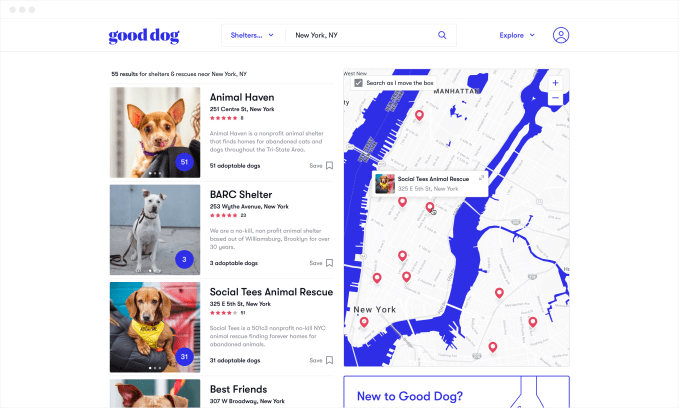
This is where Good Dog, a startup that just raised $6.7 million from David Tisch’s BoxGroup, Felicis, Slow Ventures and others, can be helpful. Good Dog, launching today, is a marketplace that pre-vets breeders, shelters and rescues and centralizes the dog-search process.

“I’ve been fortunate to be involved with Josh and Lauren since the inception of Good Dog,” Tisch said in a statement. “As I was embarking on my own dog search, it quickly became clear that this was a totally broken process, opening up a massive opportunity within the $72 billion dollar pet market.”

Good Dog co-founders Lauren McDevitt and Josh Wais, former early Jet employees, came up with the idea while they were looking for a pup to add to their family. What was most troubling in their search, McDevitt told TechCrunch, was that there was a lack of standard and expertise.

“It was hard to determine the good from the bad,” she said. “It was hard to identify who was doing the right thing. Some put dogs in harm’s way and made it hard for well-intentioned people to find the right dog.”

Good Dog focuses on educating people about what it takes to take care of a dog, as well as what kind of dog may be best for them. The startup then enables those looking for dogs to explore profiles from trusted, vetted providers and then facilitates connections.

You can search by location and shelter, or simply by breed.

“Our mission is to help connect good with good to weed out the bad,” Wais said. “The industry is broken and we see an opportunity in connecting prospective dog owners with responsible sources to help weed out the irresponsible sources.”

So far, Good Dog showcases pups from more than 1,000 responsible sources across the U.S. Before adding a source to the platform, Good Dog’s team uses its own proprietary standards to ensure the source cares for its dogs in a way its advisory team has determined is acceptable. That entails making sure the source cares for each dog’s respective health needs, socializes them properly and houses them in safe environments.

Good Dog makes money by charging a fee (around $100) once you’ve decided to go ahead and purchase a dog. Good Dog does not charge breeders, shelters or rescues. It’s worth noting that providers also cannot pay to be featured on Good Dog.


BuzzFeed teams up with Eko to create interactive recipes and other videos

BuzzFeed and Eko have been working together to create a wide range of interactive videos, and they began launching in the past week or so — starting with this Tasty potato recipe that allows you to customize your ingredients, revealing a bit about your personality in the process.

There’s also an interactive Tarot reading, a video quiz that determines what kind of dog you are and this customizable ramen video.

I spoke with BuzzFeed and Eko executives last week to learn more about how they’re working together, and where it might go next.

These videos feel pretty different from previous uses of Eko technology like “That Moment When,” which is more of a comedic, Choose Your Own Adventure-style story.

Eko’s Chief Creative Officer Alon Benari acknowledged that in the past, the company usually “started from a traditional video and injected interactivity into it.” But while “this is one of first projects where we did the other path” – namely, taking an interactive format like a quiz and introducing video — the focus is still on “bringing together the best of both worlds.”

“This isn’t a direction change,” added Vice President of Business Development Ivy Sheibar. “We have a full pipeline of what you would consider coming more from traditional video.”

As for BuzzFeed, Chief Marketing Officer Ben Kaufman suggested that this is a natural extension of the publisher’s strategy to experiment with new formats. By offering this kind of interactivity, BuzzFeed can tailor videos to their viewers’ needs and interests (for example, by customizing video recipes based on dietary restrictions)  while also “allowing our audience to engage with our videos and create data feedback loops.”

In addition to providing the technical platform to create these videos, Kaufman said Eko’s team also shared important insights from years of experience with interactivity.

“One of the things they trained us on was what the meaning of a meaningful choice was — [a choice] where actually as an audience member you would take that to heart and makes you feel like, ‘This video is really made for me,'” he said.

Kaufman added that as BuzzFeed and Eko continue rolling out different types of interactive videos, “Our goal in the next few weeks is to crack this, to build a real deep audience connection, see what they are loving and go heavy into scaling that.”


Lyft’s stock has a blue Monday as shares slide after public debut

Today, investors took off their rose-colored glasses (and pink-colored mustaches) and looked at Lyft’s shares with fresh eyes after Friday’s ebullient debut.

And — judging by the company’s share price at the end of the day — what they saw wasn’t exactly to their liking.

Lyft’s shares suffered a pretty blue Monday in trading on the Nasdaq stock exchange today, closing down $9.28 (or 11.85 percent).

Once trading after the pink confetti was swept up off the floor, analysts and investors had a different story to tell about one of the first unicorns to make its public debut.

Part of the reason for the company’s share price tumble was a report from Guggenheim Partners analyst Jake Fuller, which voiced skepticism about the ride-hailing company’s path to profitability.

Lyft’s financial picture has always been challenged. That was clear from the moment it filed its financial documents with the Securities and Exchange Commission before its public debut.

As TechCrunch wrote at the time:

According to the filing, Lyft recorded $2.2 billion in revenue in 2018, more than double the $1 billion recorded in 2017. Meanwhile, losses have been growing considerably. The company posted a net loss of $911 million on the $2.2 billion in revenue and a $688 million loss on 2017’s $1 billion.

The analysis from Fuller simply makes clear that Lyft’s purported path to profitability is dependent on a number of steps that could prove very difficult for the company to execute.

“We see four paths to profitability: cut driver pay, turn off incentives, reduce insurance costs or shift to self-driving cars,” Fuller is quoted by MarketWatch as writing. “The first two would be tough in a highly competitive category, the third might not be enough by itself and the fourth is likely 10 years out.”


What could be better than unlimited paid vacation? Well, this …

(This post originally appeared on The Guardian)

Arecent study from Metropolitan Life about trends in US employee benefits revealed a very unsurprising fact: 72% of the 2,500 human resources professionals and 2,675 workers employed at firms with more than two employees listed “unlimited paid time off” as their chosen “emerging benefit” that employers should be offering.

Makes sense to me. Who in their right mind wouldn’t want unlimited paid time off? It’s the ultimate benefit.

The reason behind this has to do with our changing workforce demographics. Approximately 50% of US workers are from the millennial generation – those aged somewhere between 18 and 35 – and if there’s one thing I believe about this generation it is that … well … they’re a lot smarter than my generation.

Don’t listen to those boomers and Xers who complain about the younger generation’s “work ethic”. The complainers are wrong. This generation – and I have three kids that are part of it – is hard-working and smart. They just have different priorities than the generations before them. They have this outlandish idea that they work to live instead of the other way around. They want to spend more time with their friends and family if possible. They want more balance in their lives than their parents or grandparents had.

Which is why a growing number of companies – mostly big companies such as HubSpot, DropBox, LinkedIn, Facebook and even accounting firm Grant Thornton – are offering “unlimited” vacation plans. But is this going overboard?

I recently spoke to about 300 owners and CEOs of mostly small and medium-sized manufacturing companies and I asked for a show of hands who offered “unlimited” paid time off plans. Not a single hand went up, although I did get a few chuckles and eye rolls. Are these people missing the boat? Probably not. These are people that have run businesses for many years. They’re not fooled. They know a gimmick when they see one – and they also know what’s best for their people. In many cases, unlimited paid time off plans are actually worse for the employee, not better.

That fact was confirmed in a 2017 study of mid-sized companies conducted by the human resources software provider Namely. The study found that employees who worked at companies that provided unlimited time off plans took an average of 13 days off a year while their counterparts who worked at companies providing fixed plans took 15 days off a year.

“We looked at the numbers, and it turned out we had a problem,” Haje Jan Kamps, a CEO at a startup that had an unlimited paid time off plan, wrote a few years ago. “The problem wasn’t that people were taking too much holiday. Quite the opposite, in fact. Because we weren’t explicitly tracking, people felt guilty about taking time off.”

This is not an isolated case. Although unlimited paid time off sounds great, companies such as Tribune Publishing and Kickstarter backed away from their unlimited paid time off policies because they found that their employees were both taking less time off and some were disgruntled at losing accrued time, according to a report in Fortune.

So what’s the bottom line? Do we, as employers, respond to Metropolitan Life’s study and start offering unlimited paid time off plans because 72% of our workers are demanding it? Not so fast. I’m not saying that these plans don’t work. Some companies have seen them succeed. But others have failed. There’s no right or wrong answer when it comes to offering this type of benefit. Everyone would like it. But not every company has the right culture for it.

So here’s what I recommend.

First, you offer a more “flexible” paid time off plan, such as giving anywhere from 10-30 days off a year to an employee based on the years they have worked for your company and let them choose how they want to use them. Just make sure that any unused time doesn’t roll over to the next year because you want them to take their vacation: too many studies have shown that the more balanced a worker is the better their work is. Taking vacation should be part of your company’s culture.

More importantly, you tell that employee that vacation time at your company can be even more flexible. If they want (or need) more time off it will be considered on a case-by-case basis and depend on their work performance and its impact on your business. You don’t need a formal plan. You’re a small business! Your employees aren’t subject to a bureaucracy – and that’s a huge benefit for them. Just make sure you offer a pleasant, fun and challenging workplace with the opportunity for growth and a decent health insurance plan and believe me – you’ll find that your employees will be fine with the vacation plan you offer.

Unlimited vacation sounds great, particularly if you’re trying to recruit that millennial employee. But really, it’s just a gimmick. I rarely run into a small company offering this kind of benefit. Instead, they focus on running a business where their employees actually enjoy coming to work … instead of staying away.


How to handle dark data compliance risk at your company

Boston Dynamics acquires a 3D vision startup in bid to put its robots to work

Last week’s Handle video was different than past Boston Dynamics releases. Sure, it showcased the same sort of impressive robotics that have made every video from the company a viral hit, but this one took a very different approach than other recent releases: It put the robot to work.

There were some clear aesthetic differences: the robot appeared a bit larger, and its two arms were swapped out for a single, overhead limb with several suction cups attached. The key differentiator, however, was a relatively mundane setting, in which Handle was moving boxes on and off of pallets and conveyor belts.

Now we’ve got a little more insight into why the company was showcasing its latest creation in a warehouse setting. Today Boston Dynamics announced its first major acquisition: a Bay Area-based startup called Kinema Systems. The company develops 3D imagine solutions for pick-and-place logistics.

The acquisition is telling. Over the last few years, Boston Dynamics was acquired by Alphabet and then sold to SoftBank. Somewhere along the way, it seems clear that the idea of monetization was impressed upon it.

“I think Google planted the seed,” CEO Marc Raibert tells TechCrunch. “And all of the other robotics companies near us were much more focused on applications and product than we were. So we’ve been turning that corner. It’s been a consistent thing. It’s not like we got to SoftBank and they hit us with a hammer and suddenly said, ‘make products.’ They’ve been extremely enthusiastic about our R&D work, too. It feels good to do both.”

Boston Dynamics will take a two-pronged approach, moving forward. The company will continue to push the boundaries of what robotics can do, with products like Atlas, while it looks for real-world applications for other products, including Handle and SpotMini, which it announced last year at TechCrunch’s Robotics event it would begin to commercialize. That product, it seems, is still due out in 2019.

Unlike many other startups in the robotics category, however, Kinema has actually had a product on the market. Kinema describes the Pick as “the world’s first Deep-learning 3D Vision systems for industrial robots.” Notably, the Pick’s suction cup-sporting arm bears more than a passing resemblance to the Handle’s newly redesigned limb.

As part of the deal, the robotic arm is being rebranded as the Boston Dynamics Pick System, as seen in the above video. The company will continue to sell and support the system, meaning that it officially beats the Spot Mini to market at Boston Dynamics’ first commercialized product. The addition of a redesigned Handle appears to find Boston Dynamics looking to build out a logistics ecosystem, something that has the potential to compete with warehouse robotics companies like Fetch or even Amazon Robotics. 

“One of the things that’s exciting about the Kinema acquisition is that they’ve already been in the product environment that’s very specific to warehouses and logistics,” Michael Perry, Boston Dynamics’ VP of Business Development tells TechCrunch. “They’ve already been through the process of figuring out what are some of the site-specific issues we need to incorporate into our design. Everything from comms to perception to safety. All of these different factors are now filtering into the design of the robot.”

Kinema’s technology will be utilized for Handle to start. Raibert notes that the wheeled robot is the closest Boston Dynamics has come thus far to developing a purpose-driven commercial robot from the ground up.

“We did a first design of Handle where we were doing what we always do,” says Raibert. “We were trying out a new form and seeing what we can make it do. We were excited because it was so dynamic. But it was really a no-application-in-mind exploration. But then, after we had it and started to think about it, it clearly dovetailed with some logistics thinking we’d been doing. And we did redesign it after that with logistics in mind.”

Another key thing Kinema brings to the table is location. The company’s Mountain View location will serve as Boston Dynamics’ first West Coast offices. “Through this [acquisition],” Perry adds, “we’ll be establishing our presence in the Bay Area for hiring a wide variety of hardware and software specialists.”


Alcatraz AI is building Face ID for corporate badges

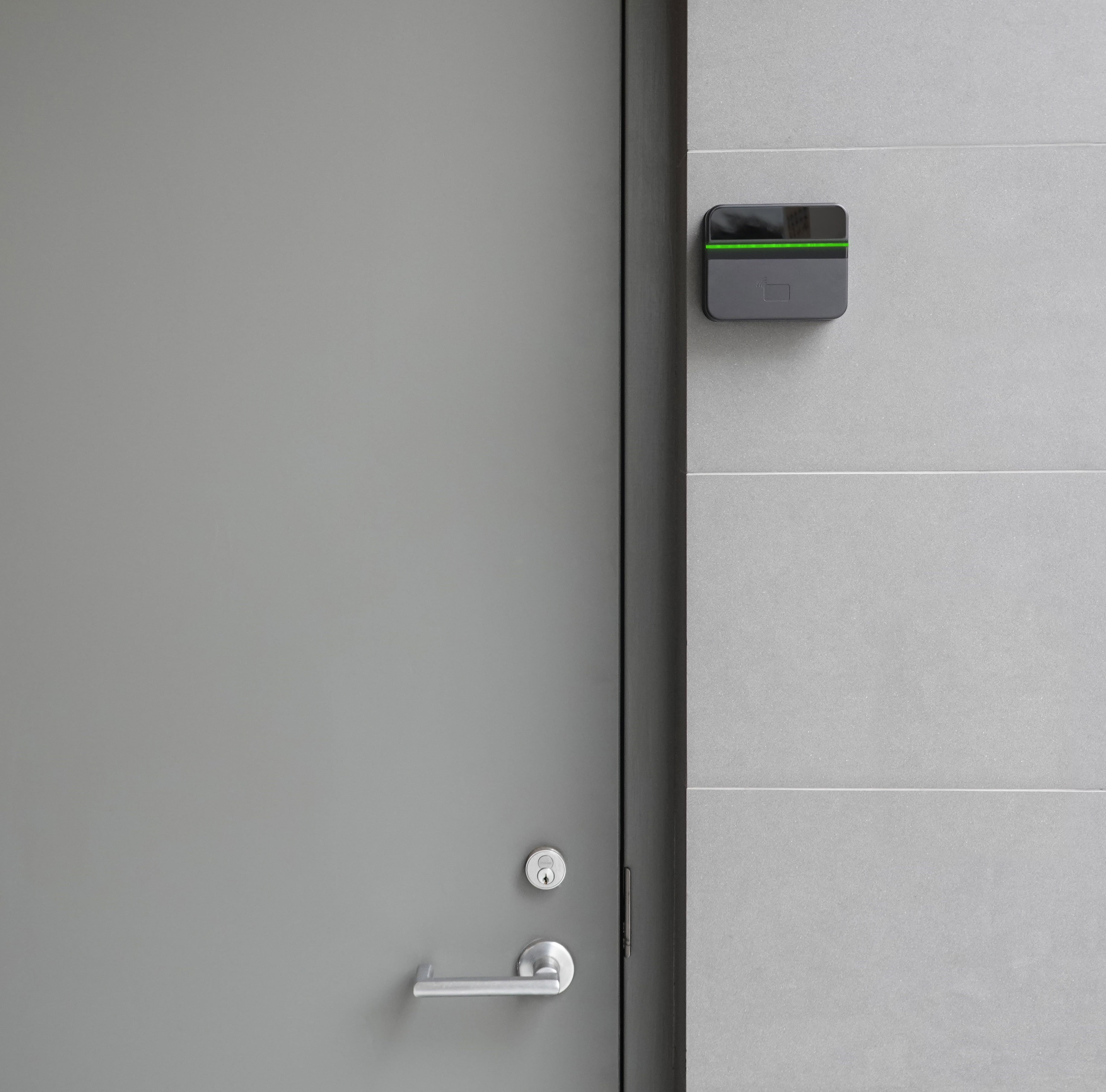
Meet Alcatraz AI, a startup that wants to replace all the bade readers in your office with a Face ID-like camera system. Alcatraz has integrated multiple sensors to identify faces and unlock doors effortlessly.

If you think about it, it’s weird that fingerprint sensors took off on mobile but everybody is still using plastic badges for their offices. Sure, high-security buildings use fingerprint and iris scanners. But it adds too much friction in too many cases.

First, when everybody gets back from their lunch break, it can create a traffic jam if everybody needs to place their finger on a sensor. Second, onboarding new employees would require you to add their biometric information to the system. It can be cumbersome for big companies.

Alcatraz AI promises a faster badging experience with facial authentication. When you join a company, you also get a physical badge. The first few times you use the badge, Alcatraz AI scans your face to create a model for future uses — after a while, you can leave your badge at the office.

The company has built custom hardware with three different sensors that include both traditional RGB sensors and infrared sensors for 3D mapping. Customers pay Alcatraz AI to install those hybrid badge/face readers. After that, companies pay an annual fee in order to use the platform.

Alcatraz AI customers get analytics, real-time notifications and can detect tailgating. This way, if somebody isn’t supposed to go in the secret lab, Alcatraz AI can detect if they’re trying to sneak in by following someone who is authorized to go in there.

The idea is that the ongoing license cost should cover what your company was paying for guards. The startup has raised nearly $6 million from Hardware Club, Ray Stata, JCI Ventures, Ruvento Ventures and Hemi Ventures.


Home buying and selling platform Perch raises $220M in debt and equity

Perch, a home-buying and selling platform, has raised $220 million in a combination of equity ($20M) to fund operations and debt ($200M) to finance home purchasing. The equity investment was led by existing investors FirstMark Capital, with participation from Accomplice and Juxtapose. Perch declined to disclose the debt lender in the deal.

Perch was founded in September of 2017 by Court Cunningham and Phil DeGisi.

The premise of Perch is to focus on the largest segment of home buyers on the market, which Perch calls “dual trackers.” These buyers are also in the process of selling their current home at the same time.

This is a generally difficult and taxing process that forces people to choose between the uncertainty of a huge investment without having sold their current home or moving into a short-term rental indefinitely until they find the right new home. The alternative is to make an offer to purchase the new home contingent upon the sale of their current home, which tends to be an unattractive proposition for sellers, according to Perch.

Perch solves this for clients by making an offer on their homes that is valid for six months, and then helping them to find a new home. Perch also conducts the closing on both homes in the same day.

There is a certain amount of risk associated with this business model considering the fluctuation of the housing market, but that doesn’t seem to be an issue for investors of Perch or their competition. Looking at the way it works now, however, it’s hard to imagine that tech won’t have gotten a strong foothold within the real estate industry over the next few decades.

Which explains the huge influx of cash going to companies the industry calls “iBuyers,” such as RedFin, Zillow, Opendoor, and OfferPad. Opendoor recently filed to raise $200 million at a $3.7 billion valuation in February, while OfferPad closed a Series C that brings total equity and debt raised to $975 million.

Perch, however, doesn’t consider itself an iBuyer.

“An iBuyer will buy your house for you at a certain price in an easy and convenient transaction,” said cofounder and CEO Court Cunningham, referencing the offerings of Perch’s competition. “It adds a lot of value, but that’s a feature of a complete offering, not the offering in and of itself.”

In short, Perch wants to tie together the three branches of home buying and selling — closing, title, and mortgage — for the 60 percent of the market comprised by “dual trackers.”

For now, Perch is squared away on the closing and title portion of the process, offering e-closing and e-notary to let users complete the transaction from the comfort of their own home. The company plans to offer its own mortgage brokerage service to customers at some point this year, and though it’s not on the roadmap anytime soon, Cunningham said he isn’t closed off to the idea of Perch becoming an underwriter somewhere down the line.

Not only will mortgages add a new revenue stream for Perch, but Cunningham sees the convenience of having everything in one place as a huge opportunity for customer acquisition.


McDonald’s To Use AI For Your Next Drive-Thru Purchase…And Other Small Business Tech News This Week

forbes_logo_main

(This post originally appeared on Forbes)

Here are five things in technology that happened this past week and how they affect your business. Did you miss them?

1 — McDonald’s will use AI to automatically tweak drive-thru menus.

McDonald’s just announced it is buying machine learning startup Dynamic Yield for $300 million and will be using the company’s artificial intelligence (AI) at more than 1,000 of its restaurants’ drive-thru windows in the next 3 months. The system will monitor factors like the weather, time, local events, traffic levels at the restaurant and on nearby roads, historical sales data, and currently popular items as well as what customers are ordering to optimize menu displays at the drive-thrus. (Source: engadget)

Why this is important for your business:

The reason why I like this story is because although McDonald’s is using a complex technology, its use is not that complex. Your website or even a self-serve kiosk in your retail store could make similar suggestions based on the very same factors that McDonald’s is using. Ask your software vendors or a programmer.

2 — Employers are using robots to catch fraud in expense reports.

The Association of Certified Fraud Examiners (ACFE) reports that only a small percentage of companies’ expense reports are closely examined, resulting in over $7 billion in annual losses from fraud. The ACFE’s director of research says that, by using robots rather than random spot checks, companies can catch fraud more than twice as fast and cut their fraud losses in half. Business owners can now get a 100 percent overview of incoming employee expense reports using AI such as SAP Concur’s Concur Detect by AppZen, which only sends a charge for examination by a human auditor if it has a red flag. (Source: Insurance Journal)

Why this is important for your business:

Concur and its competitors, like Expensify, are also using AI to better monitor employee expenses and detect potential fraud. Talk with your accounting application vendor and ask if they’ll be providing similar functionality that can be used in invoicing, bill payment and payroll.

3 — Sacked IT guy annihilates 23 of his ex-employer’s AWS servers.

An IT worker in the UK who was fired after just a month on the job at a digital marketing and software company called Voova in 2016 was sent to jail for 2 years after he stole a former colleague’s login, ripped through Voova’s Amazon Web Services (AWS) accounts, and destroyed 23 servers. He was found guilty of unauthorized access to computer material and unauthorized modification of computer material when convicted this past January. As a result, Voova lost big contracts with transport companies worth about $700,000 and reportedly was never able to retrieve the data that was deleted. (Source: Naked Security)

Why this is important for your business:

The lesson: regardless of the size of your business implement 2FA (Two Factor Authentication) for all of your systems. This will help minimize the risk of a similar breach happening.

4— Asus just patched the ShadowHammer malware that was masquerading as a security update.

It was recently revealed that “critical” software updates for Asus computers may have actually been malware, planted by hackers in a targeted attack known as ‘ShadowHammer’. The company is offering a fix in the form of a security update that users can download using the Asus Live Update software tool. And it says it has a second ‘security diagnostic’ tool that scans a computer to determine if it was affected. Asus did not apologize for the hack and, in fact, downplayed it, saying that ‘Only a very small number of specific user groups were found to have been targeted.’ (Source: The Verge)

Why this is important for your business:

If your company – or any employees – are using an Asus device that make sure they’re aware of this problem and the patch to help diagnose and fix it.

5— UPS forms B2B ecommerce service with Inxeption.

In an effort to help B2B merchants become digital sellers by letting customers order and receive products via UPS, the shipping giant is collaborating with Inxeption, a provider of blockchain-based marketing services, to create an ecommerce platform for such marketers. By integrating technology between the firms, Inxeption Zippy allows brands to manage selling and shipping from one place and receive shipping and tracking services from UPS. The dashboard also simplifies transactions and logistics and could power transactional emails and other communications—critical parts of ecommerce initiatives. (Source: Media Post)

Why this is important for your business:

Yet another powerful use of blockchain technology – this time for shipping. UPS (a client of my company, The Marks Group PC) – is investing in companies like Inxeption to streamline the shipping process for its B2B customers and provide this service in a more secure, auditable environment.  More to come, I’m sure.


Streaming service Quibi snags Snap and Pandora vet Tom Conrad as Chief Product Officer

Jeffrey Katzenberg’s upcoming mobile streaming service Quibi had added another notable name to its roster of executive talent. The company announced it has hired Tom Conrad, previously VP of product at Snap (maker of Snapchat), and a co-creator of Pandora, where he served at Chief Technology Officer. At Quibi, Conrad will be Chief Product Officer, which will see him leading product, user research and customer support.

The news of Conrad’s hire was first reported by Variety on Monday, which also noted Conrad had served on Quibi’s board since late 2018 and was officially hired as CPO on March 25. He will report to Quibi CEO Meg Whitman in his new role.

Conrad will play a big part in Quibi’s success (or lack thereof, if it doesn’t fare well!), as a significant aspect to the service is to be the app’s mobile design. Unlike modern streaming services like Netflix, Quibi aims to offer short-form, high-quality video cut into smaller pieces for easy consumption on a smartphone. At this year’s SXSW, Whitman explained the Quibi advantage noting how the technology it’s using will allow the company to do “full-screen video seamlessly from landscape to portrait.”

At Quibi, Conrad’s understanding of streaming services, thanks to his time at Pandora, and apps favored by young users, thanks to his role at Snap, will surely come into play.

Conrad had left Snap in 2018 at a critical time for the popular social app. Its massive redesign had just rolled out, and was destroyed by early user reviews, with the majority giving the update 1 or 2 stars when it hit. The design was later rolled back. However, Snap CEO Evan Spiegel was the product decision maker – Conrad was more involved in terms of execution. That experience, however, may have given Conrad insight into what doesn’t work for the young Gen Z crowd, as much as what does.

The executive also spent a decade at Pandora, as CTO and EVP of Product, which saw him leading the teams that designed, developed and maintained the Pandora apps across platforms – including web, mobile, and other consumer electronics devices, as well as automotive. While Quibi is focused on being a mobile streaming app, it’s hard to imagine a streaming service that refuses to ever go cross-platform – especially since the majority of viewing of today’s streaming service viewing takes place on a television. (Even when it’s the streaming service from YouTube.)

With its billion-dollar backing from investors, Quibi has been able to snag several big names for its exec ranks, in addition to its CEO Meg Whitman, and now Conrad.

In March, the company said it landed top CAA agent Jim Toth (married to power producer Reese Witherspoon, by the way). Toth’s clients at CAA included Matthew McConaughey, Robert Downey Jr., Scarlett Johansson, Jamie Foxx, Zoe Saldana, Chris Evans, Salma Hayek, Zooey Deschanel and Neil Patrick Harris.

Quibi also hired former DC and Warner Bros. exec Diane Nelson to run operations. Nelson had served as president of DC Entertainment since 2009, and helped spearhead development of the DC Universe movies and shows.

In addition, the streaming service itself has already been signing big-name talent for its content, including Catherine Hardwicke, Antoine Fuqua, Guillermo del Toro, Sam Raimi and Lena Waithe. It’s also working with Steph Curry’s production company and most recently announced – awkward alert? – a show detailing Snapchat’s founding, focused on Evan Spiegel’s rise.

Image credit: Conrad, via Crunchbase


Pixeom raises $15M for its software-defined edge computing platform

Pixeom, a startup that offers a software-defined edge computing platform to enterprises, today announced that it has raised a $15 million funding round from Intel Capital, National Grid Partners and previous investor Samsung Catalyst Fund. The company plans to use the new funding to expand its go-to-market capacity and invest in product development.

If the Pixeom name sounds familiar, that may be because you remember it as a Raspberry Pi-based personal cloud platform. Indeed, that’s the service the company first launched back in 2014. It quickly pivoted to an enterprise model, though. As Pixeom CEO Sam Nagar told me, that pivot came about after a conversation the company had with Samsung about adopting its product for that company’s needs. In addition, it was also hard to find venture funding. The original Pixeom device allowed users to set up their own personal cloud storage and other applications at home. While there is surely a market for these devices, especially among privacy-conscious tech enthusiasts, it’s not massive, especially as users became more comfortable with storing their data in the cloud. “One of the major drivers [for the pivot] was that it was actually very difficult to get VC funding in an industry where the market trends were all skewing towards the cloud,” Nagar told me.

At the time of its launch, Pixeom also based its technology on OpenStack, the massive open-source project that helps enterprises manage their own data centers, which isn’t exactly known as a service that can easily be run on a single machine, let alone a low-powered one. Today, Pixeom uses containers to ship and manage its software on the edge.

What sets Pixeom apart from other edge computing platforms is that it can run on commodity hardware. There’s no need to buy a specific hardware configuration to run the software, unlike Microsoft’s Azure Stack or similar services. That makes it significantly more affordable to get started and allows potential customers to reuse some of their existing hardware investments.

Pixeom brands this capability as “software-defined edge computing” and there is clearly a market for this kind of service. While the company hasn’t made a lot of waves in the press, more than a dozen Fortune 500 companies now use its services. With that, the company now has revenues in the double-digit millions and its software manages more than a million devices worldwide.

As is so often the case in the enterprise software world, these clients don’t want to be named, but Nagar tells me they include one of the world’s largest fast food chains, for example, which uses the Pixeom platform in its stores.

On the software side, Pixeom is relatively cloud agnostic. One nifty feature of the platform is that it is API-compatible with Google Cloud Platform, AWS and Azure and offers an extensive subset of those platforms’ core storage and compute services, including a set of machine learning tools. Pixeom’s implementation may be different, but for an app, the edge endpoint on a Pixeom machine reacts the same way as its equivalent endpoint on AWS, for example.

Until now, Pixeom mostly financed its expansion — and the salary of its more than 90 employees — from its revenue. It only took a small funding round when it first launched the original device (together with a Kickstarter campaign). Technically, this new funding round is part of this, so depending on how you want to look at this, we’re either talking about a very large seed round or a Series A round.


Cyber Attacks Cost Small Businesses $53,987 on Average, Survey Claims

Opportunities for Managed Service Security Providers

Cybersecurity remains one of the most challenging issues for small business owners. And the problem leads small business owners to seek out managed service providers to present them with solutions.

But a new report from Continuum says the state of cybersecurity among small businesses in 2019 still needs to improve. The data suggests great opportunities for service providers who offer cyber security as part of their package. And predicts troubles for those who don’t.

The reason MSPs are so important for small businesses is many providers offer a one-stop shop for all things IT. However, some providers don’t include cyber security. And as the report reveals, SMBs are holding MSPs accountable when a security breach takes place, whether they provide security solutions or not.

In the press release, Michael George, CEO, Continuum, addressed this very issue in the press release. George said, “Businesses expect to be protected by their MSPs, and are ready to pay more for that protection – whether from their existing MSP or by switching to a provider that promises a better solution.”

Opportunities for Managed Service Security Providers

Businesses now have a better understanding of the digital ecosystem they operate in and the cybersecurity threats they face. The increased awareness has resulted in looking for and implementing the best system possible to protect their digital assets.

For MSPs providing cyber security as part of their service, this means more opportunities. George said, “If MSPs can deliver the right cybersecurity solutions to their end-clients, they will hold the competitive advantage in the SMB market.”

In the US close to half or 47% of SMBs said they would pay at least 20% more from a new provider if they have the right cyber security solution. Overall small businesses are willing to pay 24% more on average for the right cyber security solution.

An even more startling finding is 93% would consider moving to a new provider if they have the right cyber security offering.

The growth opportunity for MSPs providing cybersecurity is on the upside. The report says 77% of the businesses in the survey expect to outsource at least half of their cybersecurity needs in five years’ time. In the near term, 78% are planning to invest more in cybersecurity in the next 12 months.

Worsening Cybersecurity Threat

Cyber attacks cost small businesses in the survey $53,987 on average. Large organizations lost more money.

Companies with 10-49 employees lost $41,269 and those with 50-249 employees were in the hole for $48,686. Those with 250-1,000 employees ended up losing $64,085 per incident.

The cyber threat landscape is getting worse. The good news is small businesses are more aware of this fact, but not everyone is.

In the survey, more than 6 in 10 or 62% of the organization don’t have an in-house expert to properly deal with security issues.  Only 41% currently have cybersecurity experts in-house.

The Survey

Continuum commissioned Vanson Bourne to conduct the 2019 State of SMB Cyber Security report research. It was carried out between January and March 2019.

A total of 850 IT and business decision makers involved in cybersecurity as part of their organization took part in the survey. The organizations represented a number of core industries across different sectors in the US, UK, France, Germany and Belgium

Image: Depositphotos.com

This article, "Cyber Attacks Cost Small Businesses $53,987 on Average, Survey Claims" was first published on Small Business Trends


How to Get Started with Private Label Skin Care Business

Private label skin care provides the same benefits as expensive products. How can you get started with private label business.

[[ This is a content summary only. Visit my website for full links, other content, and more! ]]


FireHydrant lands $1.5M seed investment to bring order to IT disaster recovery

FireHydrant, a NYC startup wants to help companies recover from IT disasters more quickly, and understand why they happened with the goal of preventing similar future scenarios from happening again. Today, the fledgling startup announced a $1.5 million seed investment from Work-Bench, a New York City venture capital firm that invests in early stage enterprise startups.

In addition to the funding, the company announced it was opening registration for its FireHydrant incident management platform. The product has been designed with Google’s Site Reliability Engineering (SRE) methodology in mind, but company co-founder and CEO Bobby Ross says the tool is designed to help anyone understand the cause of a disaster, regardless of what happened, and whether they practice SRE or not.

“I had been involved in several fire fighting scenarios — from production databases being dropped to Kubernetes upgrades gone wrong — and every incident had a common theme: ​absolute chaos​,” Ross wrote in a blog post announcing the new product.

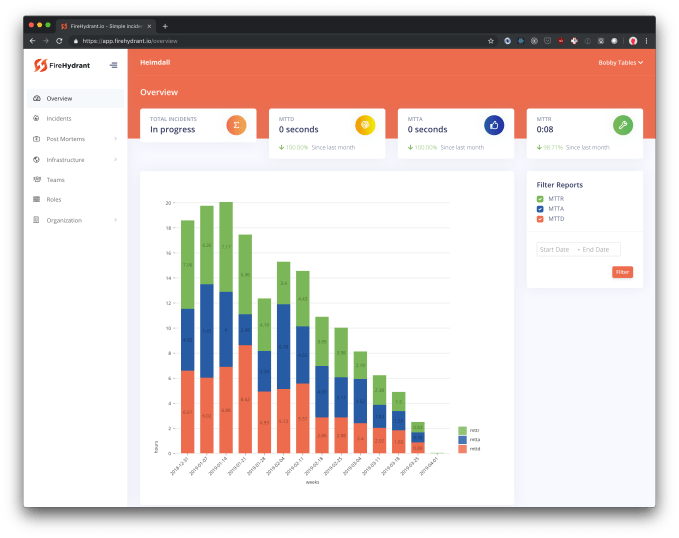
The product has two main purposes, according to Ross. It helps you figure out what’s happening as you attempt to recover from an on-going disaster scenario, and once you’ve put out the fire, it lets you do a post-mortem to figure out exactly what happened with the hope of making sure that particular disaster doesn’t happen again.

As Ross describes it, PagerDuty alerts IT is there is a problem, while FireHydrant lets them figure out what is going wrong and how to solve it. He says that the tool works by analyzing change logs. He says that a change is often the primary source of IT incidents and when you have an incident, FireHydrant will surface that suspected change, so you can check that first.

“We’ll say, hey, you had something change recently in this vicinity where you have an alert going off. There is a high likelihood that this change was actually causing your incident. And we actually bubble that up will mark it as a suspect,” Ross explained.

Screenshot: FireHydrant

Like so many startups the company developed from a pain point the founders were feeling. The three founders were responsible for solving major outages at companies like Namely, DigitalOcean, CoreOS, and Paperless Post.

But the actual idea for the company actually came about almost accidentally In 2017, Ross was working on a series of videos and needed a way to explain what he was teaching. “I began writing every line of code with live commentary, and soon FireHydrant started to take the shape of what I envisioned as an SRE while at Namely and I started to want it more than the video series. 40 hours of screencasts recorded later, I decided to stop recording and focus on the product…,” Ross wrote in the blog post.

Today it integrates with PagerDuty, Github and Slack. The company wants to use part of the money from this round to hire more engineers and expand its capabilities and integrations with other tools.

The company is just getting started with the three founders, all engineers, working on the product and a handful of Beta customers. It is planning to hire more engineers to keep building out the product. It’s early days, but if this tool works as described, it could go a long way toward solving the fire fighting issues that every company faces at some point.


Edgybees’s new developer platform brings situational awareness to live video feeds

San Diego-based Edgybees today announced the launch of Argus, its API-based developer platform that makes it easy to add augmented reality features to live video feeds.

The service has long used this capability to run its own drone platform for first responders and enterprise customers, which allows its users to tag and track objects and people in emergency situations, for example, to create better situational awareness for first responders.

I first saw a demo of the service a year ago, when the team walked a group of journalists through a simulated emergency, with live drone footage and an overlay of a street map and the location of ambulances and other emergency personnel. It’s clear how these features could be used in other situations as well, given that few companies have the expertise to combine the video footage, GPS data and other information, including geographic information systems, for their own custom projects.

Indeed, that’s what inspired the team to open up its platform. As the Edgybees team told me during an interview at the Ourcrowd Summit last month, it’s impossible for the company to build a new solution for every vertical that could make use of it. So instead of even trying (though it’ll keep refining its existing products), it’s now opening up its platform.

“The potential for augmented reality beyond the entertainment sector is endless, especially as video becomes an essential medium for organizations relying on drone footage or CCTV,” said Adam Kaplan, CEO and co-founder of Edgybees. “As forward-thinking industries look to make sense of all the data at their fingertips, we’re giving developers a way to tailor our offering and set them up for success.”

In the run-up to today’s launch, the company already worked with organizations like the PGA to use its software to enhance the live coverage of its golf tournaments.


10 SMS Marketing Best Practices for Small Businesses

10 SMS Marketing Best Practices for Small Businesses

One of the biggest reasons that small business needs to look at SMS marketing is the effectiveness. According to information supplied from EZ Texting,  text messaging has a 98% percent open rate. The response rate is 45% compared to 6% for email.

There are other good reasons why text messages are a good choice.

Small business owners don’t have a lot of time or resources to put into marketing, so they need a way to reach their customers directly but also have a tool that helps them automate their marketing messaging,” Matt Reid, Chief Marketing Officer of EZ Texting, writes in an email. “Text marketing has a low overhead, and EZ Texting makes it simple for small business owners to execute a marketing strategy on their own.”

SMS Marketing Best Practices

Here’s 10 SMS marketing best practices for small businesses

Offer A Text Only Deal

Reid says you never want to make your prospects feel like you’re spamming them. One aspect that makes SMS so appealing is prospects can opt in and out.

“To get new leads to opt in to your text marketing campaigns, offer an exclusive text-only deal.”

For example, a diner can offer a meal deal through SMS only.

Write Clearly

You’ve got 160 characters to get a pitch across. Avoid jargon and don’t use all caps or even emoticons. If you’re telling prospects about a sale you’re having, make sure to tell them when it ends to pump up urgency.

Use Calls to Action

A good CTA is a valuable piece of almost any marketing campaign including texts. One good technique is to use a “click here” button that leads to your website since text space is limited. Two word CTA’s like “Buy Now” work well.

Use the Available Platforms

“Considering what design resources are needed to create a really great marketing email or shareable social media post, building a text marketing campaign can easily be DIY’d,” Reid writes.

“Some business texting platforms like EZ Texting even offer users free tools like message templates or a QR code generator that make the process even simpler.”

Time Your Texts

If you time your text message releases properly, you’ll be able to make the most out of impulse buying. Keep in mind there are “office hours” for SMS marketing that are really more guidelines than hard and fast rules.

Most experts agree the best hours are between 8 AM and 9 PM. These are good times   to capitalize. Include analytics that can check open rates.

Customize for Each Client

It’s important to make sure that each text is customized to a particular customer segment. For example, promo codes are great for bringing in new clients. Customers you’ve had for some time can get invitations to reward programs.

Don’t forget to consider putting together location-based campaigns.

Don’t Forget Boomers

A good text marketing campaign won’t make the assumption that Millennials need to be the primary target group for any campaign. Reid explains:

“Research shows that 76.4% of the youngest Boomers, aged 55-65, have smartphones while 47.2% of people ages 65+ own and use them.”

Watch Your Inbox

Quick response rates with SMS campaigns means that you’ll need to watch for fast responses. In fact, Reid also points out “ the response rate of a text message is 90 seconds whereas for emails it’s 90 minutes.”

That means that you should carefully monitor your inbox after sending out a promotion for 24 hours so you can be on top of any leads.

Get Personal

Making sure your prospects don’t feel like just another contact is about getting personal. Including their name as well as a reference to a local event or sports team makes a big difference.

Add Value

A well crafted message is good—but not always good enough. Try adding additional value with coupons and other unique special offers. Integrating rich media using mobile landing pages will set you apart.

Reid has the final word on why SMS marketing works if you’re still sitting on the fence:

“Text marketing stands out because it allows business owners to reach customers where they already are — on their mobile devices,” he writes. “With 91% of Americans keeping their mobile devices within arm’s length at all times, text messages reach a more captive audience than web marketing tactics like SEO and affiliate marketing can.”

Image: Depositphotos.com

This article, "10 SMS Marketing Best Practices for Small Businesses" was first published on Small Business Trends


What is Interoperability and How Can It Impact Your Business?

Employee Health and Interoperability

You may have given little thought to your business’s healthcare interoperability. Exceptions might include small business operating as an active part of the healthcare system such as a technology startup. But achieving true healthcare interoperability profoundly impacts all businesses with one or thousands of employees.

Let’s start with a simple definition of interoperability. According to HIMSS, interoperability describes how well systems and devices exchange and interpret shared data. So all your business’s systems need be able to exchange and present data in a way every user can understand.

The Healthcare Interoperability/ Business Connection

Interoperability requires more than communication between different electronic health records systems and hospitals. You need to make every person’s current and past health data accessible. Meanwhile records must kept secure, understandable understood, and constantly updated single source of truth.

Record must remain shareable with other organizations. And businesses must share and have interactive access to data in real time to improve health outcomes. True interoperability also brings major benefits to business. These benefits appear in the form of cost and productivity improvements.

Financial and operational good health of a small business depends on the physical and mental health of its people. So small businesses pay for poor healthcare one way or another. And this happens regardless of whether they provide health insurance to their employees.

Here’s How Interoperability Costs Your Business

The cost to business plays out in many ways. And these include:

  • Physical, emotional, and financial stress regarding health, which makes employees less productive
  • Lost time from work because of health diagnosis, treatment, recuperation issues
  • Lost time from work for health care administrative issues with payers, providers and ancillary health organizations when personal health information is incorrect or incomplete

Seventy percent of workers stress about their health, jobs and finances. And over 20 percent spend at least five hours each week at work caught up in stress. This data comes from a Colonial Life study. And the result amounts to billions in losses from these millions of full-time employees’ average hourly wage. The study used data  from the U.S. Bureau of Labor Statistics.

Changing the dynamic has major implications for small business in terms of workforce productivity, focus, and the bottom line. True interoperability becomes the key to unlocking many other doors for employee health and productivity. Without getting too far into the weeds, we’ll look at how it can work.

How Interoperability Changes Healthcare and Business

While the goal of interoperability is to improve patient health outcomes, a major byproduct for businesses is it minimizes the direct productivity and financial losses associated with employee health. It does this by enabling bi-directional communication between all connected systems and entities affecting a person’s health. It also makes the person an active part of their own health data through secure access.

The approach also means allowing users to find, understand and act on clinical, administrative and financial health information when they need it. This interoperability will enable patients to:

  • Conduct healthcare interactions like appointment setting bill paying, test result review and digital physician consult through web-based platforms at their convenience
  • Monitor and update healthcare record changes
  • Fulfill e-prescribing and price transparency comparison decisions in real time with physician monitoring based on budget and health condition
  • Integrate wearable healthcare device and telemedicine data into real-time care across providers and payers

How to Improve Interoperability

The combination of APIs and FHIR protocols will drive interoperability in healthcare. APIs are modern web application programmer interface (API) technology while FHIR stands for Fast Healthcare Interoperability Resources. Web APIs enable secure communication between health information systems like EHRs via the internet. FHIR (pronounced “fire”), is the proposed common standard of choice for APIs developed by the  Health Level Seven International (HL7) health-care standards organization.

FHIR APIs makes for easy health data communication across disparate systems regardless of the operating system or software in use. As this standard reaches universal acceptance and adherence, it will enable:

  • Health systems and third-party developers to create technology and apps that work across existing health records and systems
  • Fast and simple provider reconciliation of health data from other trusted health care organizations
  • Referral management between connected specialists so relevant patient data can be transmitted, tracked and confirmed across the referral cycle
  • Broad population healthcare changes through the secure and authorized data exchange via electronic Health Information Exchanges (HIE)

Employee Health and Interoperability

True interoperability will make it possible for there to be a consistent standard of language in healthcare data communication across the entire healthcare continuum. This simplifies and removes the errors of communication across settings between care providers, payers and the wider healthcare marketplace. The result is a dramatic change in healthcare outcomes in a proactive rather than a reactive way that saves money and lives while increasing productivity

Achieving true interoperability is just one of the biggest trends in healthcare unfolding today and on the horizon. As we move towards true interoperability, it has emerged as a key component of healthcare transformation that will impact people, populations, and businesses in countless ways.

Image: Depositphotos.com

This article, "What is Interoperability and How Can It Impact Your Business?" was first published on Small Business Trends