Monday, 1 June 2020

Should SaaS founders be raising capital now?

COVID-19 quickly put the stock market in the ICU, with signs of unprecedented volatility and declines. However, the market’s resilience and swift action by the Fed made this downward spiral short-lived. The Russell 2000 Index, a benchmark for small-cap stocks, is one of several indices that highlights this.

Within a one-month period from late February into March, The Russell 2000 Index was down more than 40%, signaling the end of a long bull market and entrance into bear territory. Yet, two months later, at the end of May, the Index is up over 35% from its low. In the private market, the impact of volatility on healthy, pre-COVID-19 software company valuations is much easier to track. As SaaS founders consider their financing options, the picture might be a bit less glum than they might imagine.

Still going strong

Changes to private market valuations often lag behind what transpires in the public markets. Also, fundraising cycles for private companies generally take 2-3 months from start to close. Unlike the 2000 dot-com crash and the 2008 Great Recession, where valuations dropped for extended periods of time, private company valuations, for the most part, have not had time to adjust for the volatility seen in the public markets.


Danggeun Market, the South Korean secondhand marketplace app, raises $33 million Series C

Danggeun Market, the startup behind Karrot, South Korea’s largest neighborhood marketplace and networking app, announced today that that it has raised a $33 million Series C. The round was led by Goodwater Capital and Altos Ventures.

The funding brings Danggeun Market’s total raised so far to $40.5 million. Its list of investors also include Kakao Ventures, Strong Ventures, SoftBank Ventures and Capstone Partners. Danggeun Market, which launched Karrot in the United Kingdom last November, will use part of the funding to expand into more international markets and increase its monetization tools.

One of Karrot’s most unique features is that its peer-to-peer marketplace only shows people listings from sellers located within a 6-kilometer radius (the distance is set slightly wider for more remote areas), and most transactions are completed in person. As a safety measure, all user identities are verified through their mobile numbers and location.

In a call with TechCrunch, Danggeun Market co-founder and co-CEO Gary Kim and vice president Chris Heo said Karrot’s model works because of the high population density in many South Korean cities. As the app launches overseas, the company will focus on other densely populated areas, especially ones that don’t already have a dominant neighborhood marketplace app.

Danggeun Market planned to enter three new countries this year, but slowed down the pace of its expansion because of the COVID-19 pandemic. Instead, it will focus on enhancing its community features in South Korea, with the goal of launching in at least one new country by the end of this year.

Danggeun Market was founded in 2015 by Gary Kim and Paul Kim, both of whom previously worked at KakaoTalk, South Korea’s largest messaging app. Before Danggeun Market launched, the most popular online secondhand marketplace in South Korea was website Joonggonara, but it didn’t have a mobile app.

Being designed for smartphones helps Karrot differentiate from other peer-to-peer marketplaces. For example, its distance limits make listings easier to spot, and also encourages interactions among neighbors. Its approach to neighborhood networking is also the foundation of the company’s monetization model. Instead of charging listing fees, the app is free to use, and the company makes money through hyperlocalized advertising.

Danggeun Market says its monthly active users have grown 130% year-over-year, reaching seven million in April and making Karrot the second-largest shopping app in South Korea after Coupang, the country’s largest e-commerce platform. Users spend an average of 20 minutes per day on the app, and gross merchandise value increased by 250% year-over-year, despite the COVID-19 pandemic.

Heo said the number of listings on the app actually grew from 4.4 million in January to 8.4 million in April, as more people spent time at home and found things they wanted to get rid of, and also preferred to remain within their neighborhoods. Danggeun Market’s community features also saw a jump in the number of postings made.

Heo said face-to-face transactions continued, because many South Koreans were already used to wearing masks and other safety measures that were ramped up during the pandemic. The company added a new feature called Karrot Help, with tools to help match people with neighbors who needed help running errands and a mask inventory checker for nearby pharmacies, and implemented tools to automatically control the price of mask listings and prevent profiteering.


Singapore’s micromobility startup Beam raises $26 million

Beam, a Singapore-headquartered micromobility firm that offers shared e-scooters, has raised $26 million in a new financing round as it looks to expand its footprint in Korea, Australia, Malaysia, New Zealand and Taiwan.

Sequoia India and Hana Ventures led the two-and-a-half-year-old startup’s Series A financing round, while several more investors from the Asia Pacific region participated, including RTP Global, AppWorks, Right Click, Cherubic and RedBadge Pacific, Beam said. The startup has raised $32.4 million to date, a spokesperson told TechCrunch.

Beam, like Bounce and Yulu in India, offers electric scooters in the aforementioned five markets. Electric and gasoline scooters have become popular in several Asian nations and elsewhere as people look for alternative transportation mediums to move around faster and at less cost.

While these vehicles make inroads into various markets, it’s also not uncommon to find these scooters abandoned carelessly in the streets. Beam said unlike other startups, it incentivizes its riders through in-app offers to park the scooters at predetermined spots.

“I’m really excited about our new technology and its ability to reduce the problems associated with randomly scattered scooters around a city. This helps us to further improve our industry-leading vehicle retention rates, reduce operational costs and, most importantly, benefits communities by keeping city streets neater,” said Beam co-founder and chief executive Alan Jiang.

Beam, which did not disclose how many customers it has amassed, will use the fresh capital to grow its operational and engineering focus and grow deeper in its existing markets, it said. It will also “accelerate” to more markets the launch of its third-generation e-scooter, the Beam Saturn, which features swappable batteries and improved build, it said.

Abheek Anand, managing director at Sequoia Capital India, said Beam’s collaboration with regulators, technology and insights into the transportation landscape stand to give it an edge in the Asia Pacific region.

The startup’s fundraising comes at a time when many young firms in Asia, especially those operating in the transportation category, are struggling to raise capital. Beam said it had implemented stringent cleaning and operations practices to limit the possibility of virus transmission to allay riders’ concerns.


Partners at B2B European VC henQ discuss remote work’s biggest advantages

HenQ, an Amsterdam-based VC that invests in European B2B software startups typically at seed and Series A, recently disclosed the first close of its fourth fund at €70 million. The final close is expected to top out at between €75-€85 million later this year, and the firm has already begun backing companies out of the new fund.

However, what sets henQ apart from many VC firms isn’t just its pure focus on B2B software but that its team is fully remote. Primarily investing in the Nordics and Benelux, henQ doesn’t have any official offices, with the team working from different temporary locations. Even before the coronavirus pandemic, henQ closed deals remotely.

Successes from its previous funds include Mendix (acquired by Siemens) and SEOshop (acquired by Lightspeed).

I spoke to partners Jan Andriessen, Mick Mackaay and Jelmer de Jong to learn more about henQ, what it’s like to be a fully remote VC and how the firm envisions the post-pandemic era.

TechCrunch: Can you be more specific regarding the size of check you write and the types of companies, geographies, technologies and business models you are focusing on?

Jan Andriessen: Our main focus is seed rounds, in which we often are the lead investor. We also invest in Series A rounds, often as a co-investor. Initial check sizes vary from €500,000 to €3.5 million.

A typical seed investment has a product and perhaps a few pilot customers. The key here is not revenue (which is OK to be zero), but there is proof of the actual need for the product.

Most of our recent deals were in the Nordics and Benelux, the areas where we spent the majority of our time. But we have also invested in the Baltics, Czech Republic and the UK. For henQ 4, we expect this to be the same: the bulk of our investments will be in the Nordics and Benelux, with an occasional deal in broader Europe.

In terms of technology and business trends, one of the things we firmly believe in is the consumerization of enterprise software: successful startups are centered around their customers and focus on the job to be done. More generally, we have always been focused on startups with staying power: companies that have a right to exist over time, not just now, as they deliver a product that touches the core processes of their customers and operate at the heart of their customer’s business.

For example, looking at our portfolio, Zivver delivers secure communication solutions for hospitals and governments. Stravito works deep in the research departments of FMCGs, delivering a knowledge management platform. Mews runs the full operations of hotels with their property management system, and Orderchamp enables retailers to digitize their buying process.

We see the business model of a company as a means, not an end. Most of the startups we invest in charge a SaaS plus implementation fee, and have a more enterprise-sales driven business model. We are not afraid to invest in startups that have a more complex and longer sales cycle, and are not per se looking for SaaS ‘by-the-book.'


Africa Roundup: DHL invests in MallforAfrica, Zipline launches in US, Novastar raises $200M

Events in May offered support to the thesis that Africa can incubate tech with global application.

Two startups that developed their business models on the continent — MallforAfrica and Zipline — were tapped by international interests.

DHL acquired a minority stake in Link Commerce, a turn-key e-commerce company that grew out of MallforAfrica.com — a Nigerian digital-retail startup.

Link Commerce offers a white-label solution for doing online-sales in emerging markets.

Retailers can plug into the company’s platform to create a web-based storefront that manages payments and logistics.

Nigerian Chris Folayan founded MallforAfrica in 2011 to bridge a gap in supply and demand for the continent’s consumer markets. While living in the U.S., Folayan noted a common practice among Africans — that of giving lists of goods to family members abroad to buy and bring home.

With MallforAfrica, Folayan aimed to allow people on the continent to purchase goods from global retailers directly online.

The e-commerce site went on to onboard more than 250 global retailers, and now employs 30 people at order processing facilities in Oregon and the U.K.

Folayan has elevated Link Commerce now as the lead company above MallforAfrica.com. He and DHL plan to extend the platform to emerging markets around the world and offer it to companies who want to wrap online stores, payments and logistics solution around their core business.

“Right now the focus is on Africa…but we’re taking this global,” Folayan said.

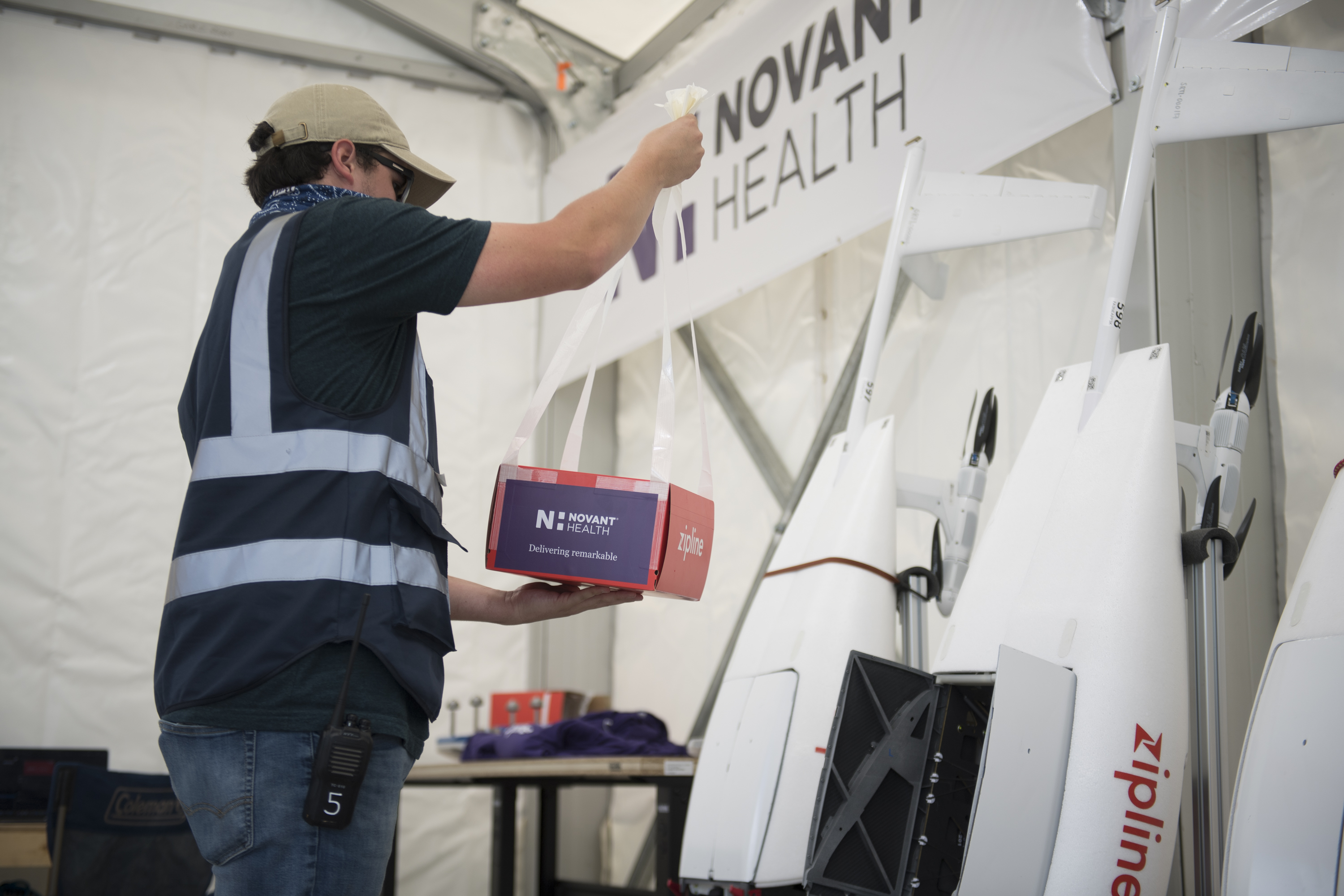
Another startup developed in Africa, Zipline, was tapped by U.S. healthcare provider Novant for drone delivery of critical medical supplies in the fight against COVID-19.

The two announced a partnership whereby Zipline’s drones will make 32-mile flights on two routes between Novant Health’s North Carolina emergency drone fulfillment center and the nonprofit’s medical center in Huntersville — where front-line healthcare workers are treating coronavirus patients.

Zipline and Novant are touting the arrangement as the first authorized long-range drone logistics delivery flight program in the U.S. The activity has gained approval by the U.S. Federal Aviation Administration and North Carolina’s Department of Transportation.

The story behind the Novant, Zipline UAV collaboration has a twist: The capabilities for the U.S. operation were developed primarily in Africa. Zipline has a test facility in the San Francisco area, but spent several years configuring its drone delivery model in Rwanda and Ghana.

Image Credits: Novant Health

Co-founded in 2014 by Americans Keller Rinaudo, Keenan Wyrobek and Will Hetzler, Zipline designs its own UAVs, launch systems and logistics software for distribution of critical medical supplies.

The company turned to East Africa in 2016, entering a partnership with the government of Rwanda to test and deploy its drone service in that country. Zipline went live with UAV distribution of life-saving medical supplies in Rwanda in late 2016, claiming the first national drone-delivery program at scale in the world.

The company expanded to Ghana in 2016, where in addition to delivering blood and vaccines by drone, it now distributes COVID-19-related medication and lab samples.

In addition to partner Novant Health, Zipline has caught the attention of big logistics providers, such as UPS — which supported (and studied) the startup’s African operations back to 2016.

The presidents of Rwanda and Ghana  — Paul Kagame and Nana Akufo-Addo, respectively — were instrumental in supporting Zipline’s partnerships in their countries. Other nations on the continent, such as Kenya, South Africa and Zambia, continue to advance commercial drone testing and novel approaches to regulating the sector.

African startups have another $100 million in VC to pitch for after Novastar Ventures’ latest raise.

The Nairobi and Lagos-based investment group announced it has closed $108 million in new commitments to launch its Africa Fund II, which brings Novastar’s total capital to $200 million.

With the additional resources, the firm plans to make 12 to 14 investments across the continent, according to Managing Director Steve Beck.

On-demand mobility powered by electric and solar is coming to Africa.

Vaya Africa, a ride-hail mobility venture founded by Zimbabwean mogul Strive Masiyiwa, launched an electric taxi service and charging network in Zimbabwe this week with plans to expand across the continent.

The South Africa-headquartered company is using Nissan Leaf EVs and has developed its own solar-powered charging stations. Vaya is finalizing partnerships to take its electric taxi services on the road to countries that could include Kenya, Nigeria, South Africa and Zambia, Vaya Mobility CEO Dorothy Zimuto told TechCrunch.

The initiative comes as Africa’s on-demand mobility market has been in full swing for several years, with startups, investors and the larger ride-hail players aiming to bring movement of people and goods to digital platforms.

Uber and Bolt have been operating in Africa’s major economies since 2015, where there are also a number of local app-based taxi startups. Over the last year, there’s been some movement on the continent toward developing EVs for ride-hail and delivery use, primarily around motorcycles.

Beyond environmental benefits, Vaya highlights economic gains for passengers and drivers of shifting to electric in Africa’s taxi markets, where fuel costs compared to personal income is generally high for drivers.

Using solar panels to power the charging station network also helps Vaya’s new EV program overcome some of challenges in Africa’s electricity grid.

Vaya is exploring EV options for other on-demand transit applications — from mini-buses to Tuk Tuk taxis.

In more downbeat news in May, Africa-focused tech talent accelerator Andela had layoffs and salary reductions as a result of the economic impact of the COVID-19 crisis, CEO Jeremy Johnson confirmed to TechCrunch.

The compensation and staff reductions of 135 bring Andela’s headcount down to 1,199 employees. None of Andela’s engineers were included in the layoffs.

Backed by $181 million in VC from investors that include the Chan Zuckerberg Initiative, the startup’s client-base is comprised of more than 200 global companies that pay for the African developers Andela selects to work on projects.

There’s been a drop in the demand for Andela’s services, according to Johnson.

More Africa-related stories @TechCrunch  

African tech around the ‘net


6 Guidelines to Follow to Nail Job Interviews

Job interviews can be scary and can put you under quite some stress if you don’t have much experience with them. These tips can put you at ease and nail the interview.

[[ This is a content summary only. Visit my website for full links, other content, and more! ]]


Register.com Upgrades Platform, Discontinues Some Legacy Products

register upgrades platform

Register.com has announced new and revamped services to its platform infrastructure in a bid to improve its customer experience. The new offerings by the domain name registration, web site design and management services company come with improved pricing.

According to the company, the updated features will provide its customers with additional features that will help build and expand their digital presence. Among the significant products available on the platform now include WordPress, Microsoft 365 and advanced website security tools. These upgraded solutions will enable Register.com to improve pricing across its entire product portfolio, including Domains, Websites, Email and Web Hosting.

Register.com Upgrades Platform

“These latest enhancements underscore Web.com Group’s vision of leveraging the strength of its business and core offerings, focusing on the customer experience, and continuing to develop and deliver the latest online technologies for today’s always-on digital world,” says Sharon Rowlands, CEO and President of Web.com Group, in the press release.

What’s New at Register.com

As part of the system overhaul, the company is introducing a new Account Manager that comes with common sense navigation and clear labels. This makes it easier than ever for customers to manage their digital services and launch new tools. The inclusion of this feature allows customers to experience more intuitive interactions, a clean interface, and a modernized look highlighted by a fresh color palette.

This will come in handy for businesses looking to create more impact on their website. In addition to simply creating a website, businesses will have a choice of templates to choose in a bid to attract customers to visit the site, stay around, and come back often.

As a result of these improvements, Register.com is announcing it is doing away with legacy products that are no longer aligned with the updated infrastructure. The benefit to customers according to the company, is immediate access to cutting-edge tools and technologies. This the company says can help them achieve even greater success in the digital economy.

The revamped features have also come with discounts for customers. For example, the starter plan which was set at $13 a month has been reduced to only $10 a month. The starter package includes domain name and hosting; easy web building and editing; mobile-friendly design; website performance analysis; 2GBs of email storage; daily backup of website files and more.

On the other side of the spectrum is the best value marketing package, which is now  $20 per month down from the previous $27. This comes with all the bells and whistles that a business might need for a strong online presence. It includes full support for your website such as e-commerce, security, email service, analytics and others.

 What is Register.com and How Can Small Businesses Use it?

Founded in 1999 Register.com provides internet domain name registration services. The services it offers include email, web hosting, domain name forwarding and name management. In 2010 Register.com was acquired by Web.com for about $135 million. Register.com has some 2.5 million customers which range from individuals and small businesses to large corporations.

Register.com offers businesses a do it yourself option to build their own website in three easy steps. This comes with a free domain name, easy website builder, an option to use its stock image library, personalized emails and much more. For those who are less sure of their website prowess a do it for me option is also available.

Its e-commerce website solutions come with customizable design, an online product catalog and an easy shopping option for handheld devices. Best of all, the basic package for your online store is $7 a month. This includes 10 email boxes; 25 products; 1 GB storage and a free domain. Register.com will charge a transaction fee of 1.25%. Other robust features are also available in its Online Store Plus ($9/month) and Online Store Premium ($19/month) packages.

With Register.com’s affordable prices, businesses can now navigate across the roadblocks towards managing professional websites. This being able to build customer goodwill, collect customer feedback, and support other sales channels.

“These improvements are just the beginning for Register.com, as we plan to launch even more exciting new products and features in the coming months”, promised Rowlands.

READ MORE: 

Image: register.com

This article, "Register.com Upgrades Platform, Discontinues Some Legacy Products" was first published on Small Business Trends


Zoom’s earnings to test hot tech valuations

Hello and welcome back to our regular morning look at private companies, public markets and the gray space in between.

This week will see two richly-valued SaaS business share their Q1 earnings reports: CrowdStrike and Zoom. Both are 2019 IPOs, but these relatively young public companies have enjoyed a strong run in the public markets this year.

Zoom started off 2020 worth around $69 per share; today it is worth $179.48 ahead of the start of today’s trading. CrowdStrike started the year at a little over $49 per share; today it’s worth $87.81 per share. The business-focused, but consumer-friendly video chat service Zoom and the cybersecurity-focused CrowdStrike are perfect examples of the updraft that SaaS businesses have rode this year.

With both firms reporting earnings at the same time, we’ll get notes on the work-from-home trend, and how it is impacting services that help make remote-work possible; and, CrowdStrike’s earnings will inform us on how the cybersecurity space is performing — are businesses shelling out more than expected to keep their networks and employees safe when so many are out of the office?

If Zoom and CrowdStrike report results that disappoint investors, they could do more than just deflate their own shares. Missed earnings reports from either could puncture SaaS valuations more broadly, perhaps impacting private valuations for companies that are in the market for new capital. Why?

Prominence and timing.

Earnings expectations


21+ Best Market Research Tools

21+ Best Market Research Tools

Stories about companies failing to do market research are all too common. For instance, the 1990s saw the introduction of a soft drink with little balls of gelatin floating in it. Sounds appetizing – not! Called Orbitz, the product reportedly tasted terrible too. It launched with an incoherent marketing campaign about coming from another planet. Not surprisingly, the product was a bust.

Marketing professionals study such failures and try to learn from them. The point of many lessons is: if only the company had done its market research. Perhaps held some focus groups or blind taste testings. Then the company could have saved its money.

Conducting market research is just a good business move. Research minimizes risk and positions businesses to use precious resources wisely. And picking the right market research tools saves time and money for startups and small businesses. A good market research tool makes it much easier to gather critical information for decisions such as estimating the size of the market opportunity, how to price products and services, which brand name to use, or which advertising messages resonate with customers.

Best Market Research Tools

Here are the best market research tools to consider.

1. Pew Research Center

The Pew Research Center has copious data on social trends, technology usage, science and many other current topics. Register and you can get access to datasets and reports with excellent charts. Pew does a great job explaining the methodology behind its studies, with good demographic breakdowns helpful to marketing teams. Pew data can help you identify new opportunities and understand your target market.

Price: Free

2. Living Facts

Living Facts is a sister site to the Pew Research Center that can provide information to help you market to potential customers. The site says it “is about Americans today — who we are and how we live.” The site has colorful image infographics, videos, and quizzes and is easy to use. Get a snapshot of consumer trends, demographics, faith, health, work and other topics about American life for your marketing plan or campaign.

Price: Free

3. U.S. Census Business Data

The U.S. Census is a top market research tool. Census Business Builder is a source for conducting market research targeting a single geography. Explore Census Data is helpful for segmenting customers by demographics. The U.S. Census Bureau also provides Data Gems, a collection of videos to better explain how to access census data for your business. Other tools for market research from the U.S. government include:

Price: Free

4. Survey Monkey

To poll people for information or gather customer feedback, one of your best bets is conducting surveys. Survey Monkey is one of the most well-known tools. It’s been around since 1999 and the product is mature and robust. The Basic plan is available at no charge, providing you 10 questions per survey, with up to 40 responses per survey. If you need more, you can upgrade to a paid plan.

Price: Free and Paid Plans from $32 / month

5. Zoho Survey

Zoho Survey is a relative newcomer to the survey software industry, but has quickly ramped up to match rivals. Zoho Survey has a free version which allows you to do 10 questions and receive up to 100 responses, per survey. Zoho has over 250 professional templates. You may need a paid version to give you the flexibility and features you need. Added plus: a full version of Zoho Survey is included at no additional charge in Zoho One subscriptions.

Price: Free and Paid Plans from $20 / month.

6. Keyword Surfer

The Keyword Surfer Extension from Surfer SEO is a great tool for content marketing. You install this cool tool on your Chrome browser, and then when you search in Google you can see the volume of monthly searches for various keywords. The information is right there — no need to do keyword research using another tool. Keyword Surfer helps you see what terms your target audience might be searching for, so you can tailor your website pages to meet the expectations of customers.

Price: Free

7. SEMrush

SEMrush is an SEO (search engine optimization) tool. There are many SEO tools, but SEMRush is popular with marketers and content creators, not just SEO professionals. Its Keyword Magic tool is a powerful way to analyze a broad topic and identify niche subtopics. This helps you analyze your online presence. You can also do a gap analysis showing what keywords your main competitors are getting search rankings for and how you compare. SEMrush is a bit pricey, but extremely helpful for researching your digital presence.

Price: Starts at $99.95 / month

8. Google Trends

Google Trends gives a picture of what people are searching for on the web. It’s one of the best tools to research market trends, and track the volume of searches on products or services over time and by geographic location. You can also gain insight into related topics and related search queries, to spot patterns and identify the terminology the user is most likely to use.

Price: Free

9. Hootsuite

Social media is another important place to do marketing research. Hootsuite has a reputation as a social scheduling tool. But the tool also functions as a way to track social mention activity of your brand and various search terms on channels like Facebook, LinkedIn and Twitter. The free plan is very limited with 3 social profiles and 30 scheduled messages. Most small businesses and marketers serious about social media will need a paid plan.

Price: Starts at $29 / month

10. Facebook Audience Insights

If you use Facebook for marketing purposes, Facebook Audience Insights is one of the best market research tools. Use it to track engagement with your content. You can learn about the demographics and behaviors of your social media fans, or those of any other Facebook page by using. Insights gives you a run down of the page views on your Facebook page, post reach, page likes, actions taken on the page and more. You can also use the “Pages to Watch” feature to identify and compare your page’s performance with others in a similar niche.

Price: Free

11. Twitonomy

If you want a tool to track your social mention and engagement activity specifically on Twitter, try Twitonomy. You can also research activity involving other users and hashtags. You simply sign in for the basic service for free through connecting your Twitter account. Of course, Twitter also provides analytics tools for your own account. So if you don’t want to authorize another app, you can always try Twitter Analytics for social media research.

Price: Free and Paid Plans starting at $20 / month

12. Job Report Sites

Need to track small business hiring and employment? Two tools are helpful for market research by brands offering employment related products and services.

  • Paychex Small Business Employment Watch is a monthly report of job and wage data covering businesses with fewer than 50 workers. The reports break down the data by region, state, metro area and industry. The Paychex report can also be used by small businesses to benchmark worker earnings and hours by industry.
  • ADP Employment Report offers a national employment report on changes in all U.S. non-farm private sector employment. ADP breaks out specific monthly reports on small business employment and franchise employment, by industry.

Price: Free

13. NFIB Economic Trends

Each month, the National Federation of Independent Business (NFIB) issues the Small Business Economic Trends report. The report identifies trends and plans for spending by small businesses. The Small Business Optimism Index is part of the report and measures owner optimism. So it can be a great resource of market research for B2B companies that sell to small businesses. Small business owners can use it to gain a sense of how their peers are thinking.

Price: Free

14. Yelp

You may think of Yelp as the place to visit for reviews about your own business. But it can also be one your top tools to research competitors. Find out what other customers like about your competitors — for example, to identify products or services you might want to add to your lineup. And just as importantly, find out what customers do not like about your competitors and make changes to avoid similar problems.

Price: Free

15. TripAdvisor

TripAdvisor is the key review site for the tourism industry. If your small business is a tourist destination, this is the site for tracking reviews of your own business. You also can do market research on competitors. You can also research similar businesses similar to yours even in other cities and even other countries. Study these reviews to figure out elements you could add to please customers who are attracted to businesses similar to yours. Or, if your business is connected to the hospitality industry, use this site to conduct market research about what’s important to people in destinations and travel, or identify potential partners who cater to an audience similar to yours.

Price: Free

16. Software Review Sites

If you’re launching or produce a software product or service, there are a number of sites that host reviews about competitors.

  • Capterra probably features the broadest array of software categories across industries.
  • G2 emphasizes that its reviews are always verified.
  • TrustRadius returns vendor listings, reviews and comparisons with other software on software searches.

It’s a great idea to look at what people are saying about your competitors — not just about what customers are saying about you. You’ll get the widest range of opinions by checking all the websites. Vendors can pay for premium services, but you don’t need that to do basic market research.

Price: Free

17. Export Information

To take advantage of export opportunities for your small business, see Export Solutions from the International Trade Association. Sections include information on learning how to export, researching foreign markets, finding potential customers and partners and more.

Price: Free

18. International Franchise Association

For small business owners who operate a franchise — or small businesses serving franchise owners — the International Franchise Association maintains a Franchise Industry Research section. Use this tool to do market research on different aspects of the franchise industry.

Price: Free

19. National Retail Federation

For research on the retail industry, the National Retail Federation is excellent. The Research section includes a monthly economic review with a consumer confidence index. The NRF also has a section called Retail’s Impact with retail stats broken down by state.

Price: Free

20. Small Business Statistics

The Small Business Statistics center of Small Business Trends is an essential resource to understand smaller enterprises. It has statistics on the number of small business broken down by state. It also includes information on the percentage of businesses that are small, how many people they employ, the average number of people in a small business, and statistics by industries and demographics.

Price: Free

21. Pick FU

Need to get fast feedback on a new product name or some marketing copy? Then PickFu is for you. PickFu says it matches you with U.S.-based consumers who share valuable feedback on your business ideas, product photos, marketing copy and more. PickFU does not have a free version, but it allows you to poll an audience by either asking for their opinion about something, or by asking them to vote for their favorite option. There are also many different demographic variables you can select, so you can reach almost any target consumer audience that is a match for your product or service.

Price: Starts at $50

Tools Conclusion

We hope you find this list of market research tools helpful. It has never been easier to conduct competitive intelligence or collect market research. As you can see, today much of it can be done online.

This article, "21+ Best Market Research Tools" was first published on Small Business Trends


Equity Monday: Tech’s stance on change, two funding rounds and fintech layoffs

Good morning and welcome back to TechCrunch’s Equity Monday, a brief jumpstart for your week.

A big thanks to start to the whole Equity crew for doing a stellar job last week with the show while I was on vacation, especially to Danny for taking on this particular installment of the podcast. Equity Monday is still pretty new, frankly, so him stepping up and into the role was a huge boon. Thanks, Danny.

Right, so, what did we talk about today?

  • In the face of outrageous police action and systemic racism, most of tech — both public and private, alike — said something or did something in the last few days. We go over some of the latest statements and pledges from the VC and startup world in the episode, but do take a look for yourself and decide if what’s been done and said is enough.
  • For more, read this.
  • Coming up this week: Zoom earnings. Zoom’s earnings report matters a bit more than a regular digest of three-months’ worth of corporate performance. The company is a key plank in the group of companies are have been buoyed by COVID-19 pandemic, meaning that investors that have made similar bets will have their eyes on the videochatting giant’s results. And, SaaS and cloud stocks are trading at all-time highs. If Zoom can turn in good numbers, that run might be able to continue.
  • Tia Health put together nearly $25 million for women-centric telehealth.
  • Beam, a micromobility startup headquartered in Singapore, raised $26 million.
  • And, finally, fintech layoffs. I was off last week but was a bit surprised at the number of fintech companies that were cutting staff. Why? Well, we have a guess or two on that count. (You can read more here, and here, from our own Natasha Mascarenhas for background).

Equity will be back Friday morning with more. Welcome to the week, and please help others as much as you can.

Equity drops every Monday at 7:00 AM PT and Friday at 6:00 am PT, so subscribe to us on Apple Podcasts, Overcast, Spotify and all the casts.


Zynga acquires Turkey’s Peak Games for $1.8B, after buying its card games studio for $100M in 2017

Today, some news of a huge acquisition out of Turkey that represents the first billion-dollar-plus exit for a startup out of the country. Social gaming company Zynga confirmed that it is buying Istanbul-based Peak Games, the company behind popular Candy-Crush-style mobile gaming apps Toon Blast and Toy Blast, for $1.8 billion — $900 million in cash, and $900 million in Zynga shares.

Interestingly, this is the second time that Zynga has made a Peak Games acquisition. In 2017, it purchased the company’s mobile card games business for $100 million (more on that below).

The news caps off a short period of speculation about an upcoming deal, with local tech publications like Webrazzi calling the sale (and correct price) last month.

Peak’s investors had included European VCs Earlybird and Hummingbird Ventures — both active backers of startups in emerging markets in the region — and Endeavor Global (the nonprofit that invests via its Endeavor Catalyst fund). Sidar Sahin, the founder and CEO, had been the company’s biggest shareholder.

As with all M&A in the world of gaming, Zynga is getting a couple of big gains out of this sale.

The first is picking up two very popular titles/franchises that it doesn’t have do develop from scratch (in hopes of investing R&D budget in what it hopes but can’t guarantee will be a hit). Toon Blast and Toy Blast together total more than 12 million DAUs. And on top of that, those two games are some of the highest-grossing among all in Apple’s App Store, ranking among the top-10 and top-20 games in the past two years, Zynga noted in its announcement.

It’s not just about adding popular games content, but expanding Zynga’s advertising business as well. Significantly, Peak Games’ primary users are outside of Zynga’s home market of the US, representing a real growth opportunity for the company to cross-sell other games. Zynga says that bolting on Peak’s games network to its own will boost its number of mobile daily active users by 60%, which mean a lot of scaling up for its ad network.

Of course, sustaining both of those titles and their respective franchises as hits for the long run is not a given — the world of gaming regularly sees blockbusters fizzle out when the next big thing comes along — although these “forever franchises” with their steady popularity have a strong play to be exactly that.

However, the long play is also where the third big asset comes in: talent. Peak has 100 employees working on its current franchises and other games. So while the back ends (and revenues) may be getting combined, Zynga says Peak’s people will stay put and continue to work under the Peak brand on the existing franchises as well as on new projects that are already in development.

Zynga says the deal will close in the third quarter of 2020, and it’s updated its guidance already on the news, sending its stock up more than 5% in pre-market trading. Specifically, Zynga today said it believes the deal will bump up revenues by $40 million for the year, to $1.840 billion.

A startup so nice, Zynga bought it twice

The deal is notable not just because of what it’s adding to Zynga today, but because it highlights some interesting history between the two companies.

Back in November 2017, Zynga acquired one division of Peak Games, its mobile card games studio, for $100 million in cash.

The deal included games like Spades Plus and Gin Rummy Plus, respectively the largest spade and rummy mobile games in the world at the time; and games that were popular in Peak’s home market, 101 Okey Plus and Okey Plus. And according to analysis from Apptopia, it looks like Zynga was set to recoup the money it paid out by 2019, meaning that business is now profitable.

The remainder of Peak Games is another story. If Zynga tried to buy the whole business two years ago, it might have been that Peak was reluctant to sell its remaining two titles — its own Candy Crush crushers — Toon Blast and Toy Blast for anything near $100 million. And with good reason, since (as Zynga itself pointed out) they went on to become some of the consistently highest-grossing games in all of the App Store.

In the intervening period, Zynga tried to create its own rivals, namely Wonka’s World of Candy, but it’s never been as big of a hit as the others. (Apptopia’s Adam Blacker today told me, after I published this piece, that in fact Wonka’s World has made but a tiny fraction of the revenue of Peak’s titles.)

Hence, two years on, Zynga possibly finally found the “right price” for the whole of Peak Games.

“We are honored to welcome Sidar and team to Zynga. Peak is one of the world’s best puzzle game makers and we could not be more excited to add such creative and passionate talent to our company,” said Frank Gibeau, Chief Executive Officer of Zynga, in a statement. “With the addition of Toon Blast and Toy Blast, we are expanding our live services portfolio to eight forever franchises, meaningfully increasing our global audience base and adding to our exciting new game pipeline. As a combined team, we are well positioned to grow faster together.”

“This is a monumental partnership not only for Zynga and Peak, but for the whole mobile gaming industry,” said Sidar Sahin, founder and Chief Executive Officer of Peak, in a statement. “Both companies share a common vision — to bring people together through games. Peak’s culture is rooted in relentless learning and progress, so as we embark on this new chapter in our journey together with Zynga, we remain as committed as ever to our unique culture. We’re very excited for our combined future and what we will accomplish together.”

Zynga and games business strategies aside, this is also a huge deal for Turkey’s tech ecosystem.

Turkey has been a steady presence straddling both the European and MENA markets (much as Turkey’s wider economy and political presence does), but so far with little impact in terms of exits and activity that extend outside of the region.

This acquisition is a testament to the exciting companies and talent that are being developed in the market, and is of course yet another sign of how big tech companies based out of more established centres like the Bay Area will continue to take bigger leaps to tap talent ever further afield, in their ongoing consolidation push and search for both business and audience growth.

One impact of the COVID-19 pandemic has been that many are starting to see a much faster decentralisation in the world of technology. People are working remotely, and some are even planning to move away from tech hubs; and deals are getting done not in person but over videoconferencing links. This acquisition also demonstrates how that is also playing out in the world of M&A, too.


Bonusly, the platform for employee recognition, raises $9 million Series A

Bonusly, a platform that involves the entire organization in recognizing employees and rewarding them, closed on a $9 million Series A financing round led by Access Venture Partners. Next Frontier Capital, Operator Partners, and existing investor FirstMark Capital also participated in the round.

Bonusly launched in 2013 when cofounder and CEO Raphael Crawford-Marks saw the opportunity to reinvent the way employers and colleagues recognize and reward their employees/coworkers.

“I knew that, in order to be successful, companies would be shifting their approach to employee experience and I thought software could enable that shift,” said Crawford-Marks. “Bonusly was this elegant idea of empowering employees to give each other timely frequent and meaningful recognition that would not only benefit employees because they would feel recognized but also surface previously hidden information to the entire company about who was working with whom and on what and what strengths they were bringing to the workplace.”

Most employers use year-end bonuses and performance reviews to motivate workers, with some employers providing some physical rewards.

Bonusly thinks recognition should happen year round. The platform works with the employers on their overall budget for recognition and rewards, and breaks that down into ‘points’ that are allotted to all employees at the organization.

These employees can give out points to other coworkers, whether they’re direct reports or managers or peers, at any time throughout the year. Those points translate to a monetary value that can be redeemed by the employee at any time, whether it’s through PayPal as a cash reward or with one of Bonusly’s vendor partners, including Amazon, Tango Card, and Cadooz. Bonusly also partners with nonprofit organizations to let employees redeem their points via charitable donation.

In fact, Crawford-Marks noted that Bonusly users just crossed the $500K mark for total donations, and have donated more than $100k to the WHO in six weeks.

Bonusly integrates with several collaboration platforms including Gmail and Slack to give users the flexibility to give points in whatever venue they choose. Bonusly also has a feed, not unlike social media sites like Twitter, that show employees who has received recognition in real time.

The company has also built in some technical features to help with usability. For example, Bonusly understands the social organization of a company, surfacing the most relevant folks in the point feed based on who employees have given or received points to/from in the past. In a company with tens of thousands of employees, this keeps Bonusly relevant.

Bonusly has also incorporated tools for employers, including an auto-scale button for employers with workers in multiple jurisdictions or companies. The button allows employers to scale up or down the point allotments in different geographies based on cost of living.

There are also privacy controls on Bonusly that allow high-level employees and leadership to give each other recognition for projects that may not be widely known about at the company yet, like say for an acquisition that was completed.

Bonusly says that peer-to-peer recognition is more powerful than manager-only recognition, saying its nearly 36 percent more likely to have better financial outcomes.

The company also cites research that says that a happy workforce raises business productivity by more than 30 percent.

Bonusly competes with Kazoo and Motivocity, and Crawford-Marks says that the biggest differentiation factor is participation.

“We set a very high bar for how we measure participation and engagement in the platform,” he said. “You’ll see other companies claiming really high participation rates but typically if you dig into that they’re talking about getting recognition every six months or every year or just logging in, rather than giving recognition every single month, month over month.”

He noted that 75 percent of employees on average give recognition in the first month of deployment with an organization, and that number gradually increases over time. By the two-year mark, 80 percent of employees are giving recognition every month.

Bonusly has raised a total of nearly $14 million in funding since inception.


TransUnion Offers Small Businesses Free Employee Background Screenings in Minutes

transunion shareable for hires

TransUnion, the US consumer credit reporting agency, has launched free access to its ShareAble for Hires employment screening tools packages. The ShareAble for Hires package enables small businesses to conduct background checks on prospective employees safely, securely and within minutes.

The screening tool is completely transparent and job applicants receive a copy of the reports. Access to certain elements of the Shareable for Hires employment screening tool packages will remain free until the end of July 2020.

TransUnion ShareAble for Hires

Businesses taking advantage of the screening tool avoid waiting for screening reports. There are no setup fees to pay and the tool is accessible to small business.

Hiring the Right Employees During Times of Uncertainty

The hiring of staff can make or break a business. The need to employ the right candidates for roles has long been recognized and documented.

The coronavirus pandemic has rocked the economy and businesses of almost every industry. Amid the changing business landscape, the need to hire the right employees quickly and efficiently has never been so important. For example, Amazon announced it was hiring 100,000 new employees to meet the surge in online shopping during lockdown.

Within the climate of uncertainty and changing consumer habits and demands, it is more important than ever that businesses fill positions quickly with the right people. Faced with job losses and financial uncertainty, it is also important job applicants are offered jobs without delay.

This is when the ShareAbles for Hires employment screening tool package could prove an invaluable aid for both businesses and job-seekers. As the company states:

“We don’t know what is ahead for your company, but we want to know that we will do what we can to continue to provide support and make sure your business succeeds for the long term. That all start by hiring the right people.”

With the ShareAble hiring tool, small businesses can benefit from a wealth of features designed to make hiring more seamless and efficient. The checks include instant state and county checks, federal watch lists, national sex offender registry and national most wanted.

TransUnion Identity Verification

The package also includes TransUnion Identity Verification and TransUnion Instant Match. Other features include FCRA and state filters, fraud alert checks, name and SSN match reports, and deceased persons SSN checks.

Being available at no cost until the end of July 2020, small business struggling with cash flow and lost income can benefit from advanced employment checks without any cost.

Instant Hiring on the Spot

Jobseekers receive full transparency of the system, consenting online to share the report with their employer. With reports sent on the spot, both employers and employees can enjoy instant hiring.

READ MORE: 

Image: TransUnion

This article, "TransUnion Offers Small Businesses Free Employee Background Screenings in Minutes" was first published on Small Business Trends


Sean Covey Reveals How the 7 Habits Can Help Guide You During These Times

Sean Covey Interview

This is a once in a generation time of uncertainty for small business leaders. Owners are trying to navigate an ever-changing market while inspiring their team with an updated mission of their company.

On the Small Business Radio Show this week, I interviewed Sean Covey, who is the president of FranklinCovey Education. He is the New York Times and the Wall Street Journal bestselling author who contributes the 30th anniversary updated version of his father, Stephen Covey’s “The 7 Habits of Highly Effective People”.

Sean Covey Interview

Sean says that growing up with a business icon, he saw his dad as most teenagers do; “I thought he was kind of weird and out of touch”. When he talked to people who said his father changed theri life, he couldn’t believe it; but when “I was 19, I read one of his famous books and I thought he had matured a ton!”

The publisher contacted Sean many times to contribute to the new version of “7 Habits” and initially he was reluctant. He said that “this is like the Bible and I didn’t  want my dad haunting me from his grave saying you destroyed my work.” Finally, Sean agreed to add insightful stories and modern applications to validate what Stephen had wrote.

The origination of the “7 Habits” is from a time when Stephen Covey was a professor. Sean describes that his father formulated these ideas after researching American literature over the last 200 years. Stephen describes, the first 150 years were character based on principles like integrity, honesty and hard work. However, Stephen found that in last 50 years, it turned to personality and practiced techniques. Sean believes that Stephen was discouraged by this and wanted to create principles that were based on character that were simple and practical.

Sean believes that the “7 Habits” remains relevant today because the “deeper the challenges, the more relevant the habits become because they are based on timeless principles that do not change”. This includes responsibility, hard work, renewal, service and prioritization. Sean says, that “when everything is unstable, you look for a stable force like the concepts in this book.”

Sean’s favorite habit is #5- “seek first to understand then to be understood”. In other words, listen more than you talk. Especially today during such rapid change, the key to effective communication is to understand the other person. Stephen Covey said if you want “to persuade then you need to be persuaded.”

During COVID-19, Sean reiterates that you can’t control what happens to you, but you can control your response. Sean recounts history about Sir Isaac Newton who was in quarantine for a year at age 21 as a result of the Black Plague in Northern England. It was during this time that he created his law of motions. Newton called it his “year of wonder”. Sean said this can be our “year of wonder” to reinvent ourselves and our companies.

Listen to the entire interview on The Small Business Radio Show.

READ MORE:

Image: franklincovey.com

This article, "Sean Covey Reveals How the 7 Habits Can Help Guide You During These Times" was first published on Small Business Trends


5 Tips to Expand Your Business Internationally

Expanding your business internationally presents significant opportunities as well as risks. These tips can help you improve your success rate.

[[ This is a content summary only. Visit my website for full links, other content, and more! ]]


Sunday, 31 May 2020

7 Ways You Can Humanize Your Brand and Win Big

humanize your brand

People are innately social beings. We crave connection and interaction – specifically with other humans. Ten times out of ten, a customer is going to choose to interact with a person over a cold, corporate entity. This puts brands at a distinct disadvantage, but it doesn’t necessarily knock you out of the game.

The most successful brands – the Coca Colas, Apples, and Nikes of the world – don’t allow this inhibiting factor to prevent them from engaging with consumers. Instead of fighting an uphill battle to reset the way people think and interact, they work with the natural tendencies of the human brain. They humanize their brands in ways that make their marketing more relatable and magnetic – and you can, too.

7 Tips to Humanize Your Brand

To humanize your brand is to make your brand feel like a friend that your customers have known for years. It’s not about predictability, but rather familiarity. Your goal is to be relatable and magnetic, consistent and honest, reliable and warm.

Here are some ways you can humanize your brand online and win big:

1. Be True to Yourself

“For many brands, being human is a projection rather than a practice. However, sounding human is different from being human,” GetCraft points out. “Brand humanization is not a simple task that can be enacted merely by social media managers. It should spread inherently from one’s company culture.”

The notion that you should be true to yourself sounds cliché and cheesy, but it’s absolutely essential. We’re not talking about being true to yourself in the sense that you “chase your dreams.” We’re talking about authenticity and consistency.

Your branding should be consistent with who your company really is. If your company is full of quirky individuals who like to have a good time, your branding should be creative and spontaneous. If your company is very professional and pensive, your branding should reflect these behaviors.

When you’re true to your brand, your marketing comes much more naturally. You don’t have to worry about filtering, censoring, or tweaking how you say something. It naturally flows out of what you’re already doing. (And people notice this!)

2. Educate, Don’t Sell

Think about the last time a friend recommended a product to you – a product that you eventually went out and bought. Whether it was a book, a car, or a new restaurant, it’s highly unlikely that your friend came in and delivered a buttoned-up sales pitch. Instead, he made you aware of why he liked the product so much and why you needed it.

Think of your online audience as a group of your friends. Don’t deliver an infomercial. Instead, focus on educating them. Highlight their problems, acknowledge the friction they’re dealing with, and gently mention how your products address these issues.

When discussing your products, focus on solutions, not features. In other words, don’t sell your audience on the fact that your flashlight has twice the lumens as the closest competitor. Instead, help them understand why a brighter flashlight is better and what solution your model offers (in this case, increased visibility and safety).

3. Go Behind the Scenes

People love to see what goes on behind the scenes. It’s why film outtakes, documentaries, backstage tours, and biographies are so popular. Any opportunity you have to take your audience behind the scenes will do wonders for your brand.

Facebook Live is one of the best options. Something as simple as pictures from a company picnic or a blog post about how the idea for the latest product came about can work, too.

4. Leverage Visual Content

Nothing against written copy, but it doesn’t come anywhere close to matching the value of visual content. Sight is one of the strongest human senses. In order to truly connect with people, your brand needs to leverage as much visual content as possible. This includes:

  • Professional quality video content production can help you build your audience and convey meaningful ideas in a way that a traditional blog post simply cannot. Consider using video to showcase your employees and tell your company’s story.
  • Humor is important; you just have to know when and where to use it. Memes can be super effective. (Make sure they’re relevant and appropriate to your brand. Otherwise, they’ll create confusion for your audience.)
  • Original photos. Your customers want to see the people behind the logo. Make sure your Instagram feed is filled with more than product pictures and graphics. Toss in the occasional picture of team members for humanization.

5. Stay Consistent

People occasionally act out of character, but for the most part, people tend to behave in ways that are consistent with their personalities. The same should be true of your brand.

The best way to keep your brand voice consistent is to establish and maintain a brand style guide. Any time a new employee is brought on, they should be required to read this style guide from front to back (regardless of whether they produce content or work in a customer-facing position).

6. Engage Back and Forth

A human-to-human relationship is a two-way street. If one person suddenly stops interacting, the relationship ceases to exist. The same is true with a brand.

It’s important to engage back and forth. Make sure you’re asking questions, answering questions, sharing ideas, and listening. Social media is the perfect environment for this, but you can also engage via blog comment sections, forums and message boards, email, and even podcasts.

7. Work With Influencers

It’s hard to be everywhere at once, even if you have a large marketing team at your disposal. One way to ease some of this pressure and still maximize engagement is to partner with social media influencers.

Influencers should be chosen very carefully (and monitored on an ongoing basis). You want people who reflect your brand values and understand your objectives. They’re free to be themselves, but you need to ensure their true selves align with your brand’s identity at the core. Too much inconsistency will create problems for your brand.

Give Your Brand a Winning Edge

 There are a lot of good brands out there, but very few take the time to humanize their approach in a way that maximizes engagement and produces healthy, long-term relationships with customers. However, you can be the exception.

As you can see, humanizing your brand just means cutting through all of the cold, corporate jargon and showing the marketplace who you really are, what you believe, where your passion lies, and how you can help move people from where they are to where they want to be. Do these things well and you’ll beat the competition with consistency and predictability.

CHECK OUT:

This article, "7 Ways You Can Humanize Your Brand and Win Big" was first published on Small Business Trends