Wednesday, 27 February 2019

Cequence Security hauls in $17M Series B investment to help protect applications

Cequence Security, a startup that helps companies protect applications against business logic attacks, announced a $17 million Series B investment today.

The round was by led by Dell Technologies Capital with participation from Shasta Ventures, the firm that had led the company’s $8 million A round last year. Today’s investment brings the total raised to $30 million, according to the company.

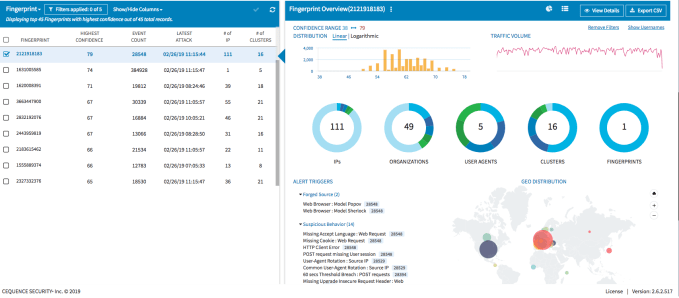
What the company does, according to CEO Larry Link, is protect applications against attacks that look like they could be normal behavior, yet are actually trying to do harm to a service. Specifically, it looks for automated bot attacks on business logic such as content scraping, account takeovers, reputation bongs, shopping bots, fake account creation and denial of inventory.

The company has a three-part approach to protecting applications from these kinds of attacks. First, the discovery phase where it finds vulnerabilities are in an application. Next, it detects who is taking advantage of these openings, and finally it defends against the attack and helps turn them away.

Screen: Cequence Security

Deepak Jeevankumar, who is leading the investment for Dell, sees a seasoned leader in Link, who spent 5 years running sales at Palo Alto Network, helping build the company into a powerhouse. Jeevankumer also likes the technical team, which helped build Symantec’s anti-malware platform. “It’s the perfect combination of top-notch go-to-market leadership and cyber technologists that is winning the confidence of many Fortune 100 customers in a short period of time,” he told TechCrunch.

One of the things that Jeevankumer liked about this approach was how it differed from more traditional application security strategy. “Traditional web application firewalls, DDOS products, RASP/IAST/DAST application security vendors can’t look in to these business logic level attacks as they focus on code-level issues. We are seeing enterprises moving a good part of their cyberspend in to this ‘business logic security’ category,” he said.

While it’s still early days for the company, which came out stealth in November, it is attracting large deals with an average size of $500,000, according to Link. Part of this is investment is going to go toward building its sales and marketing team to create awareness and sell directly to companies like financial services, social media, retail and gaming that could benefit from this kind of protection.

The company was founded in 2014, but spent a fair amount of time building the product before going to market for the first time last year. It currently has 34 employees working out of its Sunnyvale, California headquarters. That number is expected to increase fairly substantially with the new investment.


Threads emerges from stealth with $10.5M from Sequoia for a new take on enabaling work conversations

The rapid rise of Slack has ushered in a new wave of apps, all aiming to solve one challenge: creating a user-friendly platform where coworkers can have productive conversations. Many of these are based around real-time notifications and “instant” messaging, but today a new startup called Threads coming out of stealth to address the other side of the coin: a platform for asynchronous communication that is less time-sensitive, and creating coherent narratives out of those conversations.

Armed with $10.5 million in funding from Sequoia, the company is launching a beta of its service today.

Roussau Kazi, the startup’s CEO who co-founded threads with Jon McCord, Mark Rich and Suman Venkataswamy, cut his social networking teeth working for six years at Facebook (with a resulting number of patents to his name around mechanics of social media), says that the mission of Threads is to become more inclusive when it comes to online conversations.

“After a certain number of people get involved in an online discussion, conversations just break and messaging becomes chaotic,” he said. (McCord and Rich are also Facebook engineering alums, while Venkataswamy is a Bright Roll alum who worked with McCord on another startup before this.)

And if you have ever used Twitter, or even been in a popular channel in Slack, you will understand what he is talking about. When too many people begin to talk, the conversation gets very noisy and it can mean losing the “thread” of what is being discussed, and seeing conversation lurch from one topic to another, often losing track of important information in the process.

And there is an argument to be made for whether a platform that was built for real-time information is capable of handling a difference kind of cadence. Twitter, as it happens, is trying to figure that out right now. Slack, meanwhile, has itself introduced threaded comments to try to address this too — although the practical application of its own threading feature is not actually very user friendly.

Threads answer is to view its purpose as addressing the benefit of “asynchronous” conversation: topics and conversations that can stretch out over hours, days or even longer, around specific topics. Threads doeesn’t want to be the place you go for red alerts or urgent requests, but where you go when you have thoughts about a work-related subject and how to tackle it.

[gallery ids="1789615,1789614,1789613,1789612,1789611,1789609,1789608,1789607,1789606"]

These resulting threads can in turn be looked at as straight conversations, or as annotated narratives.

For now, it’s up to users themselves to annotate what might be important to highlight for readers, although it sounds like Kazi would like to incorporate over time more features that might use natural language processing to summarize and pull out what might be worth following up or looking at if you only want to skim read a longer conversation.

Indeed, in this initial launch, the focus is all about what you want to say on Threads itself — not trying to compete against the likes of Slack, or Workplace (Facebook’s effort in this space), or Teams from Microsoft, or any of the others in the messaging mix. There are no integrations of other programs to bring data into Threads from other places, but there is a Slack integration in the other direction: you can create an alert there so that you know when someone has updated a Thread.

“We don’t view ourselves as a competitor to Slack,” Kazi said. “Slack is great for transactional conversation but for asynchronous chats, we thought there was a need for this in the market. We wanted something to address that.”

It’s may not be a stated competitor, but Threads actually has something in common with Slack: the latter’s launched with the purpose of enabling a certain kind of conversation between co-workers in a way that was easier to consume and engage with than email. You could argue that Threads has the same intention: email chains, especially those with multiple parties, can also be hard to follow and are in any case often very messy to look at: something that the conversations in Threads also attempt to clear up.

The company was actually formed in 2017, and for months now it has been running closed, private version of the service to test it out with a small amount of users. So far, however, the company sizes have ranged between 5 and 60 employees, Kazi tells me.

“By using Threads as our primary communications platform, we’ve seen incredible progress streamlining our operations,” says Perfect Keto & Equip Foods Founder and CEO, Anthony Gustin. “Internal meetings have reduced by at least 80 percent, we’ve seen an increase in participation in discussion and speed of decision making, and noticed an adherence and reinforcement of company culture that we thought was impossible before. Our employees are feeling more ownership and autonomy, with less work and time that needs to be spent — something we didn’t even know was possible before Threads.”

Kazi said that the intention is ultimately to target companies of any size, although it will be worth watching what features it will have to introduce to help handle the noise, and continue to provide coherent discussions, when and if they do start to tackle that end of the market.


In the Spotlight: SquarePeg Hires Finds Applicants with a Better Fit

Spotlight: SquarePeg Hires Uses Technology for Hiring To make Recruiting Easier

Hiring hasn’t always gone smoothly for businesses. It remains difficult to find the candidates to best fit your specific job requirements and company culture. But SquarePeg Hires wants to make the process significantly easier. Find out how they’re working to improve hiring through technology in this week’s Small Business Spotlight.

What the Business Does

Uses technology to help businesses with hiring.

Founder and CEO Claire McTaggart told Small Business Trends this. “SquarePeg helps companies find, assess, and hire top non-tech talent based on fit, not just resumes.”

The company offers tens of thousands of passive candidates on its platform. These candidates get measured for personality fit. But they also get evaluated for environment fit. Other skills, experience, and other key metrics also figure in.

The company’s machine learning algorithm matches the top candidates for any role posted with SquarePeg. And the company sends curated pools of applicants to clients.

This saves time and improves quality of hire. As an SaaS company, SquarePeg can to do this at a much lower price point than a recruiting firm. That’s because the company uses data to generate top matches rather than searching piles of resumes. The data-driven approach also helps reduce biases. It helps the employers using SquarePeg to improve the diversity of their applicant pipeline.

Business Niche

Saving businesses time when hiring.

McTaggart says companies often come to SquarePeg when they’ve failed to find the right pipeline of candidates.

But clients also include businesses spending too much time trying to filter candidates. Some clients also don’t know what data they should be using to quantify what they need.

SquarePeg begins by identifying clients’ ideal hires. Say a detail-oriented and logical thinker who works well in fast-paced unstructured environments. Or perhaps a client needs an employee with a strong SEO background.

In days SquarePeg claims it will identify 10 top notch applicants interested in the role. These candidates will also fit the client’s desired salary range. The system requires far less ‘guess-work’ to understand why potential hires are a match.

In short, SquarePeg wants recruiters and hiring managers to spend less time posting, searching, and filtering. Clients instead detour directly to learning about their top prospects.

Spotlight: SquarePeg Hires Uses Technology for Hiring To make Recruiting Easier


How the Business Got Started

After overseeing the hiring process for a Fortune 100 management consulting firm.

During that experience, McTaggart noticed that the best performing hires weren’t necessarily lining up with what her team was evaluating on a resume. So she started SquarePeg to help businesses find the most relevant information to improve the hiring process.

Biggest Win

Signing up a Fortune 100 client.

McTaggart adds, “It was a truly seamless experience where the client had read a feature article about SquarePeg’s technology in Fast Company, connected with the team’s mission and wanted to be a part of the experience. They involved the most senior leadership in their Talent and Recruiting functions, to really see the potential of what the platform could offer them. This has meant a lot for our team as we have been able to start engaging enterprise level clients at the highest level.”

Biggest Risk

Saying no to an early growth opportunity.

In the early, SquarePeg received interest from companies seeking to use its assessments only for existing applicants. So applicants would take an assessment only to apply for a job. They also would see the job description before taking the assessment.

SquarePeg worried this created bad candidate experience. It also made accurate measurement difficult.

So the company said no despite the revenue these opportunities offered and the potentially easier business model.

Instead, SquarePeg stuck with its mission. The company focused on solving the pain-point they’d identified from the beginning. This saved them from being just another player in a crowded field.

“Looking back, had we chosen short-term revenue growth early on, we would have been taken on multiple directions and not remained focused,” McTaggert says.

Lesson Learned

Prioritize great design.

McTaggart says, “Having the opportunity to do it all over again, we would likely pay a little more attention to the product’s design in the beginning. There’s a general thinking that design doesn’t really matter to your product early on, especially in HR tech where there is a proliferation of Craig’s-list style job boards that are highly profitable. But thinking back, a product that’s designed better speaks to the mission a bit more and enhances the customer’s experience – both on the candidate and employer side – adding a ton of value to your product. At our outset we were focused on the science and tech – and not user-centric beautiful design, which is something we are working hard on at the moment.”

Spotlight: SquarePeg Hires Uses Technology for Hiring To make Recruiting Easier

How They’d Spend an Extra $100,000

Developing analytics and assessment techniques.

McTaggart says, “We would continue to improve our assessment measurement and matching techniques – improving the accuracy while reducing the time to participate in them – as well as develop a suite of analytics for both job seekers and employers. By developing the suite, we are equipping recruiters and hiringmanagers with actionable data that will allow them to really make strategic decisions that will affect their team and the businesses they work in. Adding integrations with applicant tracking systems at a faster pace would also allow us to provide a truly seamless experience for anyone hiring through SquarePeg.”

Company Culture

Wearing multiple hats.

McTaggart explains, “As a startup, every person on the team must wear a lot of hats and play multiple roles at once. We often joke that each person has their real job title – such as CTO, Head of Data Science or CEO, and then their internal job function – tech support, data entry associate, or admin assistant. We all spend a lot of time doing work that isn’t glamorous, but helps us save money or cut corners.”

* * * * *

Find out more about the Small Biz Spotlight program

Images: SquarePeg Hires; Top Image: Claire McTaggart, CEO; Dan Pupaza, CTO; Nitesh Surtani, Head of Data Science; Josh Hamaoui, Head of Business Development; Alisa Leshchenko, Operations

This article, "In the Spotlight: SquarePeg Hires Finds Applicants with a Better Fit" was first published on Small Business Trends


15 Best Influencer Marketing Platforms for your Business

What is the Best Influencer Marketing Platform?

By working with an individual who has built up a solid reputation and has a barrage of followers on social media, influencer marketing is an effective way to get the word out about a brand and help small businesses target a specific audience.

Influencer marketing platforms provide a direct way for businesses to work with influencers, helping brands build solid campaigns. Such platforms help influencers monetize their social media accounts by helping businesses reach their target customers and build engagement and brand awareness.

Influencer Marketing Platform List

If you’re thinking about giving your influencer marketing campaign a boost, here’s 15 of the best influencer marketing platforms.

CreatorIQ

CreatorIQ is a software platform that empowers businesses in influencer marketing by enabling them to discover leading influencers, micro-influencers and celebrities. The platform also allows businesses to track and monitor key metrics related to marketing influencer campaigns.

FameBit

With the FameBit influencer marketing platform, small businesses can receive proposals from interested influencers and track the metrics of their campaigns from one easy and convenient place. Users simply set their budget and the platform makes it easy to work with leading influencers across all social platforms at a budget that is right for their marketing campaign.

NeoReach

NeoReach provides small businesses help in creating effective influencer marketing campaigns with powerful insights. You can filter through millions of influencers’ insights to find the best influencers to work with your brand. Businesses can use the NeoReach dashboard to manage influencer communication, deals and contracts and feedback on how campaigns are performing.

Grapevine

Grapevine is an influencer marketing platform that combines influencer discovery and analytics with campaign strategy and execution to help brands make the most from this profitable type of marketing.

Hypetap

On the Hypetap platform businesses can search through a client-approved influencer list, which have been selected based on demographic, geographic and engagement data. The platform provides users with comprehensive campaign management that is handled by the Hypetap team. Campaign insights and reporting is also provided on the Hypetap system.

Heepsy

With Heepsy you can have instant access to influencers around the world, who can be searched for by location and category. You can check influencers’ metrics, cost, collaborations and more on this simple-to-use platform.

Mavrck

Mavrck describes itself as an all-in-one influencer marketing platform, which offers users workflow automation, advocacy referral, end-to-end relationship and integrated influencer measurement. The platform also provides loyalty marketing programs.

Scrunch

Through data-driven audience insights and a powerful technology platform, Scrunch helps businesses reach their target audiences, engage with potential customers and make the most out of influencer marketing campaigns. On Scrunch you can search influencers active on a range of social media platforms, including Twitter, YouTube, Facebook and Instagram.

Upfluence

Upfluence’s influencer management system provides tools to help businesses manage their influence relationships. For example, with Upfluence businesses can create lists of suitable influencer marketers for specific campaigns, thereby streamlining and saving valuable time in finding the right influencers for their marketing requirements. With Upfluence, users can also track the performance of campaigns.

BuzzStream

With BuzzStream, you can research influencers, manage your relationships with influencer and carry out a marketing influencing campaign that is personalized and efficient. This highly-effective platform ranks influencers according to their influencing strength by pooling the individual’s social media profiles.

Tap Influence

Tap Influence is focused on overcoming the difficulty of finding the right influencer for a specific campaign by enabling users to search influencers according to demographics and interests. The platform also allows users to track an influencer’s performance data history and cost per engagement.

Open Influence

Open Influence is a data-driven influencer marketing platform designed to make influencer marketing scalable. With the Open Influence system, you can track your return on investment via innovative proprietary technology. Influencers are individually selected to be part of the Open Influence platform.

IZEA

With the IZEA influencer marketing platform, your small business can benefit from having dedicated influencer marketing and content experts at your fingertips through the system’s managed services. With the IZEA Unity suite, users can discover, engage, create, transact, distribute and measure with powerful influencer marketing technology.

Julius

Julius is an effective tool for businesses wanting to capitalize on the power of influencer marketing by allowing users to research, manage and measure influencer marketing programs. On this powerful platform you can discover influencers to align with your brand voice and campaign objectives quickly and efficiently by using over 50 search filters.

Traackr

Traackr enables businesses to benefit from influencer search, discovery, management and analytics to scale the impact their relationship with influencers brings to their brand. By working from one central database, businesses can track workflows with influencers and benefit from data-driven influencer vetting.

Image: Depositphotos.com

This article, "15 Best Influencer Marketing Platforms for your Business" was first published on Small Business Trends


Challenger bank N26 plans to expand to Brazil

Fintech startup N26 plans to launch its retail banking service in Brazil in 2019. The company announced the news on stage at MWC in Barcelona.

N26 has already announced that its next market would be the U.S. at some point during the first half of 2019. Brazil should launch after that.

Right now, N26 is available in 24 European countries, including all of the Eurozone, the U.K., Denmark, Norway, Poland, and Sweden, Liechtenstein and Iceland.

The company reached 2 million customers back in November 2018. N26 says that it now has 2.5 million customers. It has processed €20 billion in transaction volume since its creation in 2013, and customers currently hold over €1 billion in N26 accounts.

Eduardo Prota will be the General Manager for Brazil. He’s worked for Santander, Cielo and various startups. N26 will compete with another challenger bank in Brazil, Nubank. The startup already has 5 million customers and has raised hundreds of millions of dollars.

N26 also recently raised $300 million at a $2.7 billion valuation. It’s clear that the company doesn’t want to stop at Europe. Let’s see if N26 can reproduce the same success on another continent.


Customer Service Phrases: 9 You Should Never Use and 12 You Should

8 Important Tips to Make Your Moving Less Stressful

Moving a home or office can be very stressful. These tips can help you plan ahead and be prepared for the moving day to alleviate some of that stress.

[[ This is a content summary only. Visit my website for full links, other content, and more! ]]


Benefits of Having a Laser Hair Removal Treatment in Watertown, NY

If you are looking for the best way of managing your body hair, you should try the laser hair removal treatment.

[[ This is a content summary only. Visit my website for full links, other content, and more! ]]


Tuesday, 26 February 2019

Why Every Small Business Needs to Worry about Employee Well-being

Happy and healthy employees are more productive and contribute great value to your business. Here is how you can ensure their good health.

[[ This is a content summary only. Visit my website for full links, other content, and more! ]]


For a monthly subscription fee, this startup will send out customized gifts to current and prospective clients at scale

In today’s noisy, fast-paced world, finding a way to let clients and potential customers know that they are top of mind can be a major challenge for companies.

Enter Sendoso, a 2.5-year-old, San Francisco-based online-to-offline startup that promises to source, store and ship anything a business ever needs to send — and track its return on investment, to boot.

How does it work? According to CEO and co-founder Kris Rudeegraap, Sendoso, founded in 2016, already has 110 full-time employees, hundreds of vendor relationships and six warehouses, including its biggest, an 80,000-square-foot space in Las Vegas.

It also has relationships with dozens of workers on whom it can call to help it as it needs them and, as crucially, it integrates with Salesforce, Marketo and Engagio, among other platforms where companies largely live.

Collectively, these various pieces enable an employee to log into Sendoso and — according to a budget that has been preset — click on a contact, type out a customer message and choose a gift if desired, and that directive will show up as a campaign on the company’s end and as an order over at Sendoso, which then gets to work.

Want to send cupcakes to a client in New York? Done. A handwritten note to a prospect in Washington? No problem. See something on Amazon? Sendoso will have it sent to one of its warehouses, then repackage it so that it looks like you did it yourself. Then out the door it goes with a major carrier like FedEx or UPS.

Sendoso — which charges a monthly subscription fee for its services based on a company’s number of users and its sending volume — caters to both tech startups as well as Fortune 1,000 companies, with a client list that includes the marketing data company LiveRamp, the construction management software company ProCore and the call center platform TalkDesk, where Rudeegraap was most recently a senior account executive — and where he says the idea for Sendoso was born.

“Having worked in sales for 10 years, it was clear that customer success was shifting away from this dependence on email because of the digital noise being created.” He sensed that a channel with offline gifts like wine and handcrafted notes (penned by Sendoso warehouse workers) might be the solution.

The idea of business-to-business gifting is far from new, of course, and even though Sendoso is customizing the experience, it also isn’t alone, with other upstarts like Knack in Seattle and Alyce in Boston among many others focused on power gifting.

Still, investors like Sendoso’s packaging, so to speak. Indeed, Rudeegraap tells us the company just closed on $10.7 million in Series A funding to bolster its ranks and accelerate its reach beyond the 15 countries where the service is already available. The round was led by David Sack’s Craft Ventures, with participation from Signia Partners, Storm Ventures, Struck Capital and Hack VC.

Sendoso has now raised $13.2 million to date.


Polis, the door-to-door marketer, raises another $2.5 million

Polis founder Kendall Tucker began her professional life as a campaign organizer in local Democratic politics, but — seeing an opportunity in her one-on-one conversations with everyday folks — has built a business taking that shoe leather approach to political campaigns to the business world.

Now the company she founded to test her thesis that Americans would welcome back the return of the door-to-door salesperson three years ago is $2.5 million richer thanks to a new round of financing from Initialized Capital (the fund founded by Garry Tan and Reddit co-founder Alexis Ohanian) and Semil Shah’s Haystack.vc.

The Boston-based company currently straddles the line between political organizing tool and new marketing platform — a situation that even its founder admits is tenuous at the moment.

That tension is only exacerbated by the fact that the company is coming off one of its biggest political campaign seasons. Helping to power the get-out-the-vote initiative for Senatorial candidate Beto O’Rourke in Texas, Polis’ software managed the campaign’s outreach effort to 3 million voters across the state.

However, politically focused software and services businesses are risky. Earlier this year the Sean Parker-backed Brigade shut down and there are rumblings that other startups targeting political action may follow suit.

“Essentially, we got really excited about going into the corporate space because online has gotten so nasty,” says Tucker. “And, at the end of the day, digital advertising isn’t as effective as it once was.”

Customer acquisition costs in the digital ad space are rising. For companies like NRG Energy and Inspire Energy (both Polis clients), the cost of acquisitions online can be as much as $300.

Polis helps identify which doors for salespeople to target and works with companies to identify the scripts that are most persuasive for consumers, according to Tucker. The company also monitors for sales success and helps manage the process so customers aren’t getting too many house calls from persistent sales people.

“We do everything through the conversation at the door,” says Tucker. “We do targeting and we do script curation (everything from what script do you use and when do you branch out of scripts) and we have an open API so they can push that out and they run with it through the rest of their marketing.”


Zone7 raises $2.5 million seed round to predict injury risk for athletes

Zone7, the company using data and analytics to identify the potential for injuries with athletes, has raised $2.5 million in seed funding.

The company monitors athletes’ performance to determine when they need to be rested to avoid the potential for career threatening injuries.

The company’s technology has managed to attract investors including Resolute Ventures, UpWest, Amicus Capital, Dave Pell, PLG Ventures, along with athletes like the National Basketball Association star Kristaps Porzingis.

Teams in the MLB, La Liga, Champions League, MLS, collegiate athletic departments and Olympic teams are all using the company’s technology, according to a statement.

“Getting injured is one of the worst experiences for any athlete,” said Porzingis, in a statement. “The technology behind Zone7 is extremely impressive and has the potential to change the landscape of sports forever.”

Zone7 uses pattern recognition based on an athlete’s past performance and medical history to determine what course of action is best for the player to ensure that they don’t get hurt. So far, the company says it has achieved a 95% accuracy rate when it comes to predicting injuries and reduced the potential for injuries by 75%, according to a statement.

“Injuries in professional sports cost billions annually, but in the era of big data it doesn’t have to be that way,” said Tal Brown, co-founder and CEO of Zone7. “Professional sports franchises have massive amounts of untapped health and performance data that, when unlocked by AI, can become one of a team’s most valuable assets. By better understanding every athlete’s breaking points and implementing personalized intervention plans to prevent injuries before they occur, teams no longer have to accept injuries as an inevitability.”

Founded by Tal Brown and Eyal Aliakim, two Israelis who served in the military’s elite technology division called the 8200, Zone7’s executive team has years of experience working with Salesforce on the development of its Einstein product and with professional soccer franchises in Israel.

“Professional sports is, for the most part, slow to embrace medical and performance data, and as such, this has historically been a difficult target market to break into. Tal and Eyal have built a compelling product that is making teams stand up and take notice. It’s literally a game changer,” said Raanan Bar-Cohen, general partner at Resolute Ventures, in a statement. “The fact that Zone7 is the first company to show injuries can be avoided by using artificial intelligence, makes us extremely excited to partner with the Zone7 team.”


Sapling, an employee management and on-boarding platform, lands $4 million in seed funding

Sapling, a three-year-old, San Francisco-based company whose employee management and onboarding software is being adopted by a small but growing number of mid-size companies with far-flung workforces, is announcing today that it has raised $4 million in funding from Gradient Ventures, which is Google’s AI fund, and Tuesday Capital, formerly known as CrunchFund.

It quietly secured the funding several months ago and has been using it to ramp up to the 50 people it currently employs.

The company’s founding team is the kind that investors like to see, meaning that in many ways, their previous work experiences led them to start Sapling.

Cofounder and CEO Bart Macdonald has spent his entire career in HR, working most recently in Melbourne, Australia, as a regional director for the global coding school General Assembly, where he hired and managed a 10-person marketing, sales and operations team.

Meanwhile, cofounder Andy Crebar (born in the same Sydney hospital as Macdonald, a day later) also knows the plight of individuals trying to seamlessly onboard new hires, having worked most recently on business development initiatives at a fintech startup called Credible Labs where adding headcount was, as at many companies, a point of frustration.

“I liked that Bart and Andy had lived through their own experiences dealing with crappy HR software in previous positions and thus really understood how customers view the problem,” says Tuesday Capital cofounder Pat Gallagher.  “The fact that neither are technical would have been an issue if we were investing pre product, but by the time we invested, they had proven they could build software that their customers loved.”

In fact, says Gallagher, his team was drawn to Sapling specifically because a handful of the firm’s portfolio companies has been using its onboarding software and “really raving about it.  It’s hard to find HR software that people really like, so that was a big positive for us and helped cut through the noise of the space that they operate in.”

So what’s so special about Sapling? Mostly, it seems, its approach brings together the tools and software that HR execs are already using, including ADP for payroll, or G Suite for productivity, and Lever for recruiting, integrations that also employ a heavy dose of AI to anticipate the behaviors of employees, making it easier for managers to recruit, aid, manage and support current and future staffers.

As Macdonald explains it on the simplest level, Sapling not only provisions software for them but it connects their tools “so they don’t have to  open 10 tabs. All they have to do is run their workflow inside of Sapling so that, for example, an employee can ask for time off in Slack,” and that request will automatically be reflected in the employer’s payroll and benefits systems (once approved).

Sapling currently works with companies with anywhere from 100 to 1,500 employees, including InVision, an eight-year-old commercial platform used by design teams to create digital products for mobile and desktop that is currently investing its Series F round. InVision, which has a large distributed workforce, says Sapling has saved the company 1,000 hours by speeding up communications and making employee engagement far more seamless.

What comes next for Sapling remains to be seen. It’s in an awfully crowded category, with no shortage of all-in-one HR solutions attracting venture capital. In the meantime, with low unemployment creating headaches for many outfits looking to keep its talent, Sapling is smartly positioning itself as an important tool in specifically helping companies with geographically distributed teams to retain and engage employees. Customers like Invision, along with Digital Ocean, KPMG, and Kayak, say it’s working, too.

Above, left to right: founders Bart Macdonald and Andy Crebar, courtesy of Sapling.


How to Protect Your Small Business from Social Engineering Attacks

how to protect against social engineering attacks

No business is safe from social engineering attacks, that includes small businesses. Believing that their company isn’t a possible target is the first mistake that makes small businesses vulnerable. They assume that cyber attackers are only looking at large corporations as prey. True, these big companies provide a bigger target, but cyber attackers don’t discriminate. One should also take into consideration that if there are small businesses, there are also small-time hackers who are just trying to make a quick buck. There are also cyber attackers who are banking on small businesses’ lack of security systems, and so they carry out social engineering attacks on as many small businesses as possible. Every small business should keep in mind that hackers don’t discriminate.

The Most Common Social Engineering Attacks

Phishing

Perhaps the most common of social engineering attacks, phishing means drawing out information from a person or business in order to scam them. If it sounds like fishing, that’s because it is exactly what it is — luring the victim into voluntarily giving their personal information that could be used in scams. Personal information includes names, addresses, e-mail passwords, social security numbers, and credit card numbers.

While a lot of people have heard of the term phishing, some still fall victim to it because of the notion that they are too smart to succumb to such manipulation. What they don’t realize is that phishing sometimes looks all too real. One common phishing method is when an email is embedded with a link that redirects a person to a dubious website that appears legitimate. Since the site looks genuine, then the person will innocently provide their personal information to the fake website.

Another method used is when the cyber attacker sends an email from an email address with the name of a large and credible company. One could easily think that such a large corporation would never be low enough as to prank a small business. That’s exactly how scam works: these scammers make it look legitimate. The same tactic is often attempted over the phone.

Here are ways for you to protect your company from phishing attacks:

  • Education. Every business owner must inform their employees about what phishing is and how it could happen.
  • Online filter. Install an online filter that can detect e-mails that carry viruses or blank messages, as well as spot fishy websites.
  • Security programs. Computer systems should always have the latest security programs.
  • Updated anti-virus. Install anti-virus systems and keep them up-to-date.
  • Encrypted output. Make sure outputs from employees (who are working from home) are encrypted.

Every entrepreneur should also be updated about the current trends in phishing. Businesses should always know what they are up against as hackers up their game. It is not cheap to be a phishing victim. According to the 2017 Internet Crime Report from the Federal Bureau of Investigation, 35,344 entities fell victim to phishing that year. It was the third most common Internet crime that year, just behind non-payment / non-delivery scams and personal data breaches. The total loss from phishing in 2017 was pegged at $29,703,421.

Pretexting

While a bit similar to phishing, this scam is called pretexting because the cyber attacker reaches out to the victim under the pretext of good intention. One common method among pretexters is when they call a victim saying they are doing a survey. The pretexter asks a few questions that seem legitimate. Next, they solicit from their would-be victims more personal information about them. These sensitive data are then used by scammers to steal the victim’s identity.

Another method is by way of a raffle promo. The pretexter calls, texts, or sends an email to the victim about him winning a raffle promo. But before the prize is claimed, the victim is asked to release some of his personal information. When targeting SMEs, the pretexter may try to offer the company some “good to be true” deals on supplies or services.

If you’re a business owner, here are ways to protect your organization from pretexting:

  • Educate your employees. If employees know what they are up against, then they can discern pretexters and avoid releasing personal data to suspicious people.
  • Never release important company information. One could just tell the person on the other end that the basic company information is available publicly, on the company’s website. But if they want more details, they can leave their contact information and a representative from the company will get back to them. Most pretexters would no longer proceed when one asks for their contact details.

Pretexting generally leads to identity theft and / or fraud, which are consistently on the rise in the U.S. According to Javelin’s 2018 Identity Fraud Report, there were 16.7 million people who fell victim to identity fraud in 2017, which is eight percent higher compared to the previous year. The amount stolen had reached $16.8 billion.

Baiting

This is basically just like phishing. Common examples are the offer of free downloads (movies, audio files, e-books, and the likes). But in order for the victim to get the “free” download, he or she should login to the site and input some personal identification. Another method comes in the form of a software update.

Curiosity often leads to easy baiting. A 2006 experiment showed how curiosity is used to easily con people. USB drives were used as bait and scattered around areas that were usually frequented by employees. The employees were just too curious to let go of the USB drives that they not only picked them up, they actually also plugged them into their computers.

Here are ways to protect the business from baiting:

  • Education. Obviously, if all employees know what baiting is and what possible methods there are, they will not fall victims to it. Employees should learn that while curiosity sometimes leads to discovery, it is not always a good thing. They should be cautious all the time.
  • Be wary of anything good being offered for free. Anything free should be validated and any entity offering anything for free should be verified.

Baiting is also known as Quid Pro Quo, wherein the attacker offers something in return for personal information. Many times, this happens when cyber attackers assume the personality of the IT person and assist the victim with any kind of computer problems they may be facing at that time.

Tailgating

In layman’s terms, tailgating is when one is driving too close to the vehicle in front. In social engineering, tailgating is trying to be familiar with a person from the inside of the company in order to gain access. One common method of tailgating, which is often seen in movies, is when a person (a.k.a. the criminal) waits until an employee opens the door to the company building. The criminal then calls out for the employee to hold the door so he can go in. And that’s how the attacker gains access.

Large companies have sophisticated security systems or a front desk that often checks appointments. Small businesses, on the other hand, are more vulnerable. One well-mannered employee could easily provide access to a tailgater who could then gain access to sensitive information using company data.

Here are ways to protect the business from tailgating:

  • Invest in an identification system that not only limits access to offices but also tracks an employee’s time in and out.
  • Install automatic locks on computers so that whenever there is no activity on them, they automatically enter sleep mode and cannot be accessed again without a password.

No matter how small the business is, every entrepreneur should stay one step ahead of any social engineering attack. According to Verizon’s 2018 Data Breach Investigations Report, every business owner has the responsibility to protect his or her company. Every entrepreneur should make it hard for criminals to crack the company’s security system.

Effective security doesn’t come cheap, but it is a good investment. Didn’t the doctor say that an ounce of prevention is better than a pound of cure? In the case of a business, a social engineering scam could cost the company more money than the cost of investing in a practical software solution or two. Other smart computer investments include security filters that sift out fraudulent e-mails. But then again, cyber attackers are so smart that some e-mails can pass through these filters with flying colors.

Even more important is that everyone in the company is aware of the various social engineering attack methods. Awareness is key — awareness that not all e-mails should be replied to or given attention. Employees should also know that not all links should be clicked. This is why every business owner should also invest in a regular security training program for all employees – as criminals are also continuously sharpening their methods. Every year, new methods of carrying out social engineering attacks crop up, and all employees should learn about these developments.

All it takes is one employee to make a mistake and fall victim to a social engineering attack, and the whole company could become vulnerable. So, every entrepreneur should protect their business by arming employees with technical knowledge and implementing adequate security policies and programs.

Image: Depositphotos.com

This article, "How to Protect Your Small Business from Social Engineering Attacks" was first published on Small Business Trends


Gradient Ventures, Google’s AI fund, leads $7M investment in English learning app Elsa

Google’s Gradient Ventures, the search giant’s dedicated AI fund, is casting its eye to Asia after it led a $7 million Series A round for Elsa, a startup that operates an app for English language learners.

The deal is Gradient’s first in Asia, and it includes participation from existing investors Monk’s Hill Ventures and SOSV. Elsa has now raised $12 million to date.

Elsa was founded in 2015 as a way to help non-English speakers improve their accent and general speaking ability. Vu Van, CEO and one half of the founding team, is a Vietnamese national who, despite being fluent in English, struggled to be understood after moving to the U.S. to study and then work. Together with speech recognition researcher Dr. Xavier Anguera — the startup’s CTO who leads its Portugal-based tech team — Van started Elsa to help people in the same predicament.

“I was very good at grammar, reading and writing but I realized people had a hard time understanding me because I had a very strong accent and my pronunciation wasn’t proper,” Van, who is based in San Francisco but travels extensively, told TechCrunch in an interview. “This impacts confidence when you apply for jobs or are even just meeting friends.”

“There are so many English learning solutions but they are mostly focused on expanding vocabulary or grammar, very few deal with pronunciation,” she added.

Elsa uses voice recognition and AI to grade a user’s speaking versus standard American English (and I thought us Brits were the global standard…) giving them a score at the end. That helps track their progress, while it focuses on pronunciation with a detailed review on how a user is speaking.

The service uses a freemium model that grants users full access to 1,000 courses for around $3-6 per month depending on the length of the package they select. That ranges from one month of access to 12 months. New content is added every week, Van said.

With this money in the bag, Elsa is going after growth in a number of its most promising markets.

The service has users in more than 100 countries, but Vietnam is its top market, with two million paying users. Partly because it is Van’s home market, Elsa has doubled down on Vietnam with a local sales team and localized payments, including the likes of bank transfers and local wallets.

That’s the blueprint for expansion in its next three target countries: Japan, Indonesia and India. Elsa has opened an office in Tokyo and is planning to introduce more localized content for Japanese users. Similar efforts will happen in Indonesia and India, where Van said the app sees strong engagement and downloads without any paid marketing efforts.

Elsa is also working on expanding its content from English to include other languages. Spanish is currently on the horizon and the company is already preparing the back-end technology to make it possible.

“We have to build the voice recognition technology to recognize those languages accurately. We have the infrastructure but now just need to collect voice data to train the model,” explained Van.

Vu Van started Elsa in 2015 with Dr. Xavier Anguera to help non-English speakers improve their accent and general speaking ability.

Beyond geographic expansion, Elsa is also going after schools and classrooms. Already, in Vietnam, it is working with a handful of schools that have added the app to their classroom work. The company allows schools to upload their specific content or curriculum to Elsa to make it part of a student’s homework or assessment. Teachers can see if a student has completed oral homework, and the app grades their efforts.

“We want to help these teachers help their students,” Van said. “Even with the best intentions, they simply can’t teach speaking.”

The model for the education push sees schools pay a licensing fee per student, which Van said is subsidized, while uploading their content is free.

Snagging investment from Gradient is a notable achievement for Elsa, but it will also allow the startup to tap into the company’s talent, too. That’s because Gradient operates a rotational program that allows Google employees to spend three to six months working at portfolio startups on secondment. That process hasn’t kicked off for Elsa just yet, but Van is hopeful of securing an engineer who might otherwise be prohibitively expensive for her company.

Gradient Ventures was founded in 2017 and this deal is the fund’s 18th, according to Crunchbase. Its previous investments include Canvass Analytics and Test.ai.

The Elsa team


Search marketing company Botify raises $20M

Botify, a search engine optimization company that works with customers like Expedia and Nike, announced today that it has raised $20 million in Series B funding.

Co-founder and CEO Adrien Menard said that the opportunity in SEO is “even bigger now than in the past,” and that the problem is much broader problem than many realize.

“Most people think about SEO in terms of keyword optimization, but
more than 50 percent of the pages in large websites are not being indexed,” he said. So Botify can identify which pages aren’t being crawled by Google, and then make recommendations on how to better organize your content.

Over time, Botify has also launched a keyword product, as well as tools like a JavaScript crawler and mobile versus desktop analysis. Menard said the company now offers a platform designed for “optimization of every stage of the search process.”

The new funding was led by France’s Idinvest Partners, with participation from Ventech. Botify has now raised a total of $27 million.

The company was founded in France, launching in the United States after taking the stage at TechCrunch’s Disrupt NY conference in 2016. Next, it’s opening what it calls a “second U.S. headquarters” in Seattle (the first is in New York City), which Menard said will mostly provide sales and support for West Coast customers.

In addition to announcing the funding and the new office, Botify has also grown its leadership team, with the hiring of Christophe Frenet as senior vice president of product and Rachel Meranus as chief marketing officer, as well as the addition of Neolane co-founder Stephane Dehoche and former BuzzFeed President Greg Coleman to its board of directors.


Dipsea raises $5.5M for short-form, sexy audio stories

A new wave of female-led businesses want to help women get off.

Dipsea, an app-based platform for short-form erotic audio stories, is the latest to grab funding from venture capital investors. The female-founded San Francisco-headquartered startup, which officially launched in December, has raised $5.5 million in a round led by Bedrock Capital and Thrive Capital. The funding comes amid a notable explosion in interest and investment in audio content consumption and creation, as well as an uptick in AirPod sales, easily removable wireless earbuds that encourage listeners to enjoy snackable audio like Dipsea’s erotica.

In addition to Dipsea’s seed financing, podcasting platform WaitWhat secured a $4.3 million round this month. Days earlier, Himalaya nabbed $100 million to scale its podcast distribution tool and a pair of podcast startups, Gimlet and Anchor, sold to Spotify in a nine-figure deal.

Meanwhile, as the audio content space booms, more attention is being paid to female entrepreneurs eyeing venture capital. Enter Dipsea, whose founders say the business captures the zeitgeist of female empowerment.

Dipsea’s subscription-based app, available for $8.99 per month or $48 per year, offers  short audio stories meant to turn women on. The app’s library, which is poised to expand with the new cash, includes narrative sexy stories and non-narrative guided audio pieces. The stories are designed to be listened to at any time, with the companies examples including solo in bed, while getting ready for a date, or to help turn off boss brain on the way home from work. The subscription business model made me wince at first but auditory erotica doesn’t exactly lend itself to an advertising business model after all and once I listened to a few of Dipsea’s short stories, I understood that service is something many women would pay for.  

Since the onset of internet porn, there’s been a gaping hole in content crafted specifically for women. Most women use “mental framing” to get turned on, meaning they imagine scenarios, often with detailed story-lines and characters to stimulate themselves, per a study by OMGYes & The Kinsey Institute. Dipsea’s sensorial audio storytelling sets the mood and sparks the listener’s imagination.

“Audio is amazing because it’s imaginative, it requires you to paint a picture in your brain that’s very stimulating and it’s super intimate and very personal,” Dipsea co-founder and chief executive officer Gina Gutierrez told TechCrunch.

The brand and design strategist started Dipsea alongside chief technical officer Faye Keegan, a former product manager at Neighborly. Gutierrez said she came up with the idea while meditating with Headspace, a wellness app.

The founders have prioritized diversity of perspective, working with freelance writers of different backgrounds on various episodes, as well as consensuality, ensuring a form of verbal consent is worked into storylines. They recently hired their first staff writer. 

“To me the future of entertainment is sensory,” Gutierrez said. “This felt like it could be a medium for women that hadn’t been harnessed or attempted before.”


Don’t Be Fooled by the Latest Email Scam

latest email scams

The Council of Better Business Bureaus (CBBB) is warning of a current really clever email scam.

How did the CBBB know about this email scam?

The Better Business Bureau (BBB) nearly fell for it.

Latest Email Scams

This latest scam pretends to be an alert from the project management software your company might be using. If you’re not careful or busy and preoccupied, there’s a good chance it will fool you. You’ll click on the email to respond to your manager, team project coordinator or another official sounding title the scam has used.

Once you open the email, you grant access to your computer or download malware.

Hackers can get personal details about employees, financial data, passwords, and even customer information if the data is stored on the same system.

Avoiding Workplace Scams

Avoiding workplace scams requires a comprehensive security policy across the entire organization with strict governance. Having a system in place to quickly report any suspicious activity and taking immediate action will mitigate serious damage to your business.

Because no matter how good the security system you have in place is, it will always fail if only one person doesn’t follow the protocols you have in place.

The BBB says always be suspicious of unsolicited emails. If you’re not sure about the email, confirm it by going directly to the website instead of clicking the email. Because once you click it, the damage is already done.

If you are at work and you receive an email to join any new groups, make sure you know it comes from within your company or another organization you know. Again, if you are not sure get in touch with the person who supposedly sent the invitation to verify it.

In addition to official invitations, scammers also use phony emails posing as messages from office scanners, printers, IT systems, and other software. With this approach, the scammers are looking to pass off a short email as harmless in the hopes you’ll click on it quickly without thinking.

Email Threats

The 2018 Data Breach Investigations Report from Verizon said almost half or 49% of malware in the workplace was installed through emails. According to the report, this is because workers couldn’t identify a phishing email.

In the report, Verizon warns, “Most attacks are opportunistic and target not the wealthy or famous, but the unprepared.”

If you are a small business owner, this warning is a wakeup call. Whether you are a sole operator or you have many employees, you have to increase awareness of the entire digital threat environment at all times. This includes knowing how to spot a phishing email.

What if you Fall for the Scam?

If you fall for the email scam and you open it, the BBB says don’t panic. According to the organization taking immediate action without thoroughly thinking it over is what the scammers want you to do.

The BBB says don’t give in to your fear, so thoroughly research what has taken place before you make any decision.

Consult your IT security expert if you have one. If you don’t have an in-house expert you can go to BBB.org/SmallBusiness for resources and advice.

While you are at it please report the scam and your experience at BBB.org/ScamTracker. This informs other small businesses about the scam so they won’t fall victim to it.

The ScamTracker is a great way to stay abreast of the latest scams being perpetrated by criminals across the country. If you want to learn more about scams you can go to the  BBB.org/ScamTips  and at BBB.org/PhishingScam.

Image: Depositphotos.com

This article, "Don’t Be Fooled by the Latest Email Scam" was first published on Small Business Trends


YieldStreet raises $62M to democratise alternative investments in shipping, real estate and more

There has been a wave of fintech startups emerging that make different kinds of investing more accessible to a wider pool of people, and today one of them has raised a substantial round of money to help fill out its mission.

YieldStreet — which provides a platform for making alternative investments in areas like real estate, marine/shipping, legal finance, commercial loans, and other opportunities that in the past were only open to institutional investors — is today announcing that it has raised $62 million in a Series B round of funding.

Cofounder and CEO Milind Mehere said in an interview that the money will be used to build a fundamental expansion of the platform so that any interested party can invest.

With a view to improving everyone’s financial lot in life, the name of the game is capitalism, and more specifically democratising the opportunity to invest, making it possible for more people beyond the often-cloistered and clubby environment of the investment world.

“In order for consumers to move to financial security and financial independence, they should be given access to the same products institutions have,” said Mehere. “This is about creating the most wealth out of people’s money, irrespective of their networks.”

The round was led by Edison Partners, with participation from Greenspring Associates, Raine Ventures and a large multi-billion dollar NY family office. YieldStreet’s valuation is not being disclosed with this round. Prior to this, the company raised around $116 million, with $100 million of that in debt, according to PitchBook.

To date, YieldStreet has seen more than $600 million invested on its platform from over 100,000 members, with an expected 12 percent IRR and more than 300K principal and interest payments made to its investors. Up to now a person had to be an accredited investor to benefit from this. That was already a progression on those investments being restricted only to institutions, but it is still a relatively small pool of users. In the US, where YieldStreet operates, being an accredited investor has a specific set of criteria that includes individuals having a net worth of at least $1 million and income of $200,000 or more.

The plan is now to use the funding to expand the funnel by creating new vehicles for investing that will not require people to be accredited to get involved. This will build on groundwork the company has already laid with YieldStreet Wallet, a savings account that provides 2.2 percent interest, which is open to everyone.

The idea will be to offer non-accredited investors investment vehicles, created by YieldStreet, where they will be able to access multiple products, Mehere said. “We are working through the legal and regulatory aspects now.” He added that the company is also looking at ways of tapping into retirement and IRA accounts for these users as well.

The Jobs Act in the US, and the wider growth of people shifting all of their financial services online, have created a landscape of startups that are liberalising how capital moves. Many of these are specifically freeing up the arcane and rarified world of investment. They include companies like Robinhood, which has built a platform for trading public stocks. In the area of private investment — that is, investing in businesses and opportunities that are not publicly traded — we have seen PeerStreet, which is offers a service similar to YieldStreet but focusing on real estate. In the UK, you also have startups like LendInvest which lets property buyers bypass traditional mortgages by letting others put up the funding for those purchases.

“The ability for individual, accredited and non-accredited, investors to access products that previously were only available to institutional investors is a key part of fintech’s promise to leverage technology to create access and reduce fees on these types of investments. In addition, lower fees can be passed on to investors to allow them to achieve a higher return,” said Chris Sugden, managing partner, Edison Partners, in an email. (Sugden will also be joining the startup’s board with this investment.) 

What’s interesting is that the sheer number of fintech startups, even if you only focus in on those centered around investing, will inevitably lead to some M&A down the line, and that is an area that YieldStreet will also be exploring ahead.

“We do see consolidation or another theme we call, ‘rebundling’ as well,” said Sugden. “Over the next few years we will hear more about the convergence of service offerings under a single platform. In my opinion, retail investors would like to get all of their financial services in a single, mobile application. Thus a key driver of consolidation will be the ability for sites such as YieldStreet, that are set up initially as a single product, to build or acquire new offerings. Whether these new offerings are by investment type, asset class, geography or structure all are critical to attracting investors at scale.”