Tuesday, 30 April 2019

The Secret Guide to Adding New Income Streams to Your Business

Ways to Add New Income Streams for Your Small Business

When you’re self-employed, increasing business is a constant effort. Normally, you’ll do this by growing your main business. But you can also do it by adding income streams, from sources not directly related to your main business.

Usually those income streams will mostly provide additional revenue. But sometimes they can even be used to increase your primary business.

New Income Streams

Let’s take a look at a few ways to make that happen.

Start a Blog For Your Business

So much of today’s business takes place on the Internet. One of the best ways to increase your income is by positioning yourself as an authority in your field. You can do this by starting a blog related to your business.

The basic idea is to become a preferred information source for customers. In most cases, when people go to the web they’re not looking to buy something. They’re looking for information. And while it may seem as if providing information will hurt your business, it can actually have the opposite effect.

By providing a steady stream of information related to your product line on your blog, you position yourself as an expert. That builds trust. When customers and clients are ready to make a purchase, there’s an excellent chance they’ll buy from you.

Fortunately, you can build a blog easily and inexpensively. In fact, if you use WordPress – which is the most popular blog platform – to start your blog for free.

Make Instructional YouTube Videos on Your Specialization

In a real way, this is taking the blog idea to the next level. A lot of people are visual learners, and videos are a preferred way of gathering information. You can create simple instructional videos and place them on YouTube.

The videos can be specific to your business, and work to drive customers to it, or you can make videos about whatever you have expertise in.

Videos can earn money in two ways. First, they can drive customers to your business. They’re commonly used by businesses to bring prospects to the business website, where they make purchases.

But videos can also be used to generate revenue on their own. This can be done by adding advertising to the videos, like Google Adsense, or by direct selling specific products from each video.

It’s easier to create videos than you might think. There are even videos on YouTube showing you how to create YouTube videos.

This is becoming another common way businesses are increasing their income.

Sell Related Products for Adding Income Streams

You can often add additional income streams by selling products related to your current product line. This is another common business strategy. For example, if you have a business selling organic food, you can add selling organic cookbooks, or books on how to grow your own organic food.

This will also help to create the “one-stop shop” that makes the business more valuable to its customer base. And since the add-on products are related to your main business, it won’t be like stepping out of your comfort zone.

Set Up Dedicated Websites for Specific Products

Most businesses today have a website up and running. But it’s usually designed as something like an online store, to sell the entire line of products and services.

You can move to the next level by creating websites dedicated to specific products. If you have one or more product lines that are particularly important to your business, you can increase sales by creating a dedicated website for each.

This can be a benefit because you’re zeroing in on the specific product, eliminating the clutter that crowds multi-line business websites.

This is also another way of positioning your business or product in the expert status category. You’ll be able to dedicate the entire website to the single product, making it easier to emphasize its value and benefits. And once again, when people come to the web, they’re looking for information, typically about a specific product. Your dedicated website will give them just that.

It might also make it easier to specialize your search engine optimization, enabling you to draw more people to the dedicated website. You can be more specific with your keywords and audience targeting.

You can then link back to your primary website, or create links between your individual product websites.

Add Affiliate Marketing to Your Existing Product Lines

If you have a website or blog, or you’re creating business-related YouTube videos, you might also look into affiliate marketing.

This is a different way of adding additional product lines. Instead of carrying the products directly in your business, you’re instead acting as a lead generation source for other businesses that carry those products.

Literally thousands of companies today are offering affiliate programs. You can even go through a general affiliate program, like CJ Affiliate (formerly Commission Junction), where you can find hundreds of companies.

But you can also approach individual companies. Many will pay you a percentage of each sale that’s generated by your website, blog or video. You can generate the leads either by having advertisements for those products on your website, blog, or video, or you can even write reviews or endorsements of the affiliate products.

This will help to generate additional revenue for your business, but without you having to maintain inventory or fill orders. Due to special coding in the web links, you will be paid a commission when a customer leaving your site goes to another and makes a purchase. It’ll all happen automatically.

Adding Full-on Passive Income Sources

It’s probably just about everyone’s dream — not just business owners — to have passive income sources. You know what I’m referring to, the kinds of revenue sources that produce income without any effort on your part.

The perfect example is interest on savings. Unfortunately, as we all know, interest rates on savings are pitifully low. It may qualify as passive income, but it’s not much income at that.

If you have money to invest, that isn’t earning much in the way of interest income, but you’re concerned about investing too heavily in the stock market, there are some alternatives.

Some passive income sources I’ve found to be the most generous are these three.

1. Peer-to-peer Lending

Websites like Lending Club and Prosper enable you to invest money in loans taken by other people. If you know much about banking, then you know the same bank that pays you 1% interest on your savings, will charge you 10% on a loan.

Peer-to-peer lending puts you in a banker position. But instead of earning 1% on your investment, you earn something much closer to 10%. That’s because you’re acting as a direct lender, with no “middleman” involved in the process. It’s one of the very best passive income sources available.

2. Real Estate Investment Trusts (REITs)

A lot of people would love to invest in real estate – we’ve all seen the get-rich-quick in real estate infomercials. But most of us are also well aware of the challenges it involves. Still, you can invest in real estate – especially commercial real estate – through REITs. These are something like mutual funds for commercial real estate, but they pay a steady income.

One of the advantages is that they are legally required to pay 90% of their revenues in dividends to their shareholders. In fact, the average return on REITs has been around 10%. What’s more, since they’re publicly traded funds, you can sell your position anytime you want.

This is an excellent way to earn income from real estate while you’re busy tending to your main business.

3. Become a Silent Business Partner

Do you know someone who’s running a successful business, and looking to grow? Think about becoming a silent partner to that person. By making an investment in his or her business, you can take an ownership share in the company, entitling you to a pro rata share of the profits.

It’s much like investing in stocks, except you’re investing in a private business. Of course, you’ll have to make sure it’s all nice and legal, complete with contracts. But it’s another way of increasing your income without disturbing your regular business, and without any additional effort on your part.

Final Thoughts on Adding New Income Streams When You’re Self-employed

As you can see, increasing business income doesn’t necessarily mean doing something radical – like buying a new building, or acquiring a competitor. It’s possible to increase your income, and even dramatically, by creating multiple income sources.

If you’re self-employed, you’re actually in a unique position to do this. The strategies above can easily be blended into an existing business of just about any type. All you need to do is adjust the specific tactics to your particular business.

With some creativity, and a little bit of cash, you’ll be able to do just that

Image: Due.com

This article, "The Secret Guide to Adding New Income Streams to Your Business" was first published on Small Business Trends


Vault Platform raises $4.2M to fix workplace misconduct reporting

Vault Platform, a London-based startup that has built software to “re-imagine” workplace misconduct reporting, has raised $4.2 million in seed funding. Leading the round is Kindred Capital, with participation from Angular Ventures, System.One, Jane VC, and ex-Mosaic Ventures Partner Mike Chalfen.

Founded in 2018 by Neta Meidav and Rotem Hayoun-Meidav, Vault is attempting to create a new and better way for company employees to report misconduct, such as workplace bullying or harassment, and in turn replace existing “hotline” systems, which it reckons are underused and often ineffective.

The so-called “TrustTech” offering lets employees easily record incidents in a diary-like space, with the option to only action those complaints when others also come forward. The SaaS consists of an employee app, corporate case management hub, and data and analytics. The latter claims to be able to help enterprises identify repeat problems and manage issues internally before they escalate.

“It’s undisputed that the world of work is going through a rapid change in light of the #MeToo and #TimesUp movements — we realised that one of the underlying reasons for this cultural revolution is the fact that reporting mechanisms are completely broken and what we really witness here is a deficit of trust,” Vault Platform co-founder and CEO Neta Meidav tells TechCrunch.

“Bullying and harassment are prevalent, however only 25 percent of misconduct is reported. This is a long-standing problem, but nowadays the risk lies with the enterprise not just the individual. Companies are waking up to the need of doing things differently”.

To tackle this, Meidav says Vault was created as an “employee-centric” platform that provides employees with a safe diary-like space to record incidents and save related evidence. If and when they choose to report it to their employer, they can do so by choosing “GoTogether,” a feature that allows them to file the report on the condition that they are not the only ones raising the same issues.

“GoTogether is a viable alternative to anonymous reporting, and it ensures that people are coming forward… with substantiated, evidence-based reports,” explains the Vault Platform CEO. “With the prevalent legacy hotline solution, abuse is much more of a possibility, since employees can just ‘tip’ anonymously without any accountability for what is being said”.

Meidav describe’s Vault Platform’s main competition as the “business as usual” solutions: anonymous reporting hotline operators that are traditionally the default for most employers. “They provide very little value for employees and employers beyond ticking the compliance and ethics box,” she says. “Alongside them, we compete with other startups who by large took the idea of anonymous reporting, digitised the same old methodology and turned it into an app”.

Meanwhile, Vault says it will use the funding to scale and expand its presence in North America and Europe. The company says target customers are organisations and enterprises from every sector and industry, typically with more than 1,000 employees. “Our client pipeline is varied, however, the most overwhelming interest has come so far from emerging tech companies,” adds Meidav.


Perkbox, the employee experience platform, raises £13.5M

Perkbox, the London-based startup now calling itself an “employee experience platform,” has raised a further £13.5 million in funding. The round is led by existing investor Draper Esprit, alongside a number of previous Perkbox angels. Prior to this, the company, which launched in 2015, had raised £11 million.

Targeting companies of all sizes, from SMEs to larger businesses, Perkbox’s platform lets employers give employees a number of benefits and rewards to enrich their work and personal life. The broader aim, of course, is to improve retention and staff well-being.

The offering now spans several products beyond its “perks” origins, including card-linked loyalty and medical provision. In addition, Perkbox enables companies to measure employee sentiment to help break down silos between management and teams, and to let employees give recognition to one another. This can either be peer-to-peer or top down from management.

“With this new suite of products, we transitioned from an employee ‘engagement’ platform to an employee ‘experience’ platform,” Perkobox co-founder and CEO Saurav Chopra tells me. “[All] with the aim of helping employers enrich the personal and working life of employees by catering for the full spectrum
of employee wellbeing: financial, physical and emotional”.

Headquartered in London but also with offices in Sheffield, Paris and Sydney, Perkbox says the new funding will be used to finance the company’s expansion operations in Australia and France.

longside this, it will invest in scaling the development and distribution of Perkbox’s new products: Perkbox Medical, Perkbox Insights and the platform’s card-linked PerksGo feature — all of which were launched late last year.


10 Effective Ways to Raise Awareness and Funds for a Cause

Raising awareness and getting funds for a cause requires marketing savvy, social media knowledge and community involvement.

[[ This is a content summary only. Visit my website for full links, other content, and more! ]]


Monday, 29 April 2019

What we want to know in the We Company (WeWork) S-1

With news that the We Company (formerly known as WeWork) has officially filed to go public confidentially with the SEC today, there’s a big question on everyone’s mind: Is this the next massive startup win or a house of cards waiting to be toppled by the glare of the public markets?

No company I follow has as much polarized opinion as the We Company. And while the company will have to reveal at least some of its hand in its official S-1, my guess is that the polarization around the company will not be alleviated until well after it goes public, if ever.

The challenge with understanding its business is how much the details of each of its leases, real estate markets and tenants matter to its bottom line. We already know the top line numbers: the company had revenue of $1.8 billion in 2018, and a net loss of $1.9 billion that year. That led to the received opinion that the company has an extraordinarily weak business. As Crunchbase News editor Alex Wilhelm put it:


ManyChat raises $18M to help businesses tap into messaging

Mobile marketing company ManyChat has raised $18 million in Series A funding.

The startup, co-founded by CEO Mikael Yang, is currently focused on Facebook Messenger. It offers tools for creating a bot on Messenger while also supporting live human chatting (ManyChat says its approach is a “smart blend of automation and personal outreach”), and additional options like advertising to get more users to engage with with your messaging channels.

ManyChat is just one of several startups hoping to build a business around Facebook Messenger bots, but this sounds like a product that businesses are actually using. The company says more than 1 million accounts have been created on the platform, with customers coming from e-commerce, traditional retail, gyms, beauty salons restaurants and more.

Those customers have collectively enlisted 350 million Messenger subscribers, and there are 7 billion messages sent on the platform each month. Plus, with an average open rate of 80 percent, these messages are actually being read.

The funding was led by Bessemer Venture Capital, with participation from Flint Capital.  Bessemer’s Ethan Kurzweil is joining the board of directors, while the firm’s Alex Ferrara also becomes a board observer.

“ManyChat is at the forefront of a major shift in how businesses market to customers,” Kurzweil said in the funding announcement. “It’s not a matter of ‘if’ but ‘when’ email lists and static forms get replaced with a more personalized and conversational approach to customer engagement.”

He added that the company’s work with Messenger is “only the beginning”: “With Instagram, WhatsApp, RCS, and others on the horizon, there’s endless potential to scale.”


Getting a piece of Uber

Menlo Ventures was founded in 1976 but it took 35 years for the venture capital firm to hit the jackpot.

Since the dot-com boom, Menlo Ventures has teetered between good and great. A prolific Silicon Valley investor, it’s never quite reached the heights of Accel or Andreessen Horowitz (a16z), or established the level of name recognition as Benchmark or Sequoia, firms that struck gold with bets on Facebook, Instagram and Snap.

But where others missed the boat entirely on one of the most valuable tech startups of all time, Menlo Ventures gnawed its way into an early deal at the last possible moment.

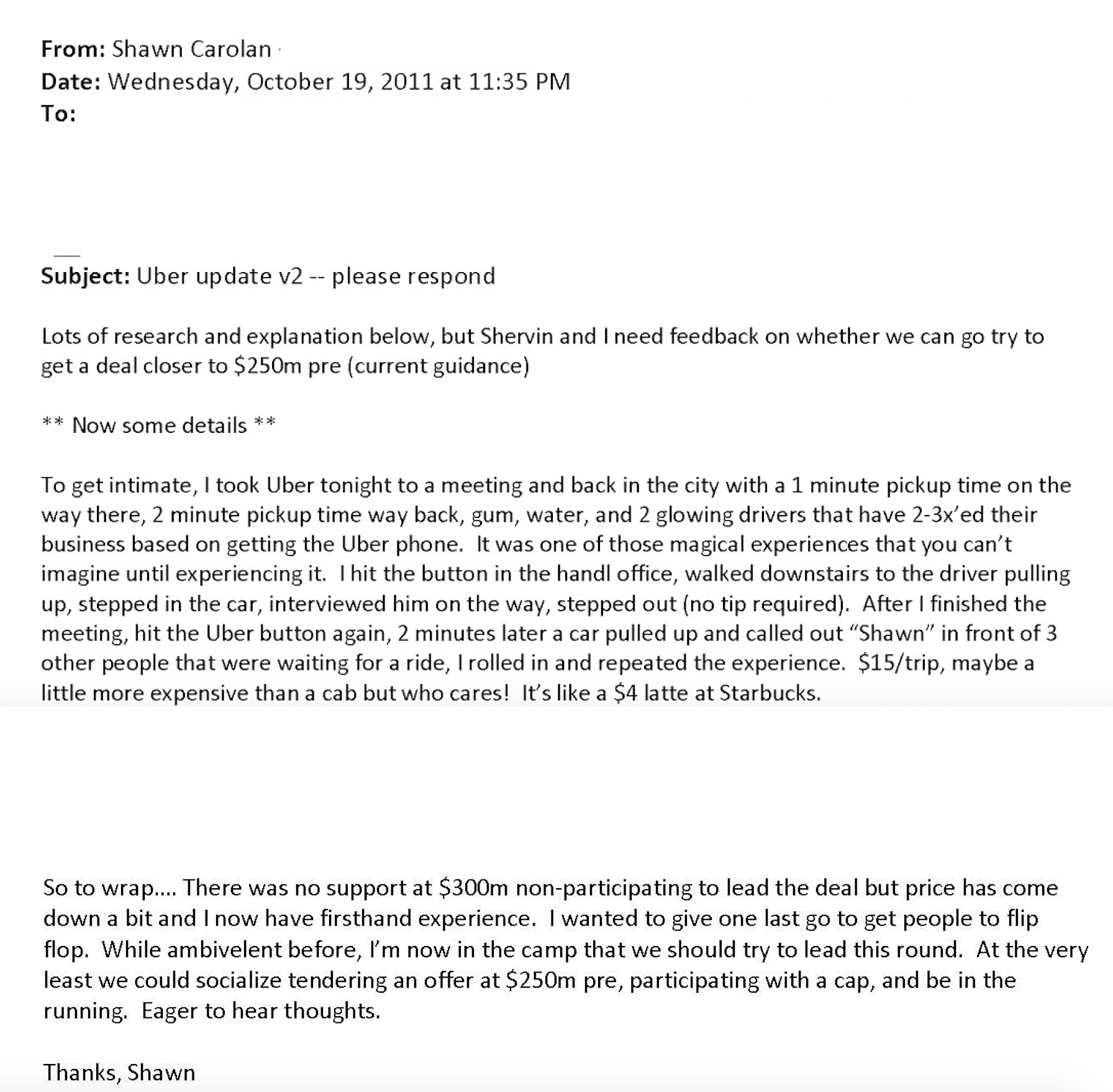
In 2011, the firm led a $32 million Series B funding in a fledgling on-demand car service called Uber, agreeing to value the startup at a colossal $322 million after the company’s first-choice investor, a16z, failed to accept Uber’s sky-high terms. Menlo would go on to invest a total of $66.5 million in the company on expected total returns of up to $3.1 billion.

“I wouldn’t have dared to dream quite this big,” Menlo Ventures partner Shawn Carolan told TechCrunch. Carolan and embattled investor Shervin Pishevar, the former Menlo Ventures partner and founder of Sherpa Capital accused of sexual misconduct, secured Menlo a spot on Uber’s cap table years ago when several firms were vying for a stake.

The pair, according to several discussions with insiders, are polar opposites, representatives of the diverging approaches to deal-making in Silicon Valley. While Pishevar, described to TechCrunch as “overpowering” and “self-promotional,” developed a lasting relationship with Uber co-founder and former chief executive officer Travis Kalanick crucial to the deal, Carolan, a reserved Midwesterner, crunched the numbers and worked to convince his firm that Uber, a young startup with a hot-headed leader, was worth their time and money.

Now, as Uber preps for an imminent initial public offering, the firm wants to shine a light on Carolan, an under-the-radar investor known more for his humility than his portfolio.

Menlo Ventures partner Shawn Carolan’s last-ditch effort to convince his firm to invest in Uber in late 2011.

A historic IPO

As Uber approaches its IPO, a slew of investors that were in the right place at the right time await a payday of unforeseen scale.

Uber dropped its IPO prospectus in early April. Next week, it’s expected to debut on the New York Stock Exchange at a valuation between $80 billion and $100 billion, up from its most recent private valuation of $72 billion. The IPO will be amidst the largest liquidity events for a U.S. VC-backed technology company in history, on par with Facebook’s 2012 public offering that valued the social media empire at $104 billion.

In addition to Menlo Ventures, the Japanese telecom giant SoftBank, Benchmark, Uber co-founders Travis Kalanick and Garrett Camp, Saudi Arabia’s Public Investment Fund and GV, the investment arm of Alphabet, own stakes in Uber worth billions.

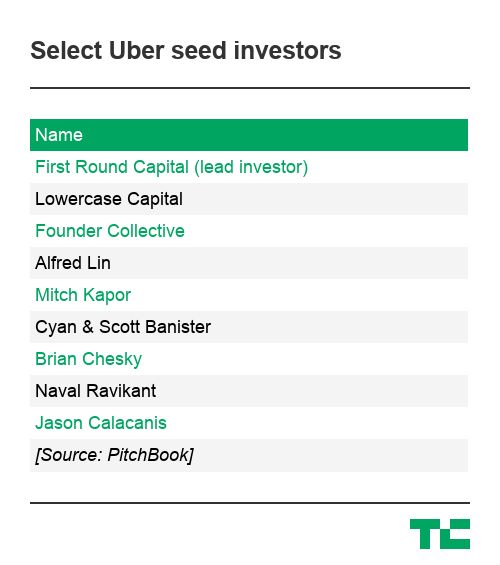
Seed backers like Chris Sacca of Lowercase Capital and Rob Hayes of First Round Capital, who invested in “UberCab” before it had anything to show for itself, will also earn tremendous payouts.

Menlo has already raked in hundreds of millions in profits from its Uber investment, as have several other investors that sold their shares on the secondary market. In 2018, Menlo earned $973 million when a group of investors led by SoftBank purchased nearly half of its Uber stock. The deal represented a 93x return on shares the firm had paid $10.5 million for years prior, according to the firm’s calculations.

Since that transaction, Menlo has expanded its Uber stake through the sale of its portfolio company Jump Bikes to Uber in 2018. The firm had invested $7.5 million in Jump, a provider of a dockless bicycle system, only months before it was acquired by Uber for $200 million. Menlo, as a result, banked another $50 million in Uber stock.

Today, it owns a 2.3 percent stake in Uber worth between $1.85 billion and $2.1 billion, depending on how Uber prices its IPO.

Beers and a term sheet

Uber founding CEO Travis Kalanick.

The story of Menlo Ventures’ investment in Uber dates back to 2005 when Carolan first met Travis Kalanick, Uber’s founder and former chief executive. The notorious entrepreneur was fundraising for an earlier company, a peer-to-peer file-sharing startup called Red Swoosh. Menlo didn’t invest, but Kalanick left a lasting impression.

Years later, Benchmark general partner Matt Cohler called Pishevar on his cell phone to let him know Uber had begun raising its Series B. Pishevar didn’t know Kalanick yet but had been introduced to his fast-growing car-sharing business by AngelList founder and Uber backer Naval Ravikant in 2010.

Pishevar was a garish type who would two years later leave Menlo to launch his own firm Sherpa Capital, a backer of Slack, Airbnb, Robinhood, Hyperloop One and more. Carolan was restrained, focused more on metrics than relationships. Together, the pair worked their way onto Uber’s cap table with Pishever serving as the lead investor externally and internally, both men receiving credit as leads.

Venture capitalists often brag about the skill required to land the best deals, but most of the time, it comes down to luck and timing. Menlo, in this case, got really lucky.

A recent feature on Andreessen Horowitz in Forbes detailed the firm’s biggest misstep: losing Uber. Hours before they were set to sign a term sheet, the firm shifted, offering Uber a lower valuation than what had been promised. Kalanick, known already at that point for his disdain for investors, walked. Little did the Menlo team know they were being used as a “stalking horse for leverage,” according to Forbes’ reporting. So when a16z tried to cheapen the deal, Uber turned immediately to its second-choice, Menlo Ventures.

A16z declined to provide additional details for this story.

“Whenever you have a company of this caliber that has that kind of growth rate, there’s a lot of people that are vying for the opportunity to invest,” Carolan said. “Frankly, there’s never been a company like Uber.”

With a sense of urgency, Pishevar hopped on a plane to Dublin, Ireland at Kalanick’s request. The CEO was speaking at a technology conference called Web Summit. It was there that the term sheets were signed over pints at the Shelbourne Hotel, and a close friendship between Pishevar and Kalanick would begin to blossom. Pishevar, according to The New York Times, later introduced the ride-hail chief to the club scene and Los Angeles celebrity culture. Until Kalanick’s final days as CEO, Pishevar would fiercely defend the founder’s dog-eat-dog style of management. To this day, the two are close friends.

Meanwhile, Carolan was heads down, benchmarking Uber against other tech companies, completing a thorough unit economics analysis and hoping his colleagues wouldn’t be disappointed by the Uber investment, a point of contention among certain Menlo staffers who viewed Uber as a limo dispatch company with an app, not the next billion-dollar business.

“There were a lot of things you had to believe back then and at that moment in time, Uber didn’t paint that picture, [Carolan] was the one who painted that picture,” Mark Siegel, a managing director at Menlo since 1996, told TechCrunch. “And he pounded the table pretty hard.”

After all, Uber was only active in four markets at the time of Menlo’s initial investment: San Francisco, Seattle, Chicago and New York City. Rider bookings were growing fast but were just $1 million per month, with close to zero net revenue after paying drivers. Carolan himself was unconvinced of the business’s longevity until his first ride in an Uber turned him.

Uber declined to confirm early booking figures.

“We had a lot of heartburn over the valuation,” Carolan said. “But it’s the ones you don’t chase, like YouTube, which I kind of dismissed as a lousy business and didn’t chase it. When you see something like Uber that has that type of repeated retention and essentially zero customer acquisition, it’s kind of like, okay, this is just a magical experience that’s going to sell itself.”

Carolan’s commitment was recognized internally but while Uber gained momentum, so did Pishevar. His involvement in Uber brought him notoriety, while Carolan’s role slipped through the cracks. Even when accusations of sexual misconduct against Pishevar surfaced in 2017, his name was often preceded by “early Uber investor.”

Pishevar was accused of sexually harassing several women, including Uber’s very own former head of global expansion, Austin Geidt. The Bloomberg expose highlighting allegations against him came just one month after a report he had been arrested in London for rape. Charges for the reported London incident were later dropped and Pishevar, through his lawyer, has said the other claims were part of a “smear campaign” against him.

Menlo Ventures sought to distance itself from the scandal, naturally, claiming in a series of tweets they had no knowledge of inappropriate behavior during his tenure at the firm.

A self-effacing venture capitalist

A Chicago native, Shawn Carolan joined Menlo Ventures in 2002 as a 28-year-old fresh out of Stanford’s business school. His wife and high school sweetheart, Jennifer Carolan, would make a career as a venture capitalist, too, co-founding Reach Capital, an edtech-focused VC fund coincidentally located next door to Menlo’s San Francisco outpost.

Menlo Ventures partner Shawn Carolan.

In 2009, the Menlo team realized they had overcompensated on enterprise and made the call to pioneer a reinvigorated consumer tech strategy spearheaded largely by Carolan.

In 2011, to bolster the new effort, Carolan hired Pishevar, a rookie VC they hoped would bring a fresh perspective to a firm of engineering geeks. Immediately, Pishevar sourced Square, Jack Dorsey’s hot new payments startup. The team rallied behind him but ultimately, Square went with Kleiner Perkins’s Mary Meeker instead. Later, Pishevar would bring in Pinterest and Snap, mere months after the ephemeral messaging app had launched but the Menlo team passed, according to a source with knowledge of the deals.

In Pishevar’s first six months at Menlo, he invested in Tumblr, Warby Parker, Machine Zone and Uber.

Carolan, for his part, has returned more capital in a single year than any partner in its history, the firm said. In a 12-month period between 2017 to 2018, Roku’s IPO and the Uber stock sale brought in some $2 billion in returns for Menlo, capital that was used to fuel its latest fund, a $500 million vehicle focused on Series B and C-stage startups.

In addition to accumulating a 35.3 percent pre-IPO stake in the digital streaming business Roku, which the firm celebrated with boxes of popcorn implanted with several thousand dollars in cash bonuses for the administrative team, Carolan was the first institutional investor in Siri, the personal assistant application Apple paid a little more than $200 million for in 2010. More recently, he invested in Chime, a mobile banking platform valued at $1.5 billion in March.

Pishevar, since leaving Menlo, has continued to ink deals with high-flying unicorns, including Uber, in which Sherpa invested an additional $200 million. However, since resigning from Sherpa Capital following the sexual misconduct scandal in 2017, he’s kept a much lower profile. Most recently, he signed on as an investor and board member at Bolt Mobility, an electric scooter business in Florida. A 2018 Florida business filing listed him as the company’s sole officer, though the Bolt team recently told BuzzFeed Pishevar was strictly an investor. The Sherpa Capital team, for their part, have relaunched as ACME Capital.

Bolt has not responded to a request for comment.

An implosion

Menlo remained one of the largest institutional backers in Uber for several years, a position that, while lucrative, proved tricky when Uber began to unravel internally.

When Pishevar left Menlo Ventures to build Sherpa Capital in 2013, Carolan assumed the Menlo board observer seat for the next 21 months. Pishevar, now a close friend to Kalanick, stayed on the board as an observer until 2015.

Eventually, Carolan would take a step back from Menlo to focus on his productivity startup, Handle. But when Handle failed to become the rocket ship Carolan had dreamed of, he returned to investing at Menlo full-time with a newfound empathy for founders.

Little did he know he would play a role in the high-profile ouster of one of the most notable tech founders of all time.

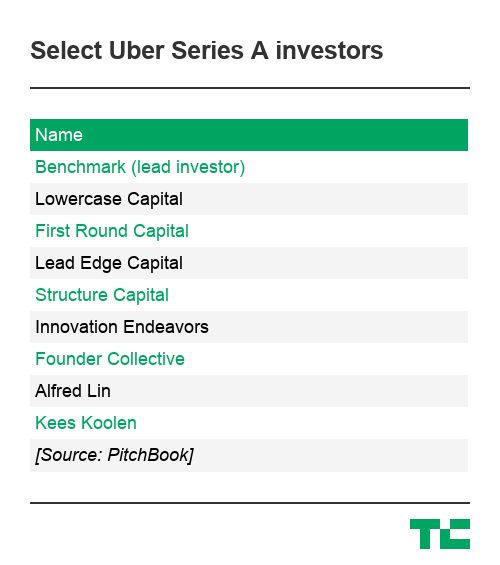
In July 2016, talks of Kalanick’s resignation led by Benchmark general partner and Uber board member Bill Gurley began. Menlo had given up its board observer seat by then, but was part of a consortium of four key early Uber investors (Benchmark, First Round Capital and Lowercase Capital) that controlled the preferred share vote, which was needed to make impactful decisions; for example, approving new board seats or remove a founding CEO.

In 2017, it became abundantly clear that Uber would never achieve profitability nor complete its highly anticipated IPO with Kalanick at the helm. Susan Fowler had published her infamous blog post, executives were quitting, remarks on Uber’s toxic culture could be found just about anywhere and the #DeleteUber campaign had turned social media against the ride-hail company.

Shervin Pishevar (right) looks on as he gives a press conference during the Web Summit at Parque das Nacoes, in Lisbon on November 10, 2016. (PATRICIA DE MELO MOREIRA/AFP/Getty Images)

Uber was going to implode if the board didn’t act. Benchmark’s Gurley took center stage, calling on Kalanick to resign. Pishevar remained a Kalanick confidant and later when Benchmark sued Kalanick, he published a bizarre open letter in an eleventh-hour attempt to sway the public to rally behind the ousted CEO. Carolan, reluctant to be perceived as anything other than founder friendly, turned against the founder and advocated alongside Gurley for Kalanick’s removal.

“I imagine he wouldn’t be particularly happy with me for having done that but you gotta do what you gotta do sometimes,” Carolan said. “Ultimately, our job is to help that company achieve its mission. It’s not an allegiance to any one person at the company.”

Finally, Kalanick gave up the Uber C-suite in June 2017 and former Expedia Group CEO Dara Khosrowshahi stepped in as his replacement. Sixteen months later, Uber would file confidentially for a 2019 IPO.

A lasting impact

Menlo Ventures leaped into cutting-edge consumer investing at a time when its reputation in The Valley was unremarkable. For years, decades even, the firm shielded itself from PR and declined to take the spotlight as the Andreessen Horowitzes of the world touted their successes.

Today, the firm is more accepting of attention, leveraging its Uber position to attract entrepreneurs and foster new unicorns, like the more recent portfolio additions Chime and Carta.

“It has clearly benefited us in terms of the overall perception of the firm and credibility,” Siegel said, admitting he was one of several Menlo partners dubious of its 2011 Uber investment. “There’s no doubt it has been a huge positive.”

In the years since Uber came along, Menlo has made key additions to its team, marking the beginning of a new era for the timeworn investor. In 2015, it hired Steve Sloane, who became the firm’s youngest partner to date when he was promoted earlier this year. Naomi Ionita, the firm’s only female partner, joined in early 2018. And Grace Ge, a fresh recruit from RRE Ventures in New York, started this week as a senior associate on the venture team. Another yet-to-be-announced hire will begin in June.

Uber, despite narrowly avoiding a complete implosion in 2017, has changed the game for many investors. The returns it will generate in the next several months will refresh the coffers of several venture capital funds. Money tied to Uber will flow toward the next generation of founders for years to come, and the investors responsible for its landmark success will boast about it for the remainder of their careers.

Even if Uber doesn’t turn out to be the Wall Street darling its investors hope — Lyft has struggled to accumulate value on the public markets — the company has indisputably transformed the Silicon Valley playbook for hypergrowth and execution in the gig-economy ecosystem.


Diving into TED2019, the state of social media, and internet behavior

Extra Crunch offers members the opportunity to tune into conference calls led and moderated by the TechCrunch writers you read every day. Last week, TechCrunch’s Anthony Ha gave us his recap of the TED2019 conference and offered key takeaways from the most interesting talks and provocative ideas shared at the event.

Under the theme, ‘Bigger Than Us’, the conference featured talks, Q&A’s, and presentations from a wide array of high-profile speakers, including an appearance from Twitter CEO Jack Dorsey which was the talk of the week. Anthony dives deeper into the questions raised in his onstage interview that kept popping up: How has social media warped our democracy? How can the big online platforms fight back against abuse and misinformation? And what is the Internet good for, anyway?

“…So I would suggest that probably five years ago, the way that we wrote about a lot of these tech companies was too positive and they weren’t as good as we made them sound. Now the pendulum has swung all the way in the other direction, where they’re probably not as bad we make them sound…

…At TED, you’d see the more traditional TED talks about, “Let’s talk about the magic of finding community in the internet.” There were several versions of that talk this year. Some of them very good, but now you have to have that conversation with the acknowledgement that there’s much that is terrible on the internet.”

Ivan Poupyrev

Image via Ryan Lash / TED

Anthony also digs into what really differentiates the TED conference from other tech events, what types of people did and should attend the event, and even how he managed to get kicked out of the theater for typing too loud.

For access to the full transcription and the call audio, and for the opportunity to participate in future conference calls, become a member of Extra Crunch. Learn more and try it for free. 


WeWork files confidentially for IPO

WeWork, the co-working giant now known as The We Company, has submitted confidential documents to the U.S. Securities and Exchange Commission for an initial public offering, the company confirmed in a press release Monday.

According to The New York Times, the business initially filed IPO paperwork in December.

WeWork, valued at $47 billion in January, has raised $8.4 billion in a combination of debt and equity funding since it was founded by Adam Neumann and Miguel McKelvey in 2010. WeWork is among several tech unicorns with hundreds of millions, billions actually, in backing from the SoftBank Vision Fund. Recently, the Japanese telecom giant eyed a majority stake in the company worth $16 billion but cooled their jets at the last minute.

WeWork doubled its revenue from $886 million in 2017 to roughly $1.8 billion in 2018, with net losses hitting a staggering $1.9 billion. These aren’t attractive metrics for a pre-IPO business; then again, Uber’s currently completing a closely-watched IPO roadshow despite shrinking growth. Here’s more from Crunchbase News on WeWork’s top line financials:

  • WeWork’s 2017 revenue: $886 million
  • WeWork’s 2017 net loss: $933 million
  • WeWorks 2018 revenue: $1.82 billion (+105.4 percent)
  • WeWork’s 2018 net loss: $1.9 billion (+103.6 percent)

On the bright side, per Axios, WeWork established a 90 percent occupancy rate in 2018, with total membership rising 116 percent to 401,000.

WeWork is often referenced as the perfect example of Silicon Valley’s tendency to inflate valuations. WeWork, a real estate business, burns through cash rapidly and will undoubtedly have to work hard to convince public markets investors of its longevity, as well as its status as a tech company.

WeWork is backed by SoftBank, Benchmark, T. Rowe Price, Fidelity, Goldman Sachs and several others.


Looking to sell your small business? Watch out for these things and you’ll likely get a better price

(This post originally appeared on Philly.com)

It’s still a strong market for business owners looking to exit.

According to a recently released report from BizBuySell, a popular online marketplace for buyers and sellers of companies, the number of firms that were sold during the first quarter of the year continued to remain at historically high levels even after falling slightly from the corresponding period in the previous year. The takeaway is that more business owners than ever are looking to exit.

The reasons are many. Interest rates are still relatively low and financing is readily available. Washington politics, international trade fears, and stock market volatility have been motivating many to sink their savings into more stable and controllable investments. The tax environment — particularly capital gains taxes — remains business friendly. Many small businesses are showing profits that make them attractive to potential buyers.

But most important, the demographics are changing. More millennials are looking to get into business ownership at the same time that business owners are getting older. Studies show that the median age of the typical small business owner is over 50, and as the population — particularly baby boomers — gets older, there’s been more interest in cashing out and hitting the golf course.

“As an owner, this represents an opportune time to exit, especially for retirement-seeking baby boomers,” said Adam Debussy, a senior marketing manager at BizBuySell. “Those owners can capitalize on the high tide, rather than risk entering and having to hold through another recession or having to sell for less than they can today.”

Debussy believes that the current market fundamentals remain strong and will continue to attract more people looking to buy companies as they capitalize on the healthy, baby boomer-fueled inventory of financially appealing businesses.

That’s good news for sellers, right? Well, maybe not for all. Even in this strong environment, many owners are finding themselves selling their businesses for much less than they thought. Why?

“The biggest mistake owners make is not thinking ahead,” said Michael Lefkowitz, a founder and managing partner of Benjamin Ross Group, a business brokerage based in Southampton, Bucks County. “Many owners do not plan for the sale of their business and then the unexpected happens, such as death, divorce, partnership issues, illness, etc. Then the owner is placed into a situation that they have to sell not on their terms and end up leaving significant money on the table.”

Lefkowitz, who has also authored a book on selling a business, says that business owners should start planning for the sale of their companies from the moment they start or purchase it. He believes that too many people run their businesses like a job where they’re no more than just a technician or a salesperson, instead of building an organization and creating a long-term asset.

“If a business owner wants to make their business attractive for sale at the highest price the market will bear, the owner’s role has to be relatively easy to transfer,” he says. “He or she has to work on the business and not in the business.”

That means building an infrastructure that be easily passed on to a third party. It means keeping detailed documentation, clean files and books and records dating back at least three years to show to a prospective buyer. It means polishing up your logo and cleaning up your databases as well as stepping up your social media presence and website. It requires that you have an existing buyout agreement in place to minimize potential disputes with your partners.

It also means figuring out why your company would be valuable to a potential buyer. Do you have a great team of employees? A key location? A unique technology or intellectual property? Maybe your business is run more profitably than your competition, or has an already established and trustworthy brand. These are the things that prospective buyers will want to know in order to determine whether your business fits in with their longer term strategy.

“While reviewing your value, you will likely uncover a few holes or areas that could use touching up,” Debussy says. “Take the time to do so, and you will find yourself in a much better position at the bargaining table.”

Debussy’s advice is indicative of the data.

The BizBuySell report found that the median sales price of sold businesses dropped 8.2 percent from the first quarter of 2018 even though the median asking price rose 4.6 percent. The average number of days a small business is on the market before it’s sold also rose 6.3 percent to 185 days from 174 days last year.

All of this points to business owners believing that the strong economy will be reflected in a higher selling price for their companies even though the market is more competitive than ever and buyers are becoming more particular.

Partnering with a good broker is also critical. Many of my clients resist doing this because they don’t want to pay the commission, which can range between 8 to 12 percent of the selling price and often requires a minimum fee. But by not hiring a broker, they’re likely hurting themselves in the long run. A good broker will have the experience to recognize a seller’s strengths and match that owner with the best buyer possible. They buy and sell businesses for a living and let’s face it: You and I don’t.

“I tried selling the company on my own for five years without luck,” said John DiSantis who formerly owned First Look Display in Bensalem, Bucks County, before selling it last year. “Using a broker was crucial in securing a quick buyer and ultimately closing on the business.” DiSantis gladly paid the additional fees because for him the means certainly justified the end.

“I thought retirement would be great,” he said. “Well, it’s 1,000 times better than I could have imagined!”


Pana raises $10 million Series A to help companies arrange travel for onsite interviews

Your last 10 emails with a recruiter before an onsite interview probably shouldn’t be about rebooking your canceled flight.

Pana is a Denver startup setting its sights on the corporate travel market, with a specific eye towards killing the back-and-forth email or spreadsheet coordination. The startup founded in 2015 has already tried to gain an inroad with consumers, but its $49 per month individual-focused travel concierge plan probably limited its reach.

The company’s latest shot at taking on corporate travel lets companies use the service to outsource dealing with out-of-network “guests.” The startup is looking to take this path as an inroad into the broader corporate travel market, and is making the choice to work with more expansive corporate travel companies like SAP’s Concur rather than against them.

The company just closed a $10 million round from Bessemer Venture Partners. Previous investors include Techstars Ventures, 500 Startups, FG Angels, The MergeLane fund and The Galvanize Fund.

Pana is already booking thousands of trips per month for companies using the service to coordinate business travel for interviewees. Rather than leaving recruiters to the arduous process of back-and-forth messaging to hammer out initial details, Pana takes care of it through an omni-channel mesh of automation and human concierge in-app chat, text or email.

“A key piece of the value proposition is that if you do ask something complex, we’re going to instantly connect you to a human agent,” founder Devon Tivona told TechCrunch in an interview. “When it does go to a person, we have a five-minute response time.”

Getting a flight booked for someone outside the company directory can be challenging enough, but with travel, everything grows infinitely more complex the second that something goes awry. In addition to functioning as a tool for coordination, the startup’s team of assistants are there to help re-book flights or re-arrange travel if everything doesn’t go according to plan.

Even if Pana is working with the big corporate travel agencies today, its investors are banking on the startup accomplishing what the giants can’t at their scale.

“…Whenever a really large incumbent, particularly in software gets acquired, and I’m thinking about when SAP acquired Concur five or so years ago, it creates this massive innovation gap that allows, I’d say, new startups to really reinvent the status quo,” Bessemer partner Kristina Shen told TechCrunch in an interview.

Pana’s current customers include Logitech, Quora and Shopify.


Caribou Biosciences CEO, Rachel Haurwitz will talk CRISPR’s present and future applications at DisruptSF

Seven years ago, Rachel Haurwitz finished her last day as a student in the University of California laboratory where she helped conduct some of the pioneering research on the gene editing technology known as CRISPR, and became employee number one at Caribou Biosciences, a company founded to commercialize that research.

In those seven years, the market for CRISPR applications has grown tremendously and Caribou Biosciences is at the forefront of the companies propelling it forward. 

Which is why we’re absolutely thrilled to have Haurwitz join us on stage at Disrupt SF 2019.

Haurwitz studied under Caribou Biosciences’ co-founder Jennifer Doudna — one of the scientists who discovered CRISPR’s gene editing applications — and Caribou was formed to be the conduit through which the groundbreaking research from the Berkeley lab would become products that companies could use.

Short for “Clustered Regularly Interspaced Short Palindromic Repeats”, CRISPR works by targeting certain sequences of DNA — the genetic instructions for the development and reproduction of all organisms — and then binding them to an enzyme that cuts the specific sequence.

Once edited, researchers can add or simply delete pieces of genetic material, or change the DNA by replacing a segment with customized code designed to achieve specific functions.

There are few industries that CRISPR doesn’t have the power to transform. Already, Caribou Biosciences technology is being used at Intellia, which is developing therapies based on CRISPR technologies (Haurwitz is a co-founder). And that’s just the beginning.

Caribou’s chief executive thinks of her company as a platform for developing technologies in therapeutics, research, agriculture and industrial biology.

Already, CRISPR technologies are being used to biologically manufacture chemicals, replace pesticides and fertilizers, and provide cures for rare diseases once though impossible.

“Any market with bio-based products will be changed by gene editing,” Haurwitz has said.

At SF Disrupt Haurwitz will talk about the implications of that transformation, and what’s ahead for the company that’s leading the charge in this genetic revolution.

Tickets are available here.


4 Creative Ways To Save Money for your Small Business

4 Creative Ways To Save Money

You may call me “Captain Obvious.” But I will point out one of the most important factors in growing a small business. Make sure you are saving as much as possible when purchasing goods and services for your company. Now you may think everyone should know this. But many entrepreneurs aren’t sure how to maximize their spend. And don’t know how to ensure they are buying the type of resources their companies require.

Creative Ways To Save Money

This article will give you some easy tips that will help you save money. When you follow these guidelines, you will have a better cash flow that you can use to invest in other areas of your business.

Use Comparison Sites

Choosing which products and services to purchase for your business can be tough. Depending on your industry, there are likely many different resources you might need to keep your business running efficiently, and each of these items come with different pricing, quality, and service levels. Determining which one is right for your business can be quite taxing at times.

One of the ways small business owners can streamline the process is to use comparison sites that do much of the work for you. They gather the data and the relevant facts of each product and packages them in a way that is easy to understand. In this way, entrepreneurs can take advantage of better pricing and quality without having to spend an inordinate amount of time to discover the right products.

Barter With Other Businesses

As a growing business, bartering is both a fantastic skill to utilize and a great way to save on cash. Other local small businesses are in the same position you are—trying to scrimp and save at every corner. Bartering services is a great way to assist both organizations.

For example, if you are a mechanic and you require plumbing repairs in your office, you could offer auto or appliance services in exchange for them. When you are in need of a service, always try to barter before offering to pay—you may not always succeed, but there’s no harm in trying!

Don’t Buy New Office Equipment

When you’re in need of office materials, there’s no shame in exploring your options. It makes sense to buy gently used equipment when you have the option and bandwidth to do so. New technology, printers, desks, and other daily-use supplies are perfect items to purchase used.

Look at your local newspaper or neighborhood Facebook pages for going out of business sales — these will often have all the furnishings you’ll need to stock your entire office on a budget. In many cases, the used equipment may be just as serviceable as if you had purchased it brand new.

Outsource As Much As Possible

Employees are essential to getting work done, but employee costs—from salaries to office space to insurance—can be the biggest chunk of a small business’s budget. Georgette Pascale, owner of PR Firm Pascale Communications, chooses to keep her full-time staff to a minimum and outsources work to independent contractors for the work that her staff cannot cover as needed.

Deborah Sweeney, CEO of My Corporation Business Services, Inc., uses the same method by hiring consultants as needed; Sweeney maintains that she can not only negotiate a lower rate with consultants, but that her business benefits from their more varied experience in their fields of expertise.

Money Saved Is Money Earned

Making sure that your business is being smart with the way it spends its money is essential to your success. The better you are at preventing unnecessary spend, the easier it will be to grow your business and earn more profit.

Image: Depositphotos.com

This article, "4 Creative Ways To Save Money for your Small Business" was first published on Small Business Trends


How To Create Content For the Finance Niche

Financial Content Marketing

Whether you’re a one-man army running a personal brand or a cog in a giant corporate wheel, you’re aware that content marketing is all the rage nowadays. More than 4 million blog posts go live on the internet every day, with niches ranging from general health and technology to risible cat facts.

So, standing out in this sea of content by investing considerable time and effort in creating high quality, valuable content may seem like a daunting (or even futile) task. Still, according to HubSpot, businesses that blog are able to acquire 67% more leads than the ones who don’t.

And for those wondering, this includes the “boring” niches like finance as well. Even finance professionals have their favorite financial blogs where they can’t stand to miss a single post.

Unsurprisingly then, almost every business, big or small, has jumped on the content marketing bandwagon by simply having a “Blog” section on their website where they publish a few paragraphs every once in a while and call it a day.

Content Marketing is About to Change

That won’t work. At least not in 2019.

Coming back to the finance niche, the savviest of firms that proffer “financial services” – banks, brokerages, internet startups, financial advisors, credit unions, alternative lenders, etc. – are empowering their websites, digital campaigns and consumer outreach with content marketing.

And there is a demand for real-time financial information, people swear by customer data security and look for guidance on all things finance. Websites like StockHead & MoneyControl consistently produce relevant and important finance related information which helps their reader base immensely.

Financial content marketing is there to fulfill this demand.

As of now, 45 percent of financial services marketers claim that their content marketing is carried out on an “ad hoc” basis. Thus, there’s still much room for improvement for companies striving to outperform their rivals and reinforce relationships with their customers.

Financial Content Marketing Tips

You need a result-oriented content marketing strategy if you are to see a positive ROI from all your content efforts. While there are no hard and fast set of rules, here are a few pointers that’ll help create a reliable strategy, especially for the finance niche.

Make Content Consistent and Useful

The first step to win at the content marketing game is a proper game plan. As mentioned before, people seek advice on financial matters all the time. For content marketers, it means delivering high quality, useful content on a consistent basis.

So, create a content calendar that not only ensures you deliver content regularly, but makes you brainstorm all the topics and ideas and put them down right from the off. Also, try to make sure that whatever content you create is absolutely invaluable to your audience. No subjective fluff. For example, Rockstar Finance, a blog focussed on personal finance, has every blog post targeted at helping the audience save money or make money. They post daily without fail, and with intriguing titles that catch your attention.

Understand Your Target Audience

Do you know precisely who your target audience is? What information are they searching for? Creating content for the wrong audience would lead to a huge waste of time and resources.

Finance itself is a very broad niche. Narrow it down and focus your efforts on creating content relevant to the services you offer. That allows you to place the desired call-to-action (CTA) at the end of each post so your readers can easily take the next steps.

Also, use Google’s Keyword Planner to capture and optimize for the right keywords in each post.

Curate and Collaborate

Going at it alone is certainly not your best bet. Even if you post twice a day, every single day, odds of getting the desired visibility (and eventual conversions) are negligible, especially if you’re starting from scratch.

Collaborating with other marketers and bloggers by guest posting is one of the most effective ways to grow your brand and gain new audiences. Moreover, it will boost your search engine rankings and organic visibility too.

So, apart from planning and posting regular content on your own website, you must regularly contribute content to other high authority websites which is crucial for long-term success. Consider the same example of Rockstar Finance, they routinely submit guest posts to the big guns like Business Insider and The Financial Diet which in turn establishes their own authority on the internet.

And it is a two-way street., they don’t write original content every day. They curate it from other bloggers and allow guest posting. It leads to a win-win for both the guest blogger and Rockstar Finance.

Promote Aggressively

Planning and writing great content is just half the battle. Getting all that content in front of the audience is where most content marketers fail.

There are many ways to promote your content: social media, blogger outreach, email marketing, and paid. Figure out which is best for you. If your audience is people seeking advice on personal finance, then building an email list and creating a dedicated Facebook page might be the way to go.

People need an incentive to subscribe to your email newsletter. Offering exclusive content such as a free email course is one way to obtain their valuable email addresses.

On the other hand, if you are a relatively big business with a substantial marketing budget, paid promotions are also worth considering. Paid promotions are not limited to search advertising and paid social media campaigns, but also influencer marketing.

Influencer marketing in the finance sector is quite interesting. While fashion brands are able to leverage the huge social following of celebrities, it’s usually the micro-influencers that can make a huge positive impact for the finance firms. Micro-influencers generally have a following of 10,000 or less, but they cover extremely niche topics and as a result, have a more loyal fanbase. They are relatively much less expensive and using them can be great for boosting brand awareness.

Measure Results

Measuring the performance of your content from time to time is crucial in order to continually improve your efforts. While doing so may seem challenging at first, it gets easier once you clearly and correctly define all the Key Performance Indicators (KPIs) and track them with an analytics tool like Google Analytics.

Wrapping Up

Financial content marketing isn’t completely disparate from other types of industry-specific marketing ventures. However, the fundamental difference is how protective the customers are as compared to other business sectors they like to read about.

We all use banking apps, invest through online platforms, and rely on web advice for helpful financial information. So, getting your content marketing right can significantly improve your business.

The margin for error is much smaller. Inaccurate web copy could mean regulatory noncompliance, and poor user experience can negatively impact your brand. Thus, marketing with authority, intent and, above all, consumer trust in mind is key.

Image: Depositphotos.com

This article, "How To Create Content For the Finance Niche" was first published on Small Business Trends


Improve your Small Business’s FICO Score: 12 Things You Should Know

How to Improve Your FICO Score

A FICO score remains important for small businesses. Because it helps these businesses get loans. But a recent webinar revealed more. “Financial Innovation and FICO Score: What Does it Mean for Small Business” examined what goes into the FICO score. And it looks at how your FICO score can be improved.

How to Improve Your FICO Score

Check out these 10 things a small business can do to improve its FICO score. Remember, good FICO scores range from 750 to over 800. While a FICO score of 250 won’t cut it.

Know What’s Included

FICO scores draw from records of repayments. The credit bureau keeps  records of how good you’ve been at repaying money. Collection information and hard credit inquiries get recorded too.

Know What’s Not Included

Age, address, employment, income and gender aren’t included.

“Income is the largest myth people feel is included into the score,” said Joanne Gaskin. Gaskin serves as Vice President of Scores and Analytics at FICO.

Check Out your Industry-specific FICO Score

The higher your score, the less risk you present. That means you’ll qualify for more money. And this industry-specific score goes up to 900.

If you fit into certain industries, you will qualify for a better number. These include businesses using credit products like mortgage loans. But credit card businesses and the auto industry are included too.

Watch Outstanding Credit Card Debt

FICO looks at credit card utilization carefully. This means the amount being used on cards. Futhermore, FICO looks at the big picture. And it gauges use across all your credit cards.

Likewise, your business spending should remain well below the limits. It also helps making more than minimum payments.

Monitor Your Installment Loans

Small business owners and sole proprietors may pay on numerous loans. You might have a home business and a mortgage.  And paying down these improves your score.

Don’t Open Too Many New Accounts

“The average number of months that an account has been opened is a key variable for a FICO score,” Gaskin says.

So resist opening a bunch of new credit accounts at once. You’ll find it tempting for a start up. But it could cost you a good rating.

Watch Your Credit Mix

Lenders also look at all the loans you have. Having a good mix here lowers your risk. Having a few different types of loans improves your FICO credit score.

Get Errors Fixed

You may get a blemished credit report through no fault of your own. Credit bureaus make mistakes after all. So see these credit bureaus correct any outdated or incorrect information.

Try the FICO Small Business Scoring Service

This tool automates the approval process. And it offers a base line scoring model lenders can use to make decisions quicker. And the SBSS uses cloud based services.

Polish up your credit score using other tips listed above. Then use the SBSS to speed things up even more.

Take Advantage of the UltraFICO Score

This tool works for folks who don’t have enough credit history to generate a regular FICO score.  It covers the 53 million consumers who don’t have a credit score.  UltraFICO operates as pilot project now. But company officials expect a full launch by year’s end.

Understand How the Score Works

“This is information that would be permissioned by the consumer,” Gaskin says. The company models this credit score on tools like checking accounts.

Millennial small business owners and recent immigrants can take advantage of this. And they can use this UltraFICO Score to allow more access to credit.

Remember this One Statistic

Finally, remember one last statistic regarding your FICO score. And this explains why it’s important to take the score more seriously.

“These scores are used on more than 90% of the credit decisions made by lenders,” said Gaskin.

Image: Depositphotos.com

This article, "Improve your Small Business’s FICO Score: 12 Things You Should Know" was first published on Small Business Trends


FutureLearn takes $65M from Seek Group for 50% stake in UK online degree platform

Edtech and recruitment continue to converge. London-based online degree platform, FutureLearn, is taking £50 million (~$64.6M) from Australian-based online job matching group, Seek, in exchange for a 50 per cent stake in the business — just days after the same group led a massive Series E in U.S. online learning giant Coursera.

U.K. distance learning veteran, the Open University — which had wholly owned the FutureLearn platform up til now — retains a 50 per cent stake in the business following the Seek Group investment.

In a press release announcing the news, FutureLearn said the investment values it at £100M ($129M) — some six years after the initiative was first announced, with the OU bringing together a consortium of U.K. universities to attack the MOOCs/online learning space which was then being rapidly expanded by U.S. edtech startups. 

“Our partnership with Seek and the investment in FutureLearn will take our unique mission to make education open for all into new parts of the world. Education improves lives, communities and economies and is a truly global product, with no tariffs on ideas,” said OU vice chancellor Mary Kellett in a statement on the investment.

The joint venture will have “contractual arrangements” to protect its academic independence, teaching methods and curriculum, the OU added — in an attempt to assuage concerns about an (overly) commercially minded takeover of its fledgling digital education platform.

The first FutureLearn courses launched in fall 2013. Since then a cumulative total of nine million+ people have signed up to learn via its platform — which now offers around 2,000 courses in all.

This includes short courses; postgraduate diplomas and certificates; all the way up to fully online degrees. (FutureLearn partners with six U.K. universities on the full degree courses at this stage.)

FutureLearn also has partnerships with management consultancy firm Accenture; the British Council; the Chartered Institute of Personnel and Development; learn-to-code foundation Raspberry Pi; and Health Education England (part of the UK’s National Health Service); and is involved in U.K. government-backed initiatives to address skills gaps — including The Institute of Coding and the National Centre for Computing Education.

Last fall the Financial Times reported that the OU was looking for a £40M capital injection for FutureLearn to fund more courses and better compete with the scale of U.S. edtech giants — like Coursera and Lynda.com.

It’s not clear how many more courses FutureLearn plans to add with its new partner on board; a spokesperson told us it is not able to provide a figure at this stage.

For a little comparative context, some 40M people have taken online classes via Coursera to date — with that platform currently offering some 3,200 courses, and partnering with the likes of Columbia University, Johns Hopkins and the University of Michigan. While Coursera’s $103M in Series E reportedly valued its business at well over a $1BN, with Seek coming on board as a strategic investor. 

The shared investor is an interesting but perhaps not surprising development given the different markets involved, and the challenging of monetizing free-to-access courses without massive scale — suggesting the Seek group, which is already well established across Australia, New Zealand, China, South East Asia, Brazil and Mexico — sees more opportunities from strengthening regional online learning platform plays in Europe and the U.S., to grow the overall online learning pipe and expand adjacent cross-marketing options in employment/job matching.

Last week, when its strategic investment in Coursera was announced, the Seek group talked effusively about how edtech platforms enabling up-skilling and re-skilling are “aligned” with its employment-focused business mission. (Or “our purpose of helping people live fulfilling working lives”, as it put it.)

The FutureLearn partnership provides Seek with access to another pool of potential job seekers — including  actively engaged learners in the UK/Europe — to further grow the geographical reach of its recruitment platform.

Commenting on the investment in a statement, Seek co-founder and CEO Andrew Bassat said: “Technology is increasing the accessibility of quality education and can help millions of people up-skill and re-skill to adapt to rapidly changing labour markets. We see FutureLearn as a key enabler for education at scale.”

“FutureLearn’s reputation is strong and it has attracted leading education providers onto its platform. We are excited to come on as a partner with The Open University,” he added.

FutureLearn’s CEO Simon Nelson said the joint venture will allow the learning platform to extend its global reach and impact.

“This investment allows us to focus on developing more great courses and qualifications that both learners and employers will value,” he said in a statement. “This includes building a portfolio of micro-credentials and broadening our range of flexible, fully online degrees and being able to enhance support for our growing number of international partners to empower them to build credible digital strategies, and in doing so, transform access to education.”