Friday, 30 August 2019

Credit Sesame, a platform for managing loans and credit scores, picks up $43M en route to IPO

Household debt in the US continues to rise and as of this year now stands at nearly $14 billion. Now, one of the startups that’s building tools to help consumers better cope with that is announcing a round of funding and plans for an IPO — signs of the demand for its services, and its success to-date.

Credit Sesame — which lets consumers check their credit scores and evaluate options to rebalance existing debts and loans to improve that score and thus their overall “financial health” in the words CEO and founder Adrian Nazri — has raised $43 million. With the company already profitable and growing revenues 90% each year for the last five, Nazari said that this round is likely to be the last round the company raises before it goes public.

Credit Sesame is not disclosing its valuation, in part because this round is likely to have some more money added to it. But Nazari noted that it’s on track to be valued at over $1 billion when it does close in the coming months. It’s now raised $110 million in total.

The round is a mixture of equity and debt, and includes both strategic and financial investors. Led by growth-stage investors ATW Partners, it also includes participation from previous investors. Past backers of Credit Sesame include Menlo Ventures, Inventus Capital, Globespan Capital, IA Capital Groups, Symantec, Capital One Ventures, and Stanford University. There will also likely be new investors coming to the company when the round does expand.

The reason the startup is raising both equity and debt is worth a note: Nazari said Credit Sesame is profitable and has been “for some time,” Nazari noted, so when it raises money now, it would prefer to do so with less dilution. The funding will be going towards continuing to work on Credit Sesame’s artificial intelligence algorithms, and to continue expanding this business, but not likely acquisitions: there are a lot of companies in the fintech arena that are working on products adjacent to what Credit Sesame does, but Nazari said that it would likely only start to work on some M&A and consolidation plays after it IPOs, using the proceeds from that to fuel that.

In addition to a number of companies building tools and products to help people manage their money better, there are direct competitors to Credit Sesame, too, including Credit Karma, NerdWallet, Experian, ClearScore, Equifax and many more. Nazari’s view is that while Credit Sesame maybe targeting a similar initial function, its approach and how helps you manage your credit score is what differentiates it.

The company has coined the term “Personal Credit Management” (as opposed to personal financial management), and has built an algorithm it calls RoboCredit, which is based on a basic score provided by TransUnion (one of the big agencies that calculates scores, alongside Equifax and Experian) but also includes other factors that it calculates to show consumers what actions they can take to improve their scores. Checking initial scores is free on Credit Sesame, as are evaluating options for how to rebalance loans and other debts to help improve the score. But users that take products referred through the engine — such as refinancing a mortgage or taking a new credit and/or transferring your existing balance — or other premium services (such as an advanced level of identity theft protection), pay fees to do so.

The credit rating industry has seen some big setbacks in the last several years — first the big breach at Equifax, and then the Consumer Financial Protection Bureau fining both Equifax and TransUnion for misrepresenting what kind of data it was providing to consumers, and for not being transparent enough in its charges. But Nazari said that in fact, this has had a positive impact on the company.

“The impact from Equifax has been net positive,” he explained. “Incidents like these create awareness and the need for consumers to watch their credit and be on top of that,” he noted. “Identity theft from breaches could happen any time.” 

Indeed, online security has become a bit of an unknown variable for many of us: we can try to prepare as much as possible, but we never know what news of a new breach might come around the corner, or when one fragment of our disclosed information might be the missing piece to someone using it to steal something from us. On the other hand, the startup is giving more transparency at least to how some of the other aspects of our online financial identity work, and how it can be used by others to evaluate us as consumers.

“Credit Sesame is revolutionizing how consumers manage their credit. What once was a mystery and black box is now distilled by Credit Sesame’s PCM platform into easy to digest actionable insights that can effortlessly and meaningfully change a consumer’s credit and financial health,” said Kerry Propper, co-founder and managing partner at ATW Partners, in a statement. “We’re thrilled to open the gates to a new age of Personal Credit Management with the Credit Sesame team leading the space.”


4 Indoor Lighting Tips to Improve Energy in the Room

The lighting in the room has big impact on your mood. energy level and productivity. These tips can help you find the proper lighting environment.

[[ This is a content summary only. Visit my website for full links, other content, and more! ]]


Update on Nigerian fintech firm Interswitch and its speculative IPO

Nigerian fintech firm Interswitch has been circulating in business news around a possible IPO on the London Stock Exchange.

Last month Bloomberg News ran a story—based on unnamed sources—reporting the financial services firm had hired investment banks to go public on the LSE later in 2019. The piece spurred additional aggregated press.

That Interswitch—which provides much of Nigeria’s digital banking infrastructure—could become one of Africa’s earliest tech companies to list on a global exchange isn’t exactly news.

It’s more deja vu of a story that began several years ago.

As TechCrunch reported, Interswitch was poised to launch on the LSE in 2016. CEO and founder Mitchell Elegbe confirmed “a dual-listing on the London and Lagos stock exchange is an option on the table,” in a January 2016 call.

Two additional sources wired into Nigeria’s tech market and close to Interswitch’s investors also said the public launch would happen by the end of that year.

The IPO would have made Interswitch Africa’s first tech company to go from startup to a billion-dollar plus unicorn valuation status. Of course, it didn’t happen in 2016.

In 2017, TechCrunch checked in with Interswitch on the delay and was told the company could not comment on its pending IPO.  In other public interviews, executives Mitchell Elegbe and Divisional Chief Executive Officer Akeem Lawal named Nigeria’s recession as a reason for the delay and reaffirmed a likely dual Longon-Lagos listing by the end of 2019.

After the latest round of IPO buzz, TechCrunch asked Interswitch this week about the Bloomberg reporting and an imminent public stock listing. ““Interswitch does not comment on market speculation,” was the only info a public spokesperson could offer.

So, its tough to say if or when the company could list. There are still a few reasons why the company (and its possible IPO) are worth keeping an eye on.

One is Interswitch’s growing role as a nexus for payments and financial services infrastructure in Nigeria (home of Africa’s largest economy), across Africa, and between Africa and the world. Back in 2002, the company became the pioneer for creating infrastructure to digitize Nigeria’s then predominantly paper-ledger and cash-is-king based economy.

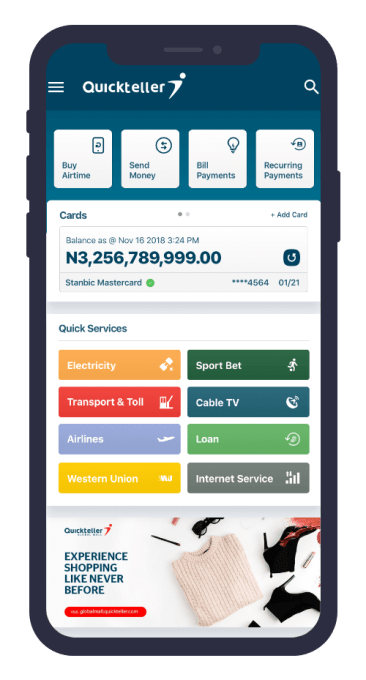
Interswitch QuicktellerInterswitch has since moved into high-volume personal and business finance, with its Verve payment cards and Quickteller payment app. The Nigerian company (which is now well beyond startup phase) has expanded with physical presence in Uganda, Gambia, and Kenya—the latter being home-turf of M-Pesa and Safaricom, which are largely responsible for making Kenya the mobile-money capital of Africa.

Interswitch also sells its products in 23 African countries, through bank partnerships, and has presence abroad. Through its Verve Global Card product, the company’s cardholders can now make payments in the U.S., UK, and UAE. Interswitch launched a partnership this month for Verve cardholders to make payments on Discover’s global network. The first transaction for the partnership was placed in New York, with an advertisement for the Nigerian company’s payment product flashing across Times Square. Verve Times Square Interswitch  Another facet to a possible Interswitch IPO is its potential to spark more corporate venture arm and acquisition activity in African fintech, which as a sector receives the bulk of the continent’s startup capital. Interswitch launched a venture arm in 2015called its global ePayment Growth Fundthat made two investments, but then went largely quiet.

A windfall of IPO capital and increasing competition from fintech startups could spur Interswitch to fire up its venture investing activity again. Startups such as Flutterwave and TeamAPT (formed by a former Interswitch alum) have already entered some of Interswitch’s product territory. If a public listing led Interswitch to ramp up investing in (or even acquiring) startups, the net effect would be more capital and exits in Africa’s fintech sector.

And finally, if Interswitch does IPO on the London and Lagos stock exchanges, it could provide another benchmark for global investors to gauge Africa’s tech sector beyond Jumia. This spring the e-commerce company became the first big tech firm operating in Africa to launch on a major exchange, the NYSE.

So far, Jumia’s IPO has been an up and down affair. The company gained investor and analyst confidence out of the gate, but also came under a short-sell assault and share-price volatility.

Two successful global IPOs of tech companies from Africa would and could become the best-case scenario for the continent’s startup scene. But for that to be a possibility, Interswitch will have to confirm the speculation and finally list as a publicly traded fintech firm.


Disrupt SF prices increase tonight

Nobody likes them, but price hikes happen, people. Price hikes happen. And the early-bird price for passes to Disrupt San Francisco 2019 disappears tonight, August 30 at 11:59 p.m. (PST). Avoid the pain of paying more and enjoy saving up to $1,300. You have only a few hours left. Buy your Disrupt SF passes right now.

Why attend Disrupt SF? It’s simply the place to be for members of the early-stage startup ecosystem — no matter what your role. Take it from Luke Heron, CEO of TestCard Diagnostics. His company exhibited in Startup Alley at Disrupt SF ’17 and again at Disrupt Berlin ’18 — and recently closed on $1.7 million in funding.

“If you’re a startup founder or an entrepreneur,” said Heron, “attending Disrupt is a no-brainer.”

Need more reasons? Okay, we’ll break it down for you.

  • Programming across four stages, workshops, Q&A Sessions, panel discussions and a roster of speakers representing a veritable who’s who of tech leaders, icons, makers and doers. Check out the Disrupt agenda.
  • Startup Battlefield, where 15-30 outstanding early-stage startups launch on a world stage and vie for a $100,000 cash prize.
  • Startup Alley, featuring more than 1,000 early-stage startups — and don’t forget to meet our hand-picked TC Top Picks — 45 incredible startups made the cut this year.
  • Networking — especially but not exclusively in Startup Alley — is practically a contact sport at Disrupt events. And by that we mean you’ll find plenty of contacts to help drive your business forward. We even have a tool to help you… read the next bullet.
  • CrunchMatch, a free, business match-making service that can help you cut through the thousands of people to find and connect with founders and investors who share similar business goals.
  • The TC Hackathon, where up to 800 talented makers will compete for a $10,000 top prize, plus thousands more in cash and prizes from sponsored contests.

Disrupt San Francisco 2019 takes place October 2-4, and you have just a few short hours left to take advantage of early-bird pricing and save up to $1,300. Price hikes happen. Don’t let them happen to you. Buy your passes before 11:59 p.m. (PST) tonight, August 30.

Is your company interested in sponsoring or exhibiting at Disrupt San Francisco 2019? Contact our sponsorship sales team by filling out this form.


Atoms nabs $8.1M for shoes you can buy in quarter sizes and separate left/right measurements

The direct-to-consumer trend in fashion has been one of the most interesting evolutions in e-commerce in the last several years, and today one of the trailblazers in the world of footwear is picking up some money from a list of illustrious backers to bring its concept to the masses.

Atoms, makers of sleek sneakers that are minimalist in style — “We will make only one shoe design a year, but we want to make that really well,” said CEO Sidra Qasim — but not in substance — carefully crafted with comfort and durability in mind, sizes come in quarter increments and you can buy different measurements for each foot if your feet are among the millions that are not exactly the same size — has raised $8.1 million.

The company plans to use the funding to invest in further development of its shoes, and to expand its retail and marketing presence. To date, the company has been selling directly to consumers in the US via its website — which at one point had a waiting list of nearly 40,000 people — and the idea will be to fold in other experiences including selling in physical spaces in the future.

This Series A speaks to a number of interesting investors flocking to the company.

It is being led by Initialized Capital, the investment firm started by Reddit co-founder Alexis Ohanian and Garry Tan (both had first encountered Atoms and its co-founders, Qasim and Waqas Ali — as mentors when the Pakistani husband and wife team were going through Y-Combinator with their previous high-end shoe startup, Markhor); with other backers including Kleiner Perkins, Dollar Shave Club CEO Michael Dubin, Acumen founder and CEO Jacqueline Novograts, LinkedIn CEO Jeff Weiner, TED curator Chris Anderson, the rapper Chamillionaire and previous backers Aatif Awan and Shrug Capital.

Investors have come to the company by way of being customers. “The thing that I love about Atoms is that it isn’t just a different look, it’s a different feel,” said Ohanian in a statement. “When I put on a pair for the first time, it was a totally unique experience. Atoms are more comfortable by an order of magnitude than any other shoe I’ve tried, and they quickly became the go-to shoe in my rotation whenever I was stepping out. That wouldn’t mean anything if the shoes didn’t look great. Luckily, that’s not a problem, I wear my Atoms all the time and even my fashion designer wife is a fan.”

Even before today’s achievement of closing a Series A, the startup has come a long way on a relative shoestring: with just around $560,000 in seed funding and some of the founders’ own savings, Atoms built a supply chain of companies that would make the materials and shoes that it wanted, and developed a gradual but strong marketing pipeline with influential people in tech, fashion and design. (That success no doubt played a big role in securing the Series A to double down and continue to build the company.)

Within the bigger trend of direct-to-consumer retail — where smaller brands are leveraging advances in e-commerce, social media and wider internet usage to build vertically-integrated businesses that bypass traditional retailers and bigger e-commerce storefronts to source their customers and sales more directly — there has been a secondary trend disrupting the very products that are being sold by using technology and advances in manufacturing. Third Love is another example in this category: the company has built a huge business selling bras and other undergarments to women by completely rethinking how they are sized, and specifically by focusing on creating as wide a range of sizes as possible.

So while companies like Allbirds — which itself is very well capitalised — may look like direct competitors to Atoms, the company currently stands apart from the pack because of its own very distinctive approach to building a mass-market business, but one that aims to make its product as individualised as possible.

You might think that approaching shoe manufacturers with the idea of creating smaller size increments and manufacturing shoes as single items rather than pairs would have been a formidable task, but as it turned out, Atoms seemed to come along at the right place and the right time.

“We thought it would be challenging, and it wasn’t unchallenging, but the good thing was that many manufacturers were already starting to think about this,” Ali said. “Think about it, there has been almost no innovation in shoe making in the last thirty or forty years.” He said they were happy to talk to Atoms because “we were the first and only company looking at shoes this way.” That helped encourage him and Qasim, he added. “We knew we would be able to figure it all out.”

Nevertheless, the pair admit that the upfront costs have been very high (they would not say how high), but given the principle of economies of scale, the more shoes that Atoms sells, the better the economics.

Currently the shoes sell for $179 a pair, which is not cheap and puts them at the high end of the market, so it will be interesting to see how and if price points evolve as it matures as a business, and competitors big and small begin to catch onto the idea of selling their own footwear at a wider range of sizes.

My colleague Josh, who first wrote about Atoms when they launched, is our own in-house tester, and as someone who could have easily moved on to another pair of kicks after he hit publish, he remains a fan:

“My Atoms have held up incredibly well from daily wear for 14 months,” he said. “They’re still my comfiest shoes and make Nikes feel uncomfortable when I try them again. They’ve sustained a tiny bit of wear on the front of the foam sole (the toe just below the fabric) while the bottoms have worn down a little like any shoes.

“The mesh fabric can pick up dirt or dust if you take them in the wilderness, and the sole isn’t hard enough that you won’t feel point rocks. But throwing them in the wash or a rub with a brush and they practically look new. The elastic laces are incredibly convenient.

“I’ve probably tied them 4 times since first lacing them up. And for a cleaner, more professional look you can tuck the bow of your laces behind the tongue. Their biggest problem is they’re porous and can let water through if you wear them in the rain or puddles.

“Overall, I’ve found them to be my best travel shoes because they’re so versatile. I can walk all day in them, but then go to a fancy dinner or nightclub. I can hike or even hit the gym with them if necessary, and they pack quite flat. With the quarter-sizing and different use cases, they make Allbirds look like restrictive outdoor slippers. For adults who still want to wear sneakers, the monochromatic color schemes and brandless, simple styles make Atoms feel as mature and reliable as you can get.”

Ali said that among those who buy one pair, some 85% have returned and purchased more, and that’s before it has even gone outside the US. Qasim said there has been a lot of interest in other regions, but for now it’s still following its original formula of keeping the organisation and business small and tight, with no plans to expand to further countries for the moment.


Could Peloton be the next Apple?

Hello and welcome back to Equity, TechCrunch’s venture capital-focused podcast, where we unpack the numbers behind the headlines.

This week we were back in the SF studio, with Kate and Alex on hand to chat venture, business, startups, and IPOs with Iris Choi. Choi is a partner at Floodgate, and one of the very few folks who have ever been invited back on the show.

Despite Floodgate being an early-stage firm, Choi was more than willing to dig into the week’s later-stage topics, starting with the Peloton IPO filing. Kate was stoked about the offering (her piece here, Alex’s notes here). Peloton, a fitness, media, hardware (and more) company, is a lot different than your run-of-the-mill enterprise SaaS exits.

Next Alex ran the team through a list of impending IPOs that we care about. There are a number of venture-backed companies looking to go public before the stock market falls apart. More on each when they price.

After the S-1 march, we turned to personnel news, namely that Instacart’s CFO is leaving the firm after about four years with the companyRavi Gupta is joining Sequoia Capital. We’ll tell you why.

Next, we touched on two rounds. First, a Kleiner deal into Consider, an app that brings power-tooling to email. And then we chatted about Inkitt, another Kleiner deal. Why the pair of early-stage rounds? Because Alex recently went to Kleiner to chat with its new partner team about where they’ll deploy capital in the future.

And that took us comfortably overtime. A big thanks to Choi for joining us, again, and you for sticking with the show. More next week!

Equity drops every Friday at 6:00 am PT, so subscribe to us on Apple PodcastsOvercastSpotify, Pocket Casts, Downcast and all the casts.


After Incorporating a Business: What You Need to Know

What You Need to Know After Incorporating a Business

Start contemplating the right business structure for your business. You’ve probably heard corporations generally demand more administrative time and resources than other entities. For example, it takes more time and money to meet all your compliance requirements as a corporation than as an LLC. And sole proprietors fall into that easier to manage class of businesses too. 

However, consider the major reduction in the corporate tax rate. As a result, the C Corporation becomes a more attractive option for more businesses. And even small businesses may find this the case. Do you plan to form a C Corporation? Then check out these things you’ll need to know.

After Incorporating a Business

1. Get a Tax ID and Open a Corporate Bank Account

One of the first things you’ll need to do is get a tax ID (or EIN, Employer ID Number) with the IRS. Think of it like a social security number for your corporation. Review the criteria and apply for an EIN on the IRS website. There’s no cost for getting an EIN. 

Once you have your EIN, you can apply for a business bank account (note that you will need an EIN before you can get a bank account). As a corporation, you are legally required to keep your personal and corporation finances separate. The corporation will need its own bank account and keep its own financial records. 

2. Choose How to Pay Yourself

So you’ve formed a corporation. Now you need to carefully consider how you get paid. Do you provide services for the C Corp? Then you could consider yourself an employee. As a result, you need to receive reasonable compensation for whatever work you provide. That compensation is subject to payroll taxes and you need to be paid this reasonable compensation before you can make any non-wage distributions/dividends. 

Beyond compensation for services, you can pay yourself (and all other shareholders) a dividend as a shareholder. These dividends are not subject to payroll taxes. But keep in mind that the C Corporation is its own tax paying entity. Employee salary and payroll taxes are deductible by the corporation, while dividends are not deductible. 

If you have elected to be taxed like an S Corporation, you will pass your percentage of the company’s profit or loss to your personal tax return. These distributions (the profits) aren’t subject to FICA/self-employment taxes. However, if you have an S Corporation and are actively working in the business, you’ll need to pay yourself a market-rate salary for the work you do. 

Chat with a tax advisor if you have any questions – such as what is a reasonable compensation for your services and what’s the best strategy for splitting your income by salary and dividends, whether you are taxed like a C Corporation or S Corporation. 

3. Using a Registered Agent

If you don’t have a physical location in a state where your business is registered, then you must select a registered agent to accept documents (what the state calls ‘service of process’ notices) on your behalf. These documents can include notices of lawsuits, tax notices, and other official federal/state correspondences. 

A registered agent must have a physical address in the state, maintain office hours from 8 a.m. to 5 p.m. on Mondays through Fridays, and meet any other state requirements. You can designate yourself or an employee as the registered agent, but you may want to find an experienced third-party registered agent to ensure your agent is always available during business hours. You can expect to pay between $100 to $200 for registered agent services in a state.

4. Renew your Corporation

Know this once you incorporate with the state. Paperwork obligations continue long after your initial filing. Currently, all states, except Alabama and Ohio, require some kind of annual or bi-annual report filing. And a few require an initial report too. Don’t fail to file these. Or you’ll probably be hit with fines. As a result, your corporation could fall out of good standing with the state. And you might lose your liability protection. 

The state uses the annual report to stay updated with a company’s activities. And it typically asks for the names and addresses of directors. You’ll also need to provide the registered agent’s address and number of shares of stock issued. The fee varies from state to state. For example, expect to pay anywhere from $50 to $400. 

Check with your state’s Secretary of State office. Or consult an online filing service. Find out all the important details. How often do you need to file? When does your specific deadline fall. And how much will you need to pay. 

5. Hold a Shareholder Meeting, and Other Compliance Needs

A C Corporation must hold at least one shareholders and directors meeting annually. And you must record meeting minutes to ensure transparency. This holds true even for closely held corporations. For example, corporations with just a few shareholders must still comply. Don’t file your minutes with the state or any external agency. Instead, they should be kept with your other corporate records. For example, keep them with your articles of incorporation, company bylaws and resolutions. Corporation must also record and maintain the voting records of the company’s common shareholders or directors. 

6. Pay your Taxes

Federal income tax law recognizes C corporations as a separate taxpaying entity. As a result, the law requires they make their own tax filings. And taxes come out of their profits. When you incorporate, you will most likely be liable for: 

  • Income tax: Similar to the personal tax return you file each year, the corporation will need to file an annual tax statement to report the income, gains, losses, deductions, and credits. Use IRS Form 1120. This form is typically due on/around April 15 for calendar-year entities. 
  • Estimated tax: Taxes must be paid as you earn or receive income during the year. This is either in the form of a withholding (employees) or estimated tax payments (corporations, self-employed individuals, etc.). A corporation will typically need to make estimated payments if it expects to owe $500 or more in taxes with their annual return. You can use IRS Form 1120-W to figure out your estimated tax. 
  • Payroll taxes: You are required to withhold payroll taxes from an employee’s paycheck. This is also true for your own paycheck, if you receive compensation for the services you provide to the corporation. These deductions include: federal income tax withholding, social security tax, Medicare tax (and additional Medicare tax), state income tax withholding, and any other local tax withholdings. 

7. Get Any Needed Local Permits and Licenses

Most likely, you will need some kind of permit or license for your corporation. I like to think of it this way: when you incorporate, it provides a solid legal foundation. But the local licenses and permits are like a driver’s license. They give a business permission to operate. Examples are professional licenses, reseller’s license, health department permit, and more. Contact your local government office, or visit BusinessLicenses.com, to figure out exactly what types of permits are needed for your business and location.

8. Get Business Liability Insurance Coverage

Incorporating represents an important step toward separating you from the business. and this minimizes your personal liability. However, don’t think this offers fail-safe protection. And don’t think of  it as a substitute for insurance. A corporation won’t protect you unconditionally from personal liability. For example, if your personal actions result in an injury, you can be personally liable. As a result, you will probably want to protect your business from personal injury or property damages in the event of a lawsuit. Insurance comes in different forms depending on your business needs, so you should discuss your specific business risks with an insurance agent or broker who’s familiar with your kind of business. 

Bottom line: understand your tax and other compliance requirements. Don’t fret the administrative obligations of a C Corporation. Just see your business complies.  

Image: Depositphotos.com

This article, "After Incorporating a Business: What You Need to Know" was first published on Small Business Trends


Final week to buy super early bird passes to Disrupt Berlin 2019

Die Zeit läuft ab, Leute translates very roughly to time is running out, people! You have only one week left to save a fat stack of euros on your pass to Disrupt Berlin 2019. Join us and startuppers from more than 50 countries on 11-12 December for the lowest possible price.

Our super early bird pricing comes to a grinding halt on 6 September at 11:59 p.m. (CEST). Buy your passes now and save up to €600.

If you want to have a uniquely thrilling experience at Disrupt Berlin, be sure to apply to one or all three major events taking place during the show. You can use this single application to apply to be considered for the TC Top Picks program and/or to compete in the mighty Startup Battlefield. Or, if the TC Hackathon is more your style, apply right here. Here’s more good news: all three programs are free. No application fees, no participation fees, no giving up equity.

If TechCrunch editors choose you to be a TC Top Pick, you’ll receive a free Startup Alley Exhibitor Package and an interview on the Showcase Stage with a TC editor. To qualify for consideration, your early-stage startup must fall into one of these categories: AI/Machine Learning, Biotech/Healthtech, Blockchain, Fintech, Mobility, Privacy/Security, Retail/E-commerce, Robotics/IoT/Hardware, CRM/Enterprise and Education.

Startup Battlefield has launched literally hundreds of startups to the world, and TechCrunch editors will select 15-20 startups to compete for $50,000 equity-free prize, serious bragging rights and a metric ton of investor and media attention.

Since 2007, 857 companies have launched at Startup Battlefield to great success. Collectively they’ve raised more than $8.9 billion in funding with 112 successful exits (IPOs or acquisitions). If you’re selected, you’ll join the ranks of this alumni community that includes Dropbox, GetAround, SirenCare, Fitbit, Mint.com, Vurb and more.

We’re accepting only 500 people to compete in the TC Hackathon — so don’t wait to apply. TechCrunch will award $5,000 for the best overall hack, and you’ll also compete for cash and prizes from our sponsored hacks — we’ll have more info on those challenges soon, so keep checking back.

There’s so much more to see and do at Disrupt Berlin — speakers, workshops, Q&A Sessions, plus hundreds of early-stage startups exhibiting in Startup Alley. Talk about a place to connect and network with people who can take your business to new heights.

Don’t miss your chance to save up to €600 on passes to Disrupt Berlin 2019. Our super early bird pricing disappears on 6 September at 11:59 p.m. (CEST). Buy your passes now and save up to €600. Die Zeit läuft ab, Leute!

Is your company interested in sponsoring or exhibiting at Disrupt Berlin 2019? Contact our sponsorship sales team by filling out this form.


Finding Your Personal Brand Hard to Define?

This article, "Finding Your Personal Brand Hard to Define?" was first published on Small Business Trends


Business Pitch Tips: Apply These 5 Secrets from an Industry Pro

Use These Five Business Pitch Tips Before Your Next Presentation

Ramon Ray is hosting a LIVE event to help small business owners get publicity for their small businesses. Join him on September 10th in NYC in a fun, fast-paced, and informative event that will help you grow your business through publicity and connecting with the media.

Business Pitch Tips

For now, keep reading to learn how to start crafting your business pitch.

1. Know Your Audience

A sales pitch can come off like a con if you pursue prospects who aren’t really interested in your product or services. Remember, your business has value to the right people.

Learn to identify prospects who will genuinely benefit from your business. Figure out what matters to different people, and learn how they do business. If you target compatible prospects, it will be easier to create a conversational tone in sales pitches that don’t make anyone feel like they are being sold to.

2. Research!

You don’t want to use the same standard sales pitch for each person you speak to. Nowadays,  individuals and businesses share information about online, so you can do your research ahead if you know who you’ll be speaking to.

Check out their websites, social media, and other online resources to gather information that can help you relate to the specific people you’ll be talking to. Time is limited when you need to create a connection quickly. Look for a way to make people feel comfortable right from the start. That way, there’s a better chance at them having an open mind and being receptive to your message.

3. Build Anticipation

What are your services worth? What tangible benefits do businesses and clients gain from hiring you or working with your business? A good pitch will provide specific information — not vague generalizations. So, how do you accomplish this? Consider the following:

  • Show a live demo of your service or product and show how it solves the problem
  • Tell a story or provide an example of a previous problem you solved in a real situation
  • Share specializations that make you particularly suited for the prospect or audience

You should consider personalizing your approach to fit each situation. A live demo is perfect for a physical product, while portfolios are better for any projects or work that are difficult to display or happened in a digital form.

4. Practice, Practice, Practice

Pitching your business successfully is a skill, and like most skills, the more you practice the better you get. Take the time to practice your entire pitch, including answers to likely questions, until you know it inside and out. The more comfortable you are with this conversation, the more likely you are to win someone over in a meeting or at an event. Practice in the mirror, with friends, colleagues, or even a business coach.

5. Putting It to Use

A pitch can happen at a networking event, a sales meeting, over lunch, or on public transportation. That’s why it’s so important to have your pitch, or pitches, retained in a comfortable and natural way. Make sure you are relaxed, as less is more when delivering this information. Also, prioritize the important topics and stick to those, try not to veer too much.

Smart Hustle Pitch is a unique experience designed for business owners to refine their pitch and meet the media. Join fellow successful business owners along with journalists, bloggers, podcasters, editors, and more to streamline your pitch and generate more publicity for your business. 

Image: Depositphotos.com

This article, "Business Pitch Tips: Apply These 5 Secrets from an Industry Pro" was first published on Small Business Trends


Thursday, 29 August 2019

What is Andela, the Africa tech talent accelerator?

As someone who covers Africa’s tech scene, I’m frequently asked about Andela. That’s not surprising, given the venture gets more global press (arguably) than any startup in Africa.

I’ve found many Silicon Valley investors have heard of Andela but aren’t exactly sure what it does.

In a bite, Andela is Series D stage startup―backed by $180 million in VC―that trains and connects African software developers to global companies for a fee.

The revenue-focused venture is often misread as a charity. In 2017, Andela CEO Jeremy Johnson described the organization as “a mission-driven for-profit company” ― a model for the concept “that you can actually build businesses that create real impact.”

I asked Johnson recently to clarify the objective behind Andela’s drive. “It’s the exact same mission as when we started, based around our founding principle… that brilliance and talent are distributed equally around the world, but opportunity is not,” he said.

“We’re about breaking down the walls that prevent brilliance and opportunity from connecting to each other.”

A major barrier for Africa’s software engineers, according to Johnson, is simply the fact that the continent has been totally off the network that companies look to for developer talent.


Marc Benioff will discuss building a socially responsible and successful startup at TechCrunch Disrupt

Salesforce chairman, co-founder and CEO Marc Benioff took a lot of big chances when he launched the company 20 years ago. For starters, his was one of the earliest enterprise SaaS companies, but he wasn’t just developing a company on top of a new platform, he was building one from scratch with social responsibility built-in.

Fast-forward 20 years and that company is wildly successful. In its most recent earnings report, it announced a $4 billion quarter, putting it on a $16 billion run rate, and making it by far the most successful SaaS company ever.

But at the heart of the company’s DNA is a charitable streak, and it’s not something they bolted on after getting successful. Even before the company had a working product, in the earliest planning documents, Salesforce wanted to be a different kind of company. Early on, it designed the 1-1-1 philanthropic model that set aside 1% of Salesforce’s equity, and 1% of its product and 1% of its employees’ time to the community. As the company has grown, that model has serious financial teeth now, and other startups over the years have also adopted the same approach using Salesforce as a model.

In our coverage of Dreamforce, the company’s enormous annual customer conference, in 2016, Benioff outlined his personal philosophy around giving back:

You are at work, and you have great leadership skills. You can isolate yourselves and say I’m going to put those skills to use in a box at work, or you can say I’m going to have an integrated life. The way I look at the world, I’m going to put those skills to work to make the world a better place.

This year Benioff is coming to TechCrunch Disrupt in San Francisco to discuss with TechCrunch editors how to build a highly successful business, while giving back to the community and the society your business is part of. In fact, he has a book coming out in mid-October called Trailblazer: The Power of Business as the Greatest Platform for Change, in which he writes about how businesses can be a positive social force.

Benioff has received numerous awards over the years for his entrepreneurial and charitable spirit, including Innovator of the Decade from Forbes, one of the World’s 25 Greatest Leaders from Fortune, one of the 10 Best-Performing CEOs from Harvard Business Review, GLAAD, the Billie Jean King Leadership Initiative for his work on equality and the Variety Magazine EmPOWerment Award.

It’s worth noting that in 2018, a group of 618 Salesforce employees presented Benioff with a petition protesting the company’s contract with the Customs and Border Patrol (CBP). Benioff in public comments stated that the tools were being used in recruitment and management, and not helping to separate families at the border. While Salesforce did not cancel the contract, at the time, co-CEO Keith Block stated that the company would donate $1 million to organizations helping separated families, as well as match any internal employee contributions through its charitable arm, Salesforce.org.

Disrupt SF runs October 2 to October 4 at the Moscone Center in the heart of San Francisco. Tickets are available here.

Did you know Extra Crunch annual members get 20% off all TechCrunch event tickets? Head over here to get your annual pass, and then email extracrunch@techcrunch.com to get your 20% discount. Please note that it can take up to 24 hours to issue the discount code.


2019 tech IPOs: Some thoughts from the public company roller coaster

2019 has already been an active year for U.S. tech IPOs. Some highly anticipated unicorns, such as Uber and Lyft, have disappointed investors with their IPO debuts and their first results as public companies. Others, such as Fiverr, Zoom and CrowdStrike, have soared. And food-tech brand Beyond Meat (two words you normally don’t see together) hit a high of $239 from their $25 IPO price.

The first of these 2019 tech IPO companies will soon face a new challenge as the early investor and employee lockups expire — often 180 days after the IPO — allowing them to sell and increasing the number of shares available to trade. Lyft will remain at the front of the 2019 pack when the lockups expire, bringing more of the company’s stock into play on the public market. Regardless of what happens next, it’s amazing to see the trajectory of companies that have built such impressive businesses in such a remarkably short period of time.

I was recently at the New York Stock Exchange (NYSE) to ring the opening bell and celebrate our three- millionth borrower on the platform. It brought back great memories from when our company, LendingClub, entered the public fray in 2014. LendingClub was the largest U.S. tech IPO that year, and is still one of the biggest U.S. tech IPOs of all time. We listed at a $5.4 billion valuation, and our shares surged 67% on the first day of trading. We were thrilled to celebrate the validation of our hard work and excited about the next stage of our growth. However, by the time our lockups expired, we had fallen back to around our IPO valuation of $15 a share.

Since then, despite being the market leader in the fastest-growing sector of consumer credit in the country with double-digit annual growth, the company today is worth less than a fifth of what it was in 2014. Our story is thankfully unique, and I’ll spare you the details here, but suffice to say… we had a rough period. We are back on track now, delivering growth and margin expansion while executing against our vision.

However bespoke our story, there are some observations I’ll share that might be useful for others as they think about life post-IPO. I’m not going to cover the issues around short-termism and the tyranny of quarterly targets (which have been well-documented elsewhere), but rather a few of the implications that sure would have been useful for me to know going in…

Things will be different — really

I’d compare the period leading up to the IPO to the period when you are expecting a baby. Intellectually, you know things will be different when you bring home a newborn. But knowing it and living it are two different things. Going public is a transformational event that permanently changes your company and how the CEO, CFO and board spend their time (with obvious trickle-down effects). From the moment we rang the NYSE bell on December 11, 2014, everything changed.

Making money matters

Investors buying your stock are essentially valuing your future cash flow. At some point, you have to have your “show them the money” moment and become profitable. Amazon famously lost a total of $2.8 billion over 17 straight quarters after their IPO and was the subject of a lot of skepticism and criticism throughout. The company maintained their strategy, delivering top-line growth and investing in their future and, suffice to say, investor patience paid off!

At LendingClub, we have invested millions of dollars to develop products that delight our 3 million+ customers (and, at 78, our NPS is at its highest level in the history of the company) and expand our competitive moat. We are now driving toward adjusted net income profitability.

Like it or not, there is a scoreboard

Once you go public, some people stop thinking of you as a business, and start thinking about you as a stock price. And that stock price is always broadcasting. It broadcasts to your equity investors, your employees, your partners, your board — to everyone who is listening.

You can’t preserve your culture, but you can and must maintain the values your company holds dear.

When the stock is up, everyone feels great. But, in a volatile market or a downturn, there are a lot of people who will be needing to hear your view on what’s happening. Communication to your stakeholders is not in the way of you doing your job, it is a critical part of your job that just got A LOT bigger. You need to stay ahead of it and deliberately carve out the time to make it a priority.

There are others sharing the microphone

When you are starting out, the world is divided into two types of people: those who love you, and those who don’t know/care. When you are a public company, a lot of voices join the conversation. You’ll add a different beat of reporters focused on your financials. You have analysts who are paid to research and think about your company, your strategy, your prospects and your value. These analysts may have never covered a company quite like yours (after all, you are breaking new ground) and you’ll need to spend time together to understand what matters.

You also can attract a whole new kind of investor, a “short” who has a vested interest in your stock going down. All of these voices are speaking to your stakeholders and you need to understand what they are saying and how it should affect your own communications.

Be careful, the microphone is on

Remember those days when everyone attended the “all hands” and you could share the details of your product road map, your corporate strategy, what’s working and what isn’t? Yeah, those are over. The risk of material nonpublic information leaking means you need to find a new balance in transparency with your employees (and your friends and partners for that matter).

It’s a change to behavior and to culture that doesn’t come naturally (at least it didn’t to me). It’s a change that can be frustrating to employees as the necessary opacity can erode trust as people feel out of the loop. At LendingClub, we still regularly communicate as much as we can and trust our employees, but there are places where you have to draw the line.

Your competitors are listening

Ironically enough, while your ability to share key details with employees is limited, you are sharing a lot with your competition. Shareholders and money managers want to know your battle plans and expect a detailed update at your earnings call every quarter. You can expect that your competitors are taking notice and taking notes.

Your scarcest resource

As the above would indicate, being public means that you are inevitably going to be spending less time running the business, and more time focused externally. Not a bad thing, but something you need to plan for so that you have the resources in place underneath you to maintain business momentum. If your management team isn’t materially different as you head to the market than it was a few years ago, I’d be surprised if you have what you need.

Your culture will change, focus on your values

I once asked a senior Google executive advice on how to preserve culture when going through massive periods of transition. She told me that you can’t preserve your culture, but you can and must maintain the values your company holds dear. Her advice, which I have followed and am passing on to you, is to make sure you write them down, hire against them and assess performance against them.

We started this practice years ago and it is remarkable how consistent our values have remained even as the company has evolved and matured. We codified six core values that put the customer at the center of everything we do. We are guided by our No. 1 value — Do What’s Right. You know a LendingClubber when you meet them, and it is part of what makes us great.

Being a public company is not for the faint-hearted, but being public is part of growing up. Being public legitimizes the company, unlocks liquidity to fuel growth and enables you to attract the next generation of talent. We always said that going public would allow us to deliver more value to a greater number of consumers and would lend legitimacy to our growing industry. We have facilitated more than $50 billion in loans and are still at a small percentage of our immediately addressable market. Although challenging at times, we’re seeing our dream to truly help everyday Americans come to life.

We’ve worked hard since our IPO to change the face people associate with finance. We’ve built a diverse team, established strong core values and nurtured a culture that has resulted in the kind of company we want to represent fintech and the tech industry as a whole — both inside and outside Silicon Valley.

So, to the new joiners in the public sphere — life in the spotlight is a wild ride. Congratulations on this step in your journey, and on to the next!


Former Google X ecec Mo Gawdat wants to reinvent consumerism

Mo Gawdat, the former Google and Google X executive, is probably best known for his book Solve for Happy: Engineer Your Path to Joy. He left Google X last year. Quite a bit has been written about the events that led to him leaving Google, including the tragic death of his son. While happiness is still very much at the forefront of what he’s doing, he’s also now thinking about his next startup: T0day.

To talk about T0day, I sat down with the Egypt-born Gawdat at the Digital Frontrunners event in Copenhagen, where he gave one of the keynote presentations. Gawdat is currently based in London. He has adopted a minimalist lifestyle, with no more than a suitcase and a carry-on full of things. Unlike many of the Silicon Valley elite that have recently adopted a kind of performative aestheticism, Gawdat’s commitment to minimalism feels genuine — and it also informs his new startup.

07 28 19 Frontrunner 38“In my current business, I’m building a startup that is all about reinventing consumerism,” he told me. “The problem with retail and consumerism is it’s never been disrupted. E-commerce, even though we think is a massive revolution, it’s just an evolution and it’s still tiny as a fraction of all we buy. It was built for the Silicon Valley mentality of disruption, if you want, while actually, what you need is cooperation. There are so many successful players out there, so many efficient supply chains. We want the traditional retailers to be successful and continue to make money — even make more money.”

What T0day wants to be is a platform that integrates all of the players in the retail ecosystem. That kind of platform, Gawdat argues, never existed before, “because there was never a platform player.”

That sounds like an efficient marketplace for moving goods, but in Gawdat’s imagination, it is also a way to do good for the planet. Most of the fuel burned today isn’t for moving people, he argues, but goods. A lot of the food we buy goes to waste (together with all of the resources it took to grow and ship it) and single-use plastic remains a scourge.

How does T0day fix that? Gawdat argues that today’s e-commerce is nothing but a digital rendering of the same window shopping people have done for ages. “You have to reimagine what it’s like to consume,” he said.

The reimagined way to consume is essentially just-in-time shipping for food and other consumer goods, based on efficient supply chains that outsmart today’s hub and spoke distribution centers and can deliver anything to you in half an hour. If everything you need to cook a meal arrives 15 minutes before you want to start cooking, you only need to order the items you need at that given time and instead of a plastic container, it could come a paper bag. “If I have the right robotics and the right autonomous movements — not just self-driving cars, because self-driving cars are a bit far away — but the right autonomous movements within the enterprise space of the warehouse, I could literally give it to you with the predictability of five minutes within half an hour,” he explained. “If you get everything you need within half an hour, why would you need to buy seven apples? You would buy three.”

Some companies, including the likes of Uber, are obviously building some of the logistics networks that will enable this kind of immediate drop shipping, but Gawdat doesn’t think Uber is the right company for this. “This is going to sound a little spiritual. There is what you do and there is the intention behind why you do it,” he said. “You can do the exact same thing with a different intention and get a very different result.”

That’s an ambitious project, but Gawdat argues that it can be done without using massive amounts of resources. Indeed, he argues that one of the problems with Google X, and especially big moonshot projects like Loon and self-driving cars, was that they weren’t really resource-constrained. “Some things took longer than they should have,” he said. “But I don’t criticize what they did at all. Take the example of Loon and Facebook. Loon took longer than it should have. In my view, it was basically because of an abundance of resources and sometimes innovation requires a shoestring. That’s my only criticism.”

T0day, which Gawdat hasn’t really talked about publicly in the past, is currently self-funded. A lot of people are advising him to raise money for it. “We’re getting a lot of advice that we shouldn’t self-fund,” he said, but he also believes that the company will need some strategic powerhouses on its side, maybe retailers or companies that have already invested in other components of the overall platform.

T0day’s ambitions are massive, but Gawdat thinks that his team can get the basic elements right, be that the fulfillment center design or the routing algorithms and the optimization engines that power it all. He isn’t ready to talk about those, though. What he does think is that T0day won’t be the interface for these services. It’ll be the back end and allow others to build on top. And because his previous jobs have allowed him to live a comfortable life, he isn’t all that worried about margins either, and would actually be happy if others adopted his idea, thereby reducing waste.


What Does an Entrepreneur or Small Business Owner Do?

What Does An Entrepreneur Do?

A reader from Anchorage, Alaska asks:

“I am thinking of becoming an entrepreneur and starting a small business.  But my current job is so uninspiring – I don’t want to get stuck in another boring career. Can you tell me, what does an entrepreneur business owner do all day?”   

–   Susie M. from Anchorage

Fantastic question, Susie. We get asked this a lot.

The short answer is:  small business owners and entrepreneurs do whatever is required to make their businesses a success. This could mean doing everything from emptying the trash cans, to picking up the mail at the post office, to making sales calls, to changing the go-to-market strategy.

It depends on the business and how you as the owner choose to spend your time.

What an entrepreneur does each day also depends on the industry and type of business. There are 30 million small businesses in the United States alone.  Naturally, there will be a wide variance in their day to day activities.

Duties and Responsibilities of a Small Business Owner

That said, every small business owner has six key areas of responsibility:

  1. staffing and management,
  2. financial,
  3. planning and strategy,
  4. daily operations,
  5. sales and marketing,
  6. customer service.

If this sounds really broad, it is.

“As the owner of the business, you’re the captain of the ship. You’re responsible for keeping the entire thing afloat. That’s why you hear about small business owners wearing many hats. You do whatever it takes — no task is too small or too big when it’s your business. And you do it happily,” says our company founder and CEO, Anita Campbell.

To better understand, let’s break this down into specific activities of a small business owner under each of the six areas.

Then later on we’ll share examples of what entrepreneurs do each day in three different businesses.

1. Staffing and Management

Small business owners are responsible for putting a top notch team in place to operate the business. This includes recruiting and hiring new staff.  It also means training and developing existing staff.

Small business owners write job descriptions, provide feedback and performance reviews, and reward employees with pay, benefits and recognition.

According to our CEO, as a business grows the pressure is on. The owner’s role has to change.  “Most business owners start out doing everything. But you won’t be able to keep that up. If you want your business to grow, you’ll soon become a bottleneck if you insist on doing it all. That’s why smart entrepreneurs hire and develop managers as soon as they can afford it. Delegation is smart,” Anita Campbell says.

2. Financial

Small business owners are responsible for the fiscal health of their companies. It’s up to the owner to establish a viable business model for how the company will earn money. The owner is responsible for establishing budgets and sales forecasts — and making sure the company meets them. The owner may actually invoice customers, collect overdue accounts, keep the accounting system up to date and reconcile bank statements.

Above all, the owner makes sure all expenses kept in line and can be met.

As our CEO Anita says, “One of a small business owner’s key roles is to ‘make payroll’ each month. In fact, I should put “Chief Payment Officer” on my business cards. It’s how I think of my main role. You have to make sure the money is there to pay everyone timely — workers, vendors, service providers, tax authorities, creditors and yourself.”

If the coffers get low, the owner may have to arrange for a line of credit or loan to bridge temporary cash flow issues.

3. Planning and Strategy

Small business owners are responsible for setting strategy and having a business plan. They establish the vision and mission for their businesses. “Every entrepreneur should ask and answer the question ‘what do we want to be known for?’ If you can’t do that, your business will be rudderless and could lack distinction,” says our CEO Anita.

The owner also communicates the vision and mission so that employees, customers and the world understand.

As part of planning and strategy, entrepreneurs keep tabs on marketplace trends, competitors and changing customer tastes and needs. After all, any good entrepreneur knows that you must deliver what the market wants and is willing to pay for. This is always changing — it doesn’t stay static. From time to time, you have to update your products and services, adjust pricing or adapt your marketing strategy to meet expectations.

4. Daily Operations

Small business owners are responsible for carrying out daily operations. For example, the owner of an organic food business may have a big role in growing and harvesting  the food.

But it’s important to look up from doing to see the bigger picture. That’s why smart entrepreneurs work on the efficiency and effectiveness of daily operations.

Every company has inefficiencies and waste. Every company has processes that could be tighter. Part of the owner’s role is to identify where that occurs and find solutions. This includes automating tedious manual procedures, or adopting new technology to drive cost out of your bottom line.  It may mean outsourcing non-core functions.

“Small business owners should network with peers. And don’t forget to attend industry events a few times a year. This is how you discover best-in-class technologies and new operational methods. Continuous learning is key to running a business,” adds Campbell.

5. Sales and Marketing

Small business owners are responsible for sales revenue and the marketing to drive sales.

Many owners, especially in the early years, also go on sales calls and help close sales. Owners may get involved in marketing, including establishing campaigns, placing ads, doing email marketing and social media marketing.

6. Customer Service

Small business owners are responsible for the overall customer service experience.  It starts with making sure your company delivers a quality product. But the whole experience should delight customers.

“In the early years, it’s common for the owner to be the person answering the phone or manning live chat to solve customer issues. Later as the business grows, smart entrepreneurs put in place a customer service organization and empower them to solve problems,” says Campbell.

A big part of customer support these days is great technology that’s integrated to avoid data silos and customers feeling like you don’t know them. A CRM system, help desk software, live chat, sophisticated phone system and autoresponder emails are just some of the solutions that can help make customers feel valued.

Ultimately, the owner must build a positive company reputation as reflected in renewal rates, repeat purchases, net promoter scores, and online reviews and testimonials.

What Does An Entrepreneur Do? Some Examples

Let’s look at a day in the life of three different entrepreneurs, to see how their roles are similar, yet vary.

The Owner of a Restaurant

A restaurant owner may go to the market to purchase the food needed for dishes. He or she may do some of the food prep — because sometimes the owner is also the head chef. The owner may greet customers at the door and seat them.

He or she may interview candidates for open positions, or write up job postings. The owner may train staff or ring up customers at the cash register.

Later in the day, the owner may be talking with someone from a sign company about a new building sign, or a landscaping service about planting flowers in front. And the owner keeps the accounting records and reconciles the bank account.

The Owner of a Web Publishing Business

Someone who owns a Web publishing business (such as an ad-supported site), may write articles or otherwise create content for the site. He or she stays up on trends by visiting other sites and social media, to see what’s popular and what other publishers are doing.

The owner may post on social media accounts. He or she manages any ad networks or ad sources, to make sure everything is working properly, troubleshoot issues and try new things to improve. The owner interacts with writers and other staff, providing feedback on content topics or input on new site features or improvements.

A Web publishing entrepreneur also analyzes pages for traffic referrals and for ideas to optimize the site. Along the way, he or she handles the finances and makes sure everyone gets paid.

The Owner of a Plumbing Business

A plumber with his or her own business may go on plumbing calls to customers’  homes or businesses. At a customer’s site, the plumber may take a photo of a broken part needing replaced and send it to an employee back at the office to look it up and order it.

The plumber may have to drive to the parts supplier to pick up a part if it is needed immediately. And he or she stops for gas and for a quick sandwich for lunch.

When a job is done, the plumber writes it up on an invoice, either a paper form or an electronic version on his or her phone or tablet.  Then proceeds to call his next stop to tell them “I’m on my way” and looks up directions to get there.

A plumbing entrepreneur with plans to grow bigger may hire other plumbers to work in the business.  Some amount of time may be spent training them or communicating with them. The plumber may also communicate throughout the day with someon3e back in the office who manages online reviews, does marketing, schedules service calls, or handles other back office functions.

Working on the Business As Well As In It

As you can see, what a small business owner does each day entails working on the business, as well as in the business.

One last piece of advice comes from Anita our CEO, “All entrepreneurs have the power to pick and choose what they want to do each day, whether they realize it or not. If you hate paperwork but love visiting customers, there’s no reason you can’t arrange your business to give you maximum face time with customers while someone else handles the back office.  It may take some planning and a bit of time to arrange your business that way. Just keep on working toward your vision of the ideal workday for you. Life is too short to do anything except what you love.”

All answers to reader questions come from the Small Business Trends Editorial Board, with more than 50 years of combined business experience. If you would like to submit a question, please submit it here.

Image: Depositphotos.com

This article, "What Does an Entrepreneur or Small Business Owner Do?" was first published on Small Business Trends


48 hours left: Buy your early-bird passes to Disrupt SF 2019

We dedicate this post to all the busy, overworked startuppers — the last-minute mamas, procrastinating papas and everyone in between. We empathize and gently offer this swift boot in the booty. You have only 48 hours left to save a bundle on your pass to Disrupt San Francisco 2019.

Beat the deadline — 11:59 p.m. (PST) on August 30 — and you can save up to $1,300. Get moving and buy your tickets right here, right now.

Don’t miss out on our flagship Disrupt, which takes place October 2-4. It’s the quintessential tech conference for anyone focused on early-stage startups. Join more than 10,000 attendees — including over 1,200 exhibiting startups — for three jam-packed days of programming. We’re talking four different stages with interactive workshops, Q&A sessions and interviews with some of the industry’s top tech titans, founders, investors, movers and shakers. Check out our list of speakers and the Disrupt agenda.

Disrupt is a breeding ground of opportunity, networking and collaboration. It’s a place where ideas are born, and partnerships are made. Don’t take our (admittedly very biased) word for it. Your peers happen to agree. Here’s what Sage Wohns, co-founder of Agolo, an artificial intelligence startup, had to say about his Disrupt experience:

Disrupt helps you connect more with the startup community in very tangible ways. You can meet investors and bigger players in your industry to see if there’s an opportunity to work together. Disrupt is unique in how it brings everyone — all the industry touch points — together under one roof. It’s incredibly valuable.

We haven’t even mentioned the Startup Battlefield pitch competition, the TC Top Picks who will set up camp in Startup Alley or the TC Hackathon!

So much to see, hear and do at Disrupt San Francisco 2019. And yet, so little time left — 48 tiny little hours — to save money on your pass. What are you waiting for? Get your early-bird tickets now before the clock strikes 11:59 p.m. (PST) on August 30.

Is your company interested in sponsoring or exhibiting at Disrupt San Francisco 2019? Contact our sponsorship sales team by filling out this form.